


Memphis, Egypt: Discover the Ancient Capital of the Pharaohs
Memphis, Egypt: Discover the Ancient Capital of the Pharaohs
Memphis, Egypt, is one of the most important archaeological destinations for travelers interested in the origins of ancient Egyptian civilization. Located near the modern village of Mit Rahina, south of Cairo and close to the famous Saqqara necropolis, Memphis was once a major political, religious, and cultural center of ancient Egypt.
Although much of the original city has disappeared over thousands of years, its archaeological remains reveal the importance of this remarkable capital. Visitors can explore the Memphis Open-Air Museum, see the colossal limestone statue of Ramesses II, admire monumental stone artifacts, and learn how the city influenced Egyptian government, religion, art, and architecture.
A visit to Memphis is particularly rewarding when combined with Saqqara and Dahshur. Together, these destinations help explain the development of ancient Egyptian royal burial practices, from early pyramids to the monumental structures that made Egypt famous around the world.
In this complete guide, you will discover the history of Memphis, its most important attractions, what to see at the open-air museum, how to plan your visit, and why this ancient city deserves a place on your Egypt itinerary.
Where Is Memphis in Egypt?
Memphis is located in the Mit Rahina area, south of modern Cairo, near the Nile Valley and the archaeological sites of Saqqara.
Its position made it strategically important in ancient times. The surrounding region connected the Nile Delta with Upper Egypt, helping the city develop as a center of administration, trade, religion, and royal power.
Today, Memphis is commonly visited as part of a day trip from Cairo or Giza. Travelers often combine the site with Saqqara, where the famous Step Pyramid of Djoser stands, and sometimes Dahshur, home to the Bent Pyramid and Red Pyramid.
Because these destinations are relatively close to one another, they can be explored together on a carefully planned private tour.
Why Was Memphis Important in Ancient Egypt?
Memphis was one of ancient Egypt's most influential cities and traditionally associated with the early unification of the country. Its strategic location near the boundary between Upper and Lower Egypt made it a natural center for administration and royal authority.
The city is traditionally connected with King Menes, a figure associated in later traditions with the unification of Egypt. The precise historical identification of Menes remains debated, and the development of the early Egyptian state was a complex process rather than a single event.
During different periods, Memphis served as a royal residence, administrative center, religious destination, and important urban settlement. Its influence extended across many centuries, although political power shifted between different Egyptian cities over time.
Memphis was also an important center of worship for Ptah, a creator god associated with craftsmanship, artisans, and architecture. The city's religious importance helped strengthen its cultural influence.
Today, the archaeological remains of Memphis provide valuable evidence of the political and religious history of ancient Egypt.
A Brief History of Memphis
The Early Dynastic Period
Memphis became important during the early stages of the Egyptian state, when rulers were consolidating control over the Nile Valley.
Its location near the meeting point of Upper and Lower Egypt made it a suitable center for royal administration. The city's early development was closely linked to the emergence of centralized government, royal institutions, and organized religious practices.
Although the exact details of its foundation remain a subject of historical discussion, Memphis became one of the defining cities of ancient Egyptian civilization.
The Old Kingdom
During the Old Kingdom, Memphis was closely associated with royal authority and the great pyramid-building projects of the nearby region.
The royal necropolises of Saqqara, Abusir, and Giza developed around the broader Memphite area. These burial grounds contain some of Egypt's most important pyramids, tombs, and funerary monuments.
Saqqara is especially important because it contains the Step Pyramid of Djoser, a landmark in the history of monumental stone architecture. Later pyramid construction at Giza demonstrates how royal funerary architecture developed over time.
The relationship between Memphis and these surrounding necropolises makes the area essential for understanding the growth of the Egyptian state.
The Middle and New Kingdoms
Memphis remained an important urban and religious center during later periods, even as other cities became prominent royal capitals.
During the New Kingdom, rulers continued to invest in religious institutions, monumental sculpture, and royal imagery. Ramesses II, one of Egypt's most famous pharaohs, was particularly associated with monumental building projects and large-scale statues.
Memphis continued to hold religious and strategic importance, although Thebes and other centers played major roles in royal administration during different periods.
The Late Period and Greco-Roman Era
Memphis remained significant during Egypt's later dynasties and under Greek and Roman rule.
Over time, however, political and economic power increasingly shifted toward other settlements, including Alexandria and areas around the growing city of Cairo.
As Memphis declined, many of its monuments were damaged, reused as building materials, or gradually buried by sediment and changing landscapes.
Despite this decline, its historical importance remains central to understanding ancient Egypt.
Memphis Open-Air Museum: What Can You See?
The Memphis Open-Air Museum, located at Mit Rahina, preserves a collection of monumental sculptures and archaeological objects associated with the ancient city.
Although the surviving remains represent only a portion of the original settlement, the museum allows visitors to appreciate the scale of ancient Egyptian sculpture and the craftsmanship used to create royal monuments.
Here are some of the most notable features to look for during your visit.
1. The Colossal Statue of Ramesses II
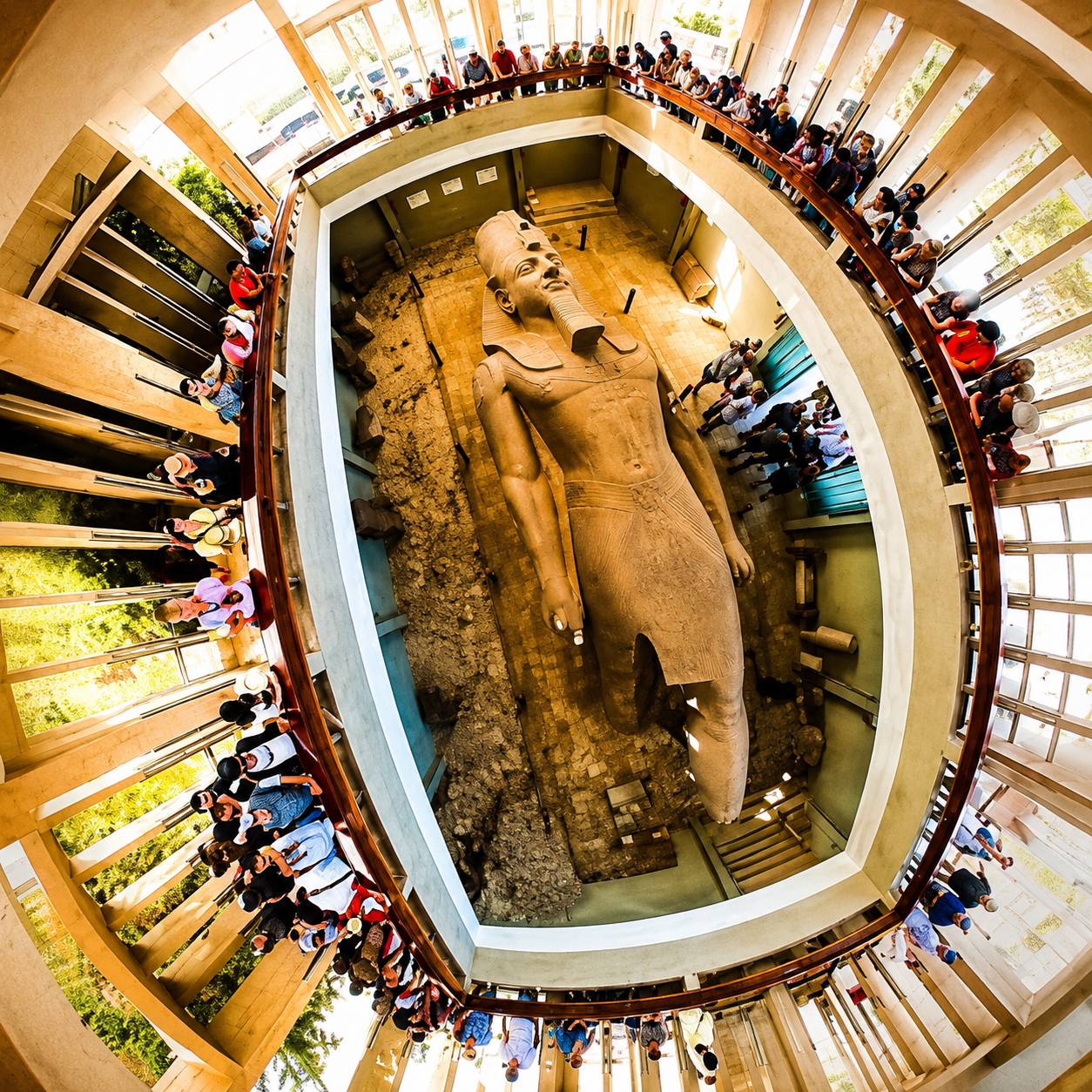
One of the most famous attractions at Memphis is the colossal limestone statue of Ramesses II.
The statue depicts the pharaoh in a royal pose and demonstrates the extraordinary skill of ancient Egyptian sculptors. Ramesses II ruled during the New Kingdom and became known for his military campaigns, diplomatic activity, temples, and monumental building projects.
The statue is particularly impressive because of its size and the surviving details of the royal figure.
Visitors can appreciate the craftsmanship, proportions, and symbolic importance of royal imagery. The monument also provides an opportunity to learn how pharaohs used statues to communicate authority, religious devotion, and their relationship with the gods.
The statue is displayed lying horizontally, which allows visitors to see details that might otherwise be difficult to observe on a standing monument.
2. The Alabaster Sphinx
Another important attraction at the Memphis museum is a large sphinx carved from alabaster, also known as Egyptian calcite.
The sphinx combines a lion's body with a human head, a form strongly associated with royal power and protection in ancient Egyptian art.
Although sphinxes are often associated with the Great Sphinx at Giza, examples were created for different temples and royal settings throughout Egyptian history.
The Memphis sphinx offers visitors an opportunity to examine this distinctive sculptural tradition at close range.
Its material, proportions, and surviving features help illustrate the variety of stones used by ancient Egyptian craftsmen.
3. Monumental Stone Fragments and Sculptures
The museum contains additional stone objects and fragments recovered from the ancient city.
These artifacts may include architectural elements, statues, inscribed stones, and objects associated with religious or royal settings.
Each surviving piece offers clues about the monuments that once stood in Memphis and the artistic traditions that shaped them.
Visitors should remember that the open-air museum is not a complete reconstruction of the ancient city. Rather, it preserves selected remains from a much larger archaeological landscape.
4. Evidence of Ancient Religious Life
Memphis was an important center of worship for Ptah, a god associated with creation, craftsmanship, and artisans.
The city's religious institutions played an important role in its identity. Priests, craftsmen, royal officials, and other members of society contributed to the development of a complex urban culture.
Although much of the original religious architecture has not survived intact, the city's historical association with Ptah helps explain why Memphis was so important for ancient Egyptian religion.
A knowledgeable guide can connect the surviving artifacts with the broader history of temples, religious practices, and royal patronage.
Memphis and the God Ptah
Ptah was one of the principal deities worshipped at Memphis. He was particularly associated with craftsmanship, artistic creation, architecture, and the formation of the world.
In ancient Egyptian religious traditions, Ptah was connected with the work of artisans and the creation of sacred objects. This made him especially relevant to a city known for royal monuments, religious institutions, and skilled craftspeople.
Memphis's religious identity was therefore closely linked to the people who created and maintained temples, statues, ceremonial objects, and other forms of monumental art.
Learning about Ptah adds another dimension to a visit. Instead of seeing Memphis only as a collection of statues, travelers can understand it as a major religious center whose influence extended beyond its immediate surroundings.
Memphis, Saqqara, and Dahshur: What Is the Difference?
Memphis, Saqqara, and Dahshur are often visited together, but each destination has a different archaeological character.
Memphis
Memphis was an ancient city and political, cultural, and religious center. Today, the main visitor attraction is the open-air museum at Mit Rahina, where travelers can see important sculptures and artifacts.
Saqqara
Saqqara is a vast necropolis containing the Step Pyramid of Djoser, royal and elite tombs, and monuments from several periods of Egyptian history.
The Step Pyramid is particularly significant because it represents a major stage in the development of monumental stone construction.
Dahshur
Dahshur is known for its pyramids, especially the Bent Pyramid and Red Pyramid, associated with King Sneferu.
The site helps visitors understand the architectural experiments that contributed to the development of the smooth-sided pyramids later built at Giza.
Visiting all three destinations creates a broader picture of ancient Egypt. Memphis explains the urban and political setting, while Saqqara and Dahshur reveal how royal funerary architecture evolved.
How to Plan a Memphis and Saqqara Day Trip
A day trip from Cairo or Giza can combine Memphis with Saqqara and, if time permits, Dahshur.
A typical itinerary may begin with pickup from your hotel, followed by a visit to Memphis Open-Air Museum. You can then continue to Saqqara to explore the Step Pyramid complex and selected tombs.
If your schedule allows, you may add Dahshur to see the Bent Pyramid and Red Pyramid.
The order of visits can be adjusted according to opening arrangements, traffic, weather, and the attractions you most want to see.
Suggested Full-Day Itinerary
Morning: Memphis Open-Air Museum
Begin with the surviving monuments of ancient Memphis. Spend time viewing the colossal statue of Ramesses II, the alabaster sphinx, and other displayed artifacts.
Late Morning: Saqqara Necropolis
Continue to Saqqara to explore the Step Pyramid of Djoser and other selected archaeological attractions. Depending on your ticket and interests, you may also visit accessible tombs.
Afternoon: Dahshur
If time and access permit, continue to Dahshur to see the Bent Pyramid and Red Pyramid. This additional stop is particularly valuable for travelers interested in pyramid architecture.
Return to Cairo or Giza
After the visits, return to your hotel or another agreed drop-off location.
This is a suggested program rather than a guaranteed schedule. The number of sites visited depends on opening hours, ticket availability, travel time, and the pace of the tour.
How Long Should You Spend at Memphis?
Many travelers spend approximately 45 minutes to 90 minutes at Memphis Open-Air Museum, depending on their interest in the sculptures and the level of historical explanation provided by their guide.
Visitors who are especially interested in ancient Egyptian art may want additional time to examine the statues and learn about the city's historical importance.
However, Memphis is only one part of the wider archaeological region. If you want to visit Saqqara and Dahshur on the same day, it is important to allow enough time for transportation, ticket arrangements, and sightseeing at each location.
For a more relaxed experience, consider a private tour with a flexible schedule.
Best Time to Visit Memphis, Egypt
The cooler months are generally the most comfortable for visiting Memphis and the surrounding archaeological sites.
October through April is usually a good period for sightseeing around Cairo, Saqqara, and Dahshur. Temperatures can still vary, so checking the forecast before your visit is recommended.
Summer can be very hot, especially when exploring exposed archaeological areas with limited shade.
If you visit during the hotter months, start early, carry water, wear a hat, use sunscreen, and follow your guide's advice about heat safety.
Comfortable walking shoes are important throughout the year because archaeological sites can contain uneven ground, stone surfaces, and exposed paths.
Is Memphis Worth Visiting?
Yes, Memphis is worth visiting for travelers who want to understand ancient Egypt beyond the famous pyramids of Giza.
The city was a major center of royal power and religion, and its surviving sculptures provide an introduction to the monumental art of the pharaohs.
The colossal statue of Ramesses II and the alabaster sphinx are highlights, while the site's historical relationship with Saqqara and Dahshur makes it especially valuable as part of a wider archaeological day trip.
Memphis is generally a relatively compact visit compared with the extensive necropolis of Saqqara. Its greatest value comes from understanding how the ancient city connects to the surrounding monuments and the development of Egyptian civilization.
For travelers interested in history, archaeology, architecture, and royal sculpture, Memphis provides useful context for the broader story of ancient Egypt.
Practical Tips for Visiting Memphis
Before visiting Memphis Open-Air Museum, keep these suggestions in mind:
-
Combine nearby sites: Memphis, Saqqara, and Dahshur can often be visited on the same day with careful planning.
-
Hire a knowledgeable guide: Historical context can make the sculptures and archaeological remains much more meaningful.
-
Wear comfortable shoes: Surfaces and walking conditions vary across archaeological sites.
-
Protect yourself from the sun: Bring water, sunscreen, sunglasses, and a hat.
-
Check ticket inclusions: Admission to individual monuments or additional attractions may require separate tickets.
-
Allow time for transportation: Traffic and the distances between sites can affect the day's schedule.
-
Confirm current access arrangements: Opening hours, available monuments, and visitor rules can change.
Frequently Asked Questions About Memphis, Egypt
Where is ancient Memphis located?
Ancient Memphis is located near Mit Rahina, south of Cairo, close to the archaeological sites of Saqqara and Dahshur.
Why was Memphis the capital of ancient Egypt?
Memphis occupied a strategic position near the boundary between Upper and Lower Egypt. It developed into a major center of royal administration, religion, and culture during the early history of the Egyptian state.
What is Memphis, Egypt, famous for?
Memphis is known for its historical role as an ancient capital, its association with the god Ptah, and the monumental sculptures displayed at the Memphis Open-Air Museum, especially the colossal statue of Ramesses II and the alabaster sphinx.
Can I visit Memphis and Saqqara in one day?
Yes. Many visitors combine Memphis and Saqqara in a single day. Dahshur can also be included if the itinerary, opening arrangements, and available time allow.
How far is Memphis from Cairo?
Memphis is south of Cairo, in the Mit Rahina area. Travel time depends on your exact starting point, traffic, and transportation arrangements.
How long does a visit to Memphis take?
A visit to the open-air museum often takes around 45 to 90 minutes, although the ideal duration depends on your interests and whether you are visiting with a guide.
Is the Step Pyramid located in Memphis?
No. The Step Pyramid of Djoser is located at Saqqara, not at the Memphis Open-Air Museum. However, the two destinations are close enough to be combined on many day trips.
Who built the colossal statue of Ramesses II?
The statue represents Ramesses II, one of ancient Egypt's most prominent pharaohs. It is a surviving example of the monumental royal sculpture associated with his reign and the broader traditions of Egyptian kingship.
Is Memphis suitable for families?
Memphis can be suitable for families interested in ancient history and archaeology. Because the visit involves outdoor areas, parents should prepare for the weather and consider the walking needs of younger children.
Should I visit Memphis or the Giza Pyramids first?
The best order depends on your overall itinerary. Travelers often visit the Giza Pyramids on one day and explore Memphis, Saqqara, and Dahshur on another, allowing enough time for each destination.
Discover Ancient Memphis With Let's Explore Egypt Travel
Memphis offers a fascinating introduction to the political, religious, and artistic foundations of ancient Egypt. Although much of the city has disappeared, its surviving monuments preserve important evidence of the civilization that developed along the Nile.
Seeing the colossal statue of Ramesses II, the alabaster sphinx, and the other museum artifacts becomes even more meaningful when combined with visits to Saqqara and Dahshur.
If you are planning a trip to Cairo or Giza, consider including Memphis in a day dedicated to the ancient history of the region.
Explore our Egypt tours and experiences and plan a journey that brings together the monuments, history, and cultural heritage of Egypt.
Let's Explore Egypt Travel can help you organize a private sightseeing experience with transportation and guiding arrangements tailored to your travel plans.
Best Memphis, Saqqara and Dahshur Tours from Cairo
Discover ancient Egyptian history with our guided tours of Memphis, Saqqara, Dahshur, and the Giza Pyramids. Choose from half-day excursions, full-day experiences, and multi-day adventures to explore the remarkable heritage of Egypt.
1. 3 Days Cairo, Saqqara & Memphis Tour
Enjoy a three-day journey through Cairo and the ancient archaeological sites of Saqqara and Memphis.
2. Combo Tour to the Pyramids of Giza, Saqqara, Dahshur, and Memphis from Cairo
Discover the Giza Pyramids and explore Memphis, Saqqara, and Dahshur in one unforgettable archaeological adventure.
3. Day Tour to Memphis and Dahshur with Egyptian Lunch from Cairo
Explore the ancient capital of Memphis and admire the Bent Pyramid and Red Pyramid at Dahshur, with an Egyptian lunch included according to the tour package.
4. Half-Day Tour to Memphis and Dahshur from Cairo
Make the most of a shorter visit with a half-day excursion to Memphis and Dahshur from Cairo.
5. Half-Day Tour to Memphis, Saqqara and Dahshur Pyramids
Visit three important archaeological destinations and learn about the evolution of ancient Egyptian pyramid architecture.
6. Saqqara, Memphis & Giza Pyramids Tour from Alexandria Port
Discover the Giza Pyramids, Saqqara, and Memphis on a shore excursion planned around your cruise ship's schedule.
7. VIP All-Inclusive Guided Day Trip to Giza Pyramids, Saqqara & Memphis with Camel Ride & Lunch
Enjoy a VIP sightseeing experience combining the Giza Pyramids, Saqqara, and Memphis, with a camel ride and lunch as specified in the package.
Plan your ancient Egypt adventure with Let's Explore Egypt Travel and discover the history of Memphis, Saqqara, Dahshur, and the Giza Pyramids.
-
Discover Memphis, one of ancient Egypt’s oldest and most important capitals.
-
See the colossal statue of Ramesses II at the Memphis Open-Air Museum.
-
Admire the impressive alabaster sphinx and ancient Egyptian sculptures.
-
Learn about Ptah, the god of craftsmanship and creation.
-
Explore the history of royal power and religion in ancient Egypt.
-
Combine your visit with the nearby Step Pyramid of Djoser at Saqqara.
-
Discover the Bent Pyramid and Red Pyramid at Dahshur.
-
Enjoy a private day trip from Cairo or Giza with a knowledgeable Egyptologist guide.