


Temple of Alexander the Great
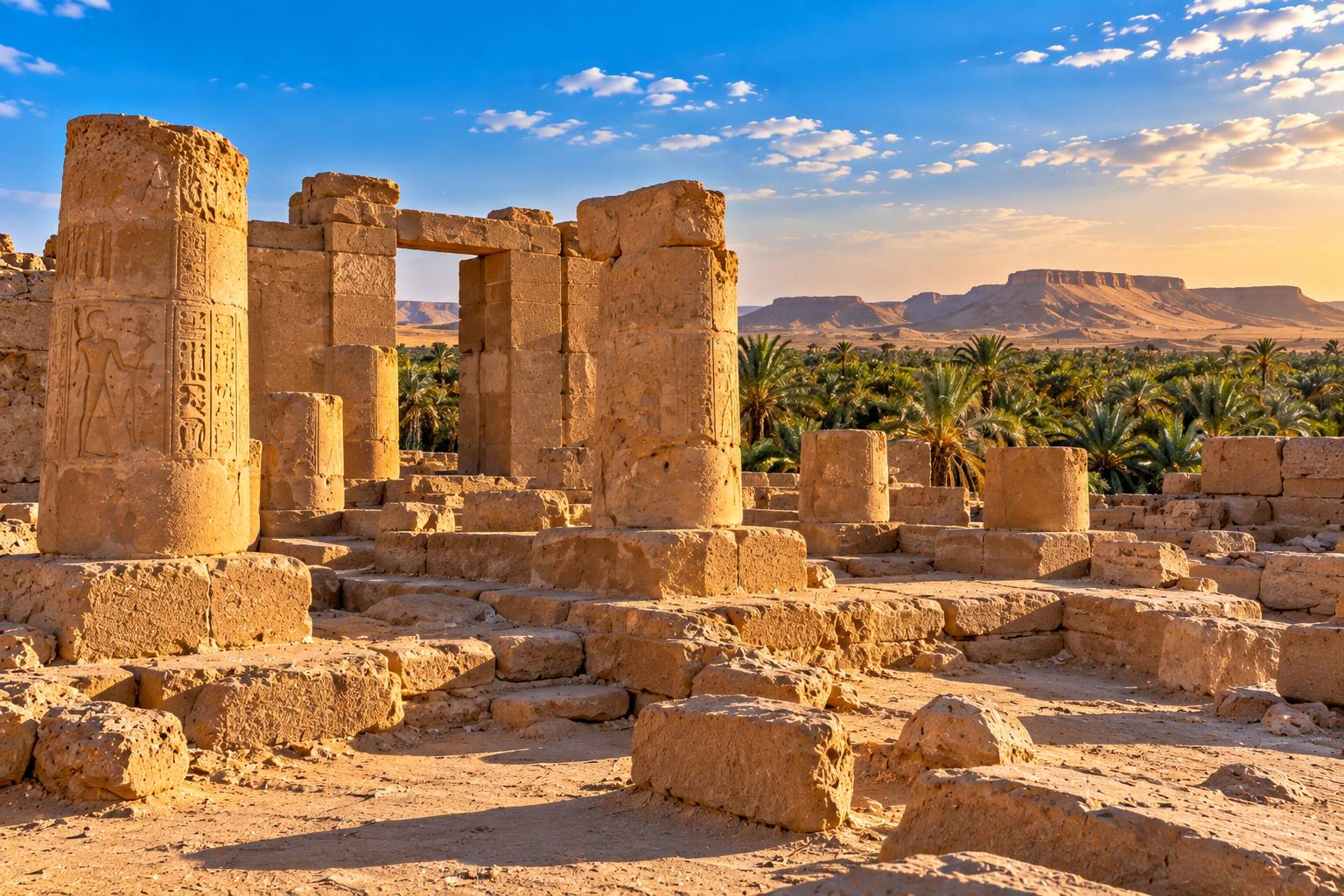
Temple of Alexander the Great, Bahariya Oasis: A Complete Travel Guide
The Temple of Alexander the Great in Bahariya Oasis, Egypt, is a fascinating archaeological site connected with one of the most famous rulers of the ancient world. Located near Ain el-Tibniya in Egypt's Western Desert, the temple provides a rare opportunity to explore Alexander's connection with ancient Egyptian religion and the oasis communities that existed more than 2,000 years ago.
Unlike the enormous temples of Luxor and Karnak, this site is relatively modest in scale. Its historical importance comes from its association with Alexander the Great and the ancient Egyptian god Amun, as well as the inscriptions that help researchers understand how Alexander was presented as a ruler of Egypt.
Bahariya Oasis is also an excellent destination for combining archaeology with nature. Travelers can explore the temple alongside the Black Desert, Crystal Mountain, and the White Desert on a wider Western Desert adventure.
In this guide, discover the temple's history, archaeological significance, what to expect during a visit, and how to plan a memorable trip with Let's Explore Egypt Travel.
Where Is the Temple of Alexander the Great?
The Temple of Alexander the Great is situated at Ain el-Tibniya, in the Bahariya Oasis region of Egypt's Western Desert, near the historic settlements around Bawiti and El-Qasr.
Bahariya Oasis lies southwest of Cairo and is known for its palm groves, ancient monuments, natural springs, and surrounding desert landscapes. The oasis was an important settlement in ancient times, with religious and agricultural communities that connected the Western Desert to wider Egyptian history.
The temple is a distinctive archaeological attraction because it links the history of Bahariya with Alexander the Great, who conquered Egypt in 332 BC.
The exact travel time depends on your starting point and the road conditions. Travelers normally arrange transportation through Bahariya Oasis and confirm the temple's accessibility with a local guide before visiting.
Who Was Alexander the Great?
Alexander the Great was the Macedonian king who conquered Egypt in 332 BC during his campaign against the Persian Empire.
His arrival marked an important turning point in Egyptian history. After entering Egypt, Alexander was welcomed as a new ruler, and his reign became associated with the beginning of the Ptolemaic period that followed his death.
Alexander is also closely connected with the oracle of Amun at Siwa Oasis in Egypt's Western Desert. According to ancient accounts, he travelled to Siwa to consult the oracle, an event that contributed to his image as a ruler favored by the gods.
Amun was one of ancient Egypt's most important deities, associated with kingship and divine authority. The connection between Alexander and Amun reflects the way the Macedonian ruler was incorporated into Egyptian religious and royal traditions.
The Temple of Alexander the Great at Bahariya provides important archaeological evidence of this relationship.
The History of the Temple
A Monument Associated with Alexander
The temple is dedicated to Amun and is known for its connection with Alexander the Great. Its historical significance lies in the way it connects Alexander's rule with traditional Egyptian religious practice.
Ancient Egyptian temples were more than places of worship. They were centers of religious ceremonies, royal representation, and community life. Dedications and inscriptions recorded the relationship between rulers and the gods.
At Bahariya, the surviving archaeological evidence helps researchers study how Alexander was represented within this religious tradition.
Although popular accounts often connect the temple with Alexander's journey to the oracle of Amun at Siwa, visitors should distinguish this historical context from details that are not conclusively established by the surviving remains.
Archaeological Work by Ahmed Fakhry
Egyptologist Ahmed Fakhry conducted important archaeological investigations in Bahariya Oasis during the twentieth century.
He first recorded the ruins associated with the temple during his work in the oasis and returned in the early 1940s to investigate the site further. Excavations uncovered evidence that identified the monument's connection with Alexander the Great.
Later investigations also examined rooms and architectural remains at the site.
These archaeological efforts helped reveal the importance of Bahariya Oasis as a historical region rather than simply a remote desert settlement.
The Significance of the Inscribed Altar
One of the most interesting discoveries associated with the temple is a sandstone altar or pedestal bearing inscriptions in two languages.
According to research published by the French Institute for Oriental Archaeology in Cairo, the object carries a hieroglyphic inscription containing Alexander's royal titulary and a Greek dedication to the god Ammon.
This combination is significant because it reflects the coexistence of Egyptian and Greek traditions during Alexander's period.
The inscriptions help scholars understand how Alexander's kingship was expressed to different cultural audiences and how Egyptian religious practices continued under a new ruler.
The altar is especially valuable as historical evidence because it connects the temple directly with Alexander's royal identity and his association with Amun.
What Can You See at the Temple?
1. The Surviving Temple Remains
The temple's ruins provide a glimpse into an ancient religious complex that has endured centuries of exposure to the desert environment.
Visitors may encounter weathered architectural remains, foundations, wall sections, and other visible traces of the ancient structure, depending on the currently accessible areas.
Unlike a fully preserved monumental temple, the site is best appreciated as an archaeological landscape. Its surviving remains invite visitors to imagine the original building and understand why researchers consider it important.
2. Evidence of Ancient Egyptian Religion
The temple's association with Amun illustrates the importance of religious traditions during Alexander's rule.
Amun had been worshipped in Egypt for centuries before Alexander arrived. Connecting the ruler with this deity helped integrate his kingship into established Egyptian religious ideas.
Learning about this connection can make the visit more rewarding, especially when accompanied by a guide who can explain the historical context.
3. The Connection Between Egyptian and Greek Cultures
The inscriptions associated with the temple provide evidence of a period when Egyptian and Greek traditions interacted.
Alexander's royal presentation combined his status as a Macedonian ruler with the religious language and customs of Egypt. This cultural interaction continued to influence Egypt throughout the Ptolemaic period.
The temple therefore offers a useful perspective on the transition from the earlier dynasties of ancient Egypt to the Hellenistic world.
4. The Desert Setting
The setting adds another dimension to the experience. The temple is part of the historic landscape of Bahariya Oasis, where archaeological sites, palm groves, settlements, and desert terrain lie close together.
For visitors interested in history and photography, the surrounding environment can provide a striking contrast between ancient architecture and the open Western Desert.
Always follow local rules about photography, walking routes, and access to protected archaeological structures.
Why Is This Temple Important?
The Temple of Alexander the Great is important because it provides archaeological evidence of the connection between Alexander's rule and Egyptian religion.
Many visitors know Alexander mainly through his military campaigns and the city of Alexandria, which bears his name. The Bahariya temple reveals another aspect of his historical legacy: his relationship with Egyptian religious traditions.
The inscribed altar is particularly significant because it combines a hieroglyphic royal inscription with a Greek dedication to Amun. This evidence helps researchers understand how a foreign ruler could be represented within the religious and political traditions of Egypt.
The temple also contributes to the wider history of Bahariya Oasis. The region's archaeological sites demonstrate that the oasis was connected to important political, religious, and commercial developments over many centuries.
For travelers, the site provides a more specialized historical experience than Egypt's largest temples. Its appeal lies in the story it tells rather than in monumental size.
Best Time to Visit the Temple
The cooler months from autumn through spring are generally comfortable for exploring Bahariya Oasis and its archaeological sites.
Morning Visits
Morning is often a practical time for sightseeing, particularly if you plan to visit several attractions in one day. The cooler conditions can make walking around exposed archaeological remains more comfortable.
Late Afternoon
Late afternoon may provide attractive light for landscape photography. However, your visit should be planned around confirmed opening hours and available transportation.
Summer Visits
Summer temperatures in the Western Desert can become very high. Visitors should carry drinking water, wear sun protection, and follow local guidance about the safest times for outdoor activities.
Important: Confirm current access arrangements, opening times, and any entrance fees with a local operator before departure. Archaeological-site access can change.
How to Get to the Temple from Cairo
Bahariya Oasis is generally reached by road from Cairo. The journey takes several hours, depending on traffic and the exact destination.
Once in the oasis, visitors can arrange local transportation to archaeological attractions around Bawiti and the surrounding area.
For travelers interested in ancient history, combining the Temple of Alexander the Great with other accessible archaeological locations can provide a more complete understanding of Bahariya's past.
For example, a wider itinerary may include Ain el-Muftella, the available displays associated with the Valley of the Golden Mummies, and other historical landmarks around the oasis.
If you also want to experience Egypt's desert scenery, a longer tour can combine the archaeological visits with the Black Desert, Crystal Mountain, Agabat Valley, and the White Desert.
Explore our Bahariya Oasis Day Tours from Cairo and Bahariya Oasis Tours to discuss possible itineraries.
Nearby Attractions to Combine with the Temple
Black Desert
The Black Desert is famous for its dark volcanic hills and rocky formations scattered across sandy terrain. It provides a dramatic contrast to Bahariya's greener oasis landscape.
Discover our Black Desert Tour.
White Desert
The White Desert is known for its pale chalk and limestone formations shaped by erosion into unusual natural sculptures.
It is one of the most distinctive landscapes in Egypt's Western Desert and is often explored on multi-day desert safaris.
Explore our White Desert Tours from Cairo.
Crystal Mountain
Crystal Mountain is a geological attraction along the route between Bahariya Oasis and Farafra. Its exposed crystalline mineral formations make it an interesting stop for visitors who enjoy natural landscapes and photography.
Ain el-Muftella Temple
Ain el-Muftella is associated with the religious history of Bahariya during the Late Period of ancient Egypt. Its decorated chapels provide a different archaeological perspective from the temple connected with Alexander the Great.
Valley of the Golden Mummies
The Valley of the Golden Mummies became internationally known after the discovery of a large Greco-Roman-era burial ground near Bawiti.
The discovery helps explain Bahariya's later historical importance. The original excavation area may not be open to the public, so confirm which museum displays or archaeological locations can be visited.
Is the Temple of Alexander the Great Worth Visiting?
The temple is a rewarding destination for travelers who want to explore a less familiar chapter of Egyptian history.
Its association with Alexander the Great, its dedication to Amun, and the inscriptions linked to the site make it particularly interesting for people who enjoy archaeology and the history of ancient religion.
It is not a large monumental complex, so visitors should approach the site with realistic expectations. Its significance comes from its historical context and surviving evidence, not from the scale of its ruins.
For the best experience, combine it with other accessible historical sites around Bahariya Oasis or include it as part of a wider cultural and desert itinerary.
Plan Your Bahariya Oasis Adventure
The Temple of Alexander the Great provides a fascinating link between one of the ancient world's best-known rulers and the religious traditions of Egypt.
A visit can be an excellent addition to a journey through Bahariya Oasis, where archaeological discoveries, palm groves, and desert landscapes come together in a distinctive travel experience.
With Let's Explore Egypt Travel, you can discuss an itinerary that combines accessible historical attractions with the natural beauty of the Western Desert.
Explore our Bahariya Oasis Tours or Bahariya Oasis Day Tours from Cairo to start planning your visit.
Discover the history of ancient Egypt beyond the famous pyramids and temples.
Recommended Trips to Explore Bahariya Oasis
Discover the ancient history and spectacular desert scenery of Egypt’s Western Desert with these recommended trips from Let’s Explore Egypt Travel.
1. Bahariya Oasis Tours
Explore Bahariya Oasis, its archaeological landmarks, palm groves, and historic sites. Ask about including the Temple of Alexander the Great and other accessible attractions around Bawiti.
2. Bahariya Oasis Day Tours from Cairo
Travel from Cairo to discover the history and natural beauty of Bahariya Oasis. Confirm the itinerary and available sightseeing time before booking.
3. Black Desert Tour
Discover the Black Desert’s dark volcanic hills and rocky landscapes. Combine desert exploration with archaeological sightseeing around Bahariya Oasis on a longer trip, subject to the route.
4. White Desert Tours from Cairo
Experience the White Desert’s extraordinary chalk formations and wide-open landscapes on a multi-day Western Desert adventure.
5. Explore Ain el-Muftella Temple
Discover another important archaeological site near Bawiti, known for its decorated chapels and religious history during the Late Period of ancient Egypt.
Plan Your Historical and Desert Adventure
Combine the Temple of Alexander the Great with other accessible archaeological sites around Bahariya Oasis, then extend your journey to the Black Desert or White Desert.
Contact Let’s Explore Egypt Travel to confirm site access, transportation, entrance fees, and the best itinerary for your travel dates.
Highlights of the Temple of Alexander the Great, Bahariya Oasis
-
Discover an ancient Egyptian temple associated with Alexander the Great, one of history’s most famous rulers.
-
Explore the temple’s connection with Amun, one of ancient Egypt’s most important gods.
-
Learn about Alexander the Great’s conquest of Egypt in 332 BC and his connection with Egyptian religious traditions.
-
Discover the archaeological significance of inscriptions linking Egyptian royal traditions with Greek culture.
-
Learn about the work of archaeologist Ahmed Fakhry and his investigations in Bahariya Oasis.
-
Explore the historical heritage of Ain el-Tibniya near Bawiti in Egypt’s Western Desert.
-
Discover how ancient Egyptian temples served as centers of religion, royal authority, and community life.
-
Capture photographs of the surviving archaeological remains and surrounding desert landscape, where permitted.
-
Combine your historical visit with Ain el-Muftella Temple and other accessible archaeological attractions.
-
Explore the contrasting landscapes of the Black Desert, Crystal Mountain, and the White Desert.
-
Enjoy a cultural and historical experience away from Egypt’s busiest tourist destinations.
-
Include the temple in a Bahariya Oasis tour from Cairo for a memorable journey through Egypt’s Western Desert.