


Karnak Temple Travel Guide
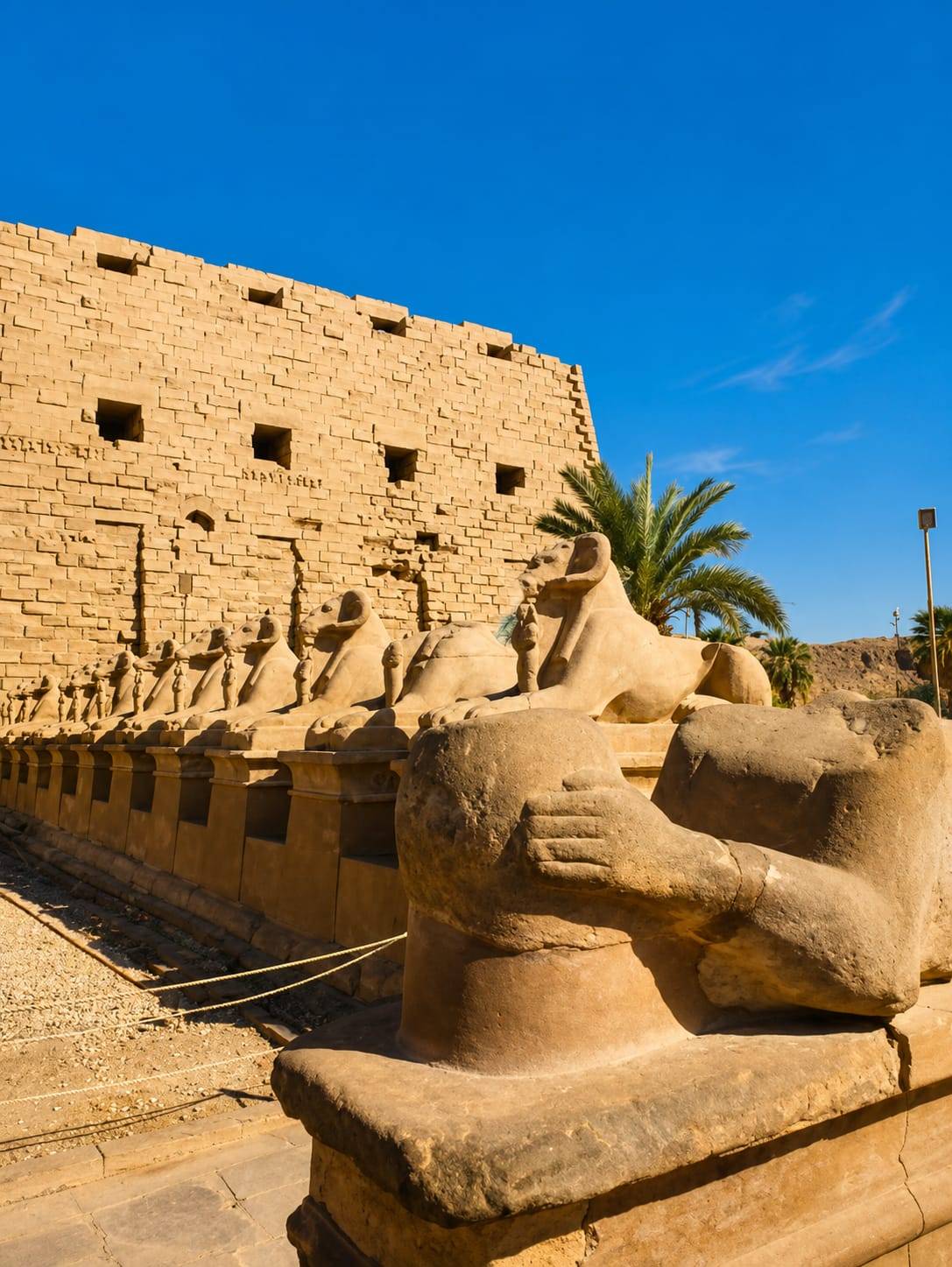
Karnak Temple Travel Guide: History, Facts, Architecture & Visiting Tips
Karnak Temple is one of the most extraordinary ancient Egyptian monuments and one of the most important historical attractions in Luxor. Located on the East Bank of the Nile River, this enormous temple complex reflects thousands of years of ancient Egyptian history, religious beliefs, and architectural achievements.
Built and expanded by generations of pharaohs, Karnak Temple was one of the most important religious centers in ancient Egypt. Its enormous columns, monumental gateways, sacred lake, towering obelisks, and beautifully decorated walls make it an unforgettable destination.
Whether you are visiting Luxor for one day or planning a longer stay, Karnak Temple deserves a place on your itinerary.
This complete Karnak Temple travel guide explains its history, famous attractions, architecture, entrance information, visiting hours, and practical travel tips.
For more sightseeing ideas, explore our complete Luxor Attractions Guide.
1. Where Is Karnak Temple Located?
Karnak Temple is located approximately 3 kilometers north of Luxor Temple on the East Bank of the Nile River in Luxor, southern Egypt.
The complex is part of ancient Thebes, one of the most important religious and political centers of ancient Egypt.
Its location makes it easy to combine with other East Bank attractions, including:
-
Luxor Temple
-
Avenue of Sphinxes
-
Luxor Museum
-
Mummification Museum
-
The Nile Corniche
Many visitors explore Karnak Temple and Luxor Temple on the same day.
2. History of Karnak Temple
Karnak Temple developed over more than 2,000 years, beginning during the Middle Kingdom and continuing through later periods of ancient Egyptian history.
Unlike monuments built by a single pharaoh, Karnak was expanded by many rulers who added temples, obelisks, statues, courtyards, and religious structures.
The complex was primarily dedicated to Amun, one of the most important gods in ancient Egyptian religion.
Together with Mut and Khonsu, Amun formed the Theban Triad.
During the New Kingdom, Thebes became an important political and religious center. Powerful pharaohs contributed to the expansion of Karnak, turning it into one of the largest religious complexes ever constructed.
Important rulers associated with the development of Karnak include:
-
Senusret I
-
Hatshepsut
-
Thutmose III
-
Amenhotep III
-
Seti I
-
Ramesses II
-
Ramesses III
Each ruler contributed to the complex in different ways, leaving behind monuments and inscriptions that help historians understand ancient Egyptian civilization.
3. Why Is Karnak Temple So Famous?
Karnak Temple is famous for its extraordinary size, architectural complexity, and historical importance.
Unlike a single temple building, Karnak is a vast religious complex containing multiple temples, courtyards, pylons, chapels, and sacred spaces.
Its most famous features include:
-
The Great Hypostyle Hall
-
The Avenue of Sphinxes
-
The Sacred Lake
-
The obelisks of Queen Hatshepsut
-
The monumental entrance pylons
-
The temple of Amun-Ra
-
Ancient statues and decorated walls
The complex also provides important evidence of ancient Egyptian religious practices and the political power of the pharaohs.
4. The Great Hypostyle Hall
The Great Hypostyle Hall is one of the most impressive architectural features of Karnak Temple.
It contains 134 massive stone columns arranged in 16 rows.
The central columns are approximately 21 meters high, creating an extraordinary architectural space.
The columns are decorated with detailed carvings, hieroglyphic inscriptions, and religious scenes.
Many of the decorations record the achievements and religious activities of ancient Egyptian rulers.
Walking through the Great Hypostyle Hall is one of the highlights of visiting Karnak.
The scale of the columns gives visitors a remarkable impression of the engineering skills of ancient Egyptian builders.
5. The Sacred Lake of Karnak
The Sacred Lake is one of the important features of the Karnak complex.
It was used for religious purification ceremonies by priests who served the temple.
The lake is located near the main temple area and remains an interesting part of the archaeological site.
Visitors can admire its surroundings and understand the importance of water and purification in ancient Egyptian religious traditions.
The area also offers attractive photography opportunities.
6. The Obelisks of Queen Hatshepsut
Queen Hatshepsut was one of the most important female rulers of ancient Egypt.
During her reign, she commissioned several impressive construction projects, including monuments at Karnak.
One of the most recognizable features associated with her building activities is the remaining standing obelisk.
Carved from a single block of granite, the obelisk was decorated with hieroglyphic inscriptions celebrating Hatshepsut's reign and religious devotion.
It is an excellent example of the architectural and artistic achievements of the 18th Dynasty.
7. The Avenue of Sphinxes
The Avenue of Sphinxes is an ancient processional road connecting Karnak Temple with Luxor Temple.
The route extends for approximately 2.7 kilometers and is lined with statues of sphinxes.
In ancient times, this road played an important role during religious ceremonies, particularly the annual Opet Festival.
During the festival, sacred statues were carried in a ceremonial procession between Karnak and Luxor temples.
Today, visitors can explore the restored avenue and appreciate the historical connection between the two major temple complexes.
If you are planning to visit both temples, consider including the Avenue of Sphinxes in your itinerary.
8. The Temple of Amun-Ra
The main sanctuary at Karnak was dedicated to Amun-Ra, a major deity in ancient Egyptian religion.
Amun became increasingly important during the New Kingdom, when Thebes was the political and religious capital of Egypt.
The temple complex was expanded by successive rulers who added religious structures and monuments to honor the god.
The area contains important courtyards, halls, columns, statues, and sacred spaces.
It is one of the most historically significant parts of Karnak Temple.
9. Other Important Areas of Karnak Temple
Beyond the main temple of Amun-Ra, the complex contains several additional structures.
Precinct of Mut
The Precinct of Mut is located south of the main Karnak complex and was dedicated to Mut, the wife of Amun in the Theban Triad.
It contains remains of temples and other religious structures.
Precinct of Montu
This area is associated with Montu, an ancient Egyptian god connected with warfare.
It forms another important part of the wider Karnak religious complex.
Temple of Khonsu
The Temple of Khonsu is dedicated to Khonsu, the moon god and son of Amun and Mut.
It is one of the better-preserved temple structures within the Karnak complex.
Open-Air Museum
The Open-Air Museum contains reconstructed architectural elements and monuments discovered during archaeological excavations.
Visitors can see important historical structures and learn more about the development of Karnak.
Access arrangements may vary, so check the current ticket information.
10. The Opet Festival: Religious Celebrations at Karnak
The Opet Festival was one of the most important religious celebrations in ancient Thebes.
During the festival, sacred statues associated with Amun, Mut, and Khonsu were transported in ceremonial processions between Karnak Temple and Luxor Temple.
The celebration symbolized the renewal of divine power and the relationship between the gods and the pharaoh.
The Avenue of Sphinxes played an important role in these ceremonies.
The festival provides valuable insight into the religious traditions and ceremonial life of ancient Egypt.
11. How Long Do You Need to Visit Karnak Temple?
Most visitors should allow approximately two hours to explore the main areas of Karnak Temple.
However, history enthusiasts and photography lovers may prefer to spend longer.
Your visit time depends on:
-
How much of the complex you want to explore.
-
Whether you visit the Open-Air Museum.
-
Your interest in ancient Egyptian history.
-
Whether you are accompanied by an Egyptologist.
-
Visitor conditions and opening arrangements.
If you want to explore the complex carefully, allow two to three hours.
12. Best Time to Visit Karnak Temple
The best time to visit Karnak Temple is generally between October and April, when the weather in Luxor is more comfortable.
October and November
These months offer pleasant conditions for exploring outdoor archaeological sites.
December to February
Winter is one of the most popular periods for visiting Luxor.
The weather is generally comfortable during the day, although mornings can be cooler.
March and April
Spring is another good time to explore Karnak Temple, but temperatures gradually increase.
May to September
Summer temperatures in Luxor can become extremely high.
If you visit during these months, consider arriving early in the morning, carrying water, and wearing sun protection.
13. Karnak Temple at Night: Sound and Light Show
Karnak Temple has traditionally hosted a Sound and Light Show that presents parts of the site's history through narration, music, and illumination.
The experience allows visitors to see the temple after sunset and learn about ancient Thebes and its rulers.
Show schedules, languages, availability, and ticket arrangements can change.
Check current availability before planning your evening visit.
14. How to Get to Karnak Temple
Karnak Temple is located on Luxor's East Bank and can be reached using several transportation options.
By Private Car
A private air-conditioned vehicle is a convenient option for visiting Karnak and other attractions in Luxor.
It provides flexibility and allows you to organize your sightseeing schedule.
By Taxi
Taxis are available throughout Luxor.
Agree on the price and destination before beginning your journey.
By Bicycle
Some visitors choose to explore parts of Luxor by bicycle.
However, consider traffic conditions, weather, and the distance involved before choosing this option.
By Organized Tour
An organized sightseeing tour can combine Karnak Temple with Luxor Temple, the Avenue of Sphinxes, and other East Bank attractions.
This is a practical choice for travelers who want transportation and professional guiding arranged in advance.
15. Attractions Near Karnak Temple
Karnak Temple is close to several important attractions on Luxor's East Bank.
Luxor Temple
Luxor Temple is one of the most beautiful ancient monuments in the city.
Located in the heart of modern Luxor, it is particularly impressive when illuminated at night.
Visitors can explore its monumental entrance, statues of Ramesses II, and decorated colonnades.
Avenue of Sphinxes
This historic processional road connects Karnak Temple with Luxor Temple.
It is an important part of the religious history of ancient Thebes.
Luxor Museum
Luxor Museum contains an impressive collection of artifacts discovered in Luxor and the surrounding archaeological sites.
It is an excellent place to learn more about the city's ancient history.
Mummification Museum
The Mummification Museum explains ancient Egyptian funerary practices and the techniques used to preserve bodies for the afterlife.
It is a useful addition for travelers interested in ancient Egyptian religious traditions.
16. Suggested One-Day East Bank Itinerary
If you want to explore the main East Bank attractions, consider the following schedule.
8:00 AM – Hotel Pickup
Start your day with transportation from your hotel.
8:30 AM – Karnak Temple
Explore the Great Hypostyle Hall, Sacred Lake, monumental gateways, and other important areas.
11:00 AM – Avenue of Sphinxes
Discover the ancient processional road connecting Karnak and Luxor temples.
11:30 AM – Luxor Temple
Explore the monumental entrance, statues, columns, and decorated walls.
1:00 PM – Lunch
Enjoy traditional Egyptian food or international cuisine at a local restaurant.
Afternoon – Optional Museum Visit
Depending on your interests, visit Luxor Museum or the Mummification Museum.
This is a suggested schedule. Actual visiting times depend on opening arrangements, transportation, and your interests.
17. Karnak Temple Entrance Tickets and Visitor Information
Karnak Temple requires an entrance ticket.
Ticket prices, opening hours, and access conditions may change.
Before visiting, confirm:
-
Current entrance ticket prices.
-
Opening and closing times.
-
Whether the Open-Air Museum is included.
-
Applicable student discounts.
-
Photography regulations.
-
Any temporary access restrictions.
If you are booking a guided tour, check whether entrance tickets are included or paid separately.
18. What to Wear and Bring
Exploring Karnak involves walking through a large outdoor archaeological complex.
For a comfortable visit, bring:
-
Comfortable walking shoes.
-
Lightweight clothing.
-
A hat or cap.
-
Sunglasses.
-
Sunscreen.
-
Drinking water.
-
A camera or smartphone.
During summer, early morning visits are recommended to avoid the hottest hours.
Respect the archaeological remains and follow the instructions displayed at the site.
19. Is Karnak Temple Worth Visiting?
Absolutely.
Karnak Temple is one of the most important historical attractions in Egypt and a highlight of any visit to Luxor.
Its enormous columns, impressive architecture, sacred spaces, and historical inscriptions offer a unique opportunity to understand ancient Egyptian civilization.
Whether you are interested in history, architecture, photography, or religious traditions, Karnak Temple is an unforgettable experience.
For first-time visitors to Luxor, it is one of the essential places to include in a sightseeing itinerary.
20. Frequently Asked Questions About Karnak Temple
Where is Karnak Temple located?
Karnak Temple is located on the East Bank of the Nile in Luxor, southern Egypt.
Who built Karnak Temple?
Karnak was developed by many pharaohs over more than 2,000 years. Important contributors included Senusret I, Hatshepsut, Thutmose III, Amenhotep III, Seti I, and Ramesses II.
What is Karnak Temple famous for?
It is famous for its enormous religious complex, Great Hypostyle Hall, Sacred Lake, obelisks, monumental gateways, and historical importance.
How many columns are in the Great Hypostyle Hall?
The Great Hypostyle Hall contains 134 massive columns.
How long should I spend at Karnak Temple?
Approximately two hours is a good starting point. Visitors who want to explore the complex in greater detail may need longer.
Can I visit Karnak Temple and Luxor Temple on the same day?
Yes. Both temples are located on the East Bank and can comfortably be combined in one sightseeing day.
Is Karnak Temple the same as Luxor Temple?
No. They are separate temple complexes connected by the ancient Avenue of Sphinxes.
What is the Avenue of Sphinxes?
It is an ancient processional road connecting Karnak Temple with Luxor Temple.
What is the best time to visit Karnak Temple?
October through April is generally more comfortable for sightseeing. During summer, early morning visits are recommended.
Is Karnak Temple suitable for children?
Yes. Families can visit, but children should wear comfortable shoes and be protected from the sun.
Do I need a guide at Karnak Temple?
A guide is not compulsory, but a licensed Egyptologist can explain the history, religious symbolism, and architecture in greater detail.
Is there a Sound and Light Show at Karnak Temple?
A Sound and Light Show has traditionally been offered at the complex. Confirm current schedules and availability before visiting.
21. Explore Karnak Temple with Let's Explore Egypt Travel
Discover one of Egypt's most extraordinary ancient monuments with Let's Explore Egypt Travel.
We help visitors explore Luxor through private sightseeing experiences, comfortable transportation, and knowledgeable local guides.
Our Karnak Temple Tour offers an opportunity to discover the history and architecture of this remarkable religious complex.
You can also combine your visit with Luxor Temple and other East Bank attractions.
Explore our Luxor Attractions Guide to discover more places to visit during your stay.
If you are planning a longer holiday in Egypt, browse our Egypt Tour Packages.
Ready to discover Karnak Temple?
Contact Let's Explore Egypt Travel with your travel date and group size to arrange your private Luxor sightseeing experience.
Travel information note: Entrance fees, opening hours, show schedules, and visitor access rules may change. Confirm the latest information through official channels before your visit.