


Valley of the Queens, Luxor: Complete Visitor Guide
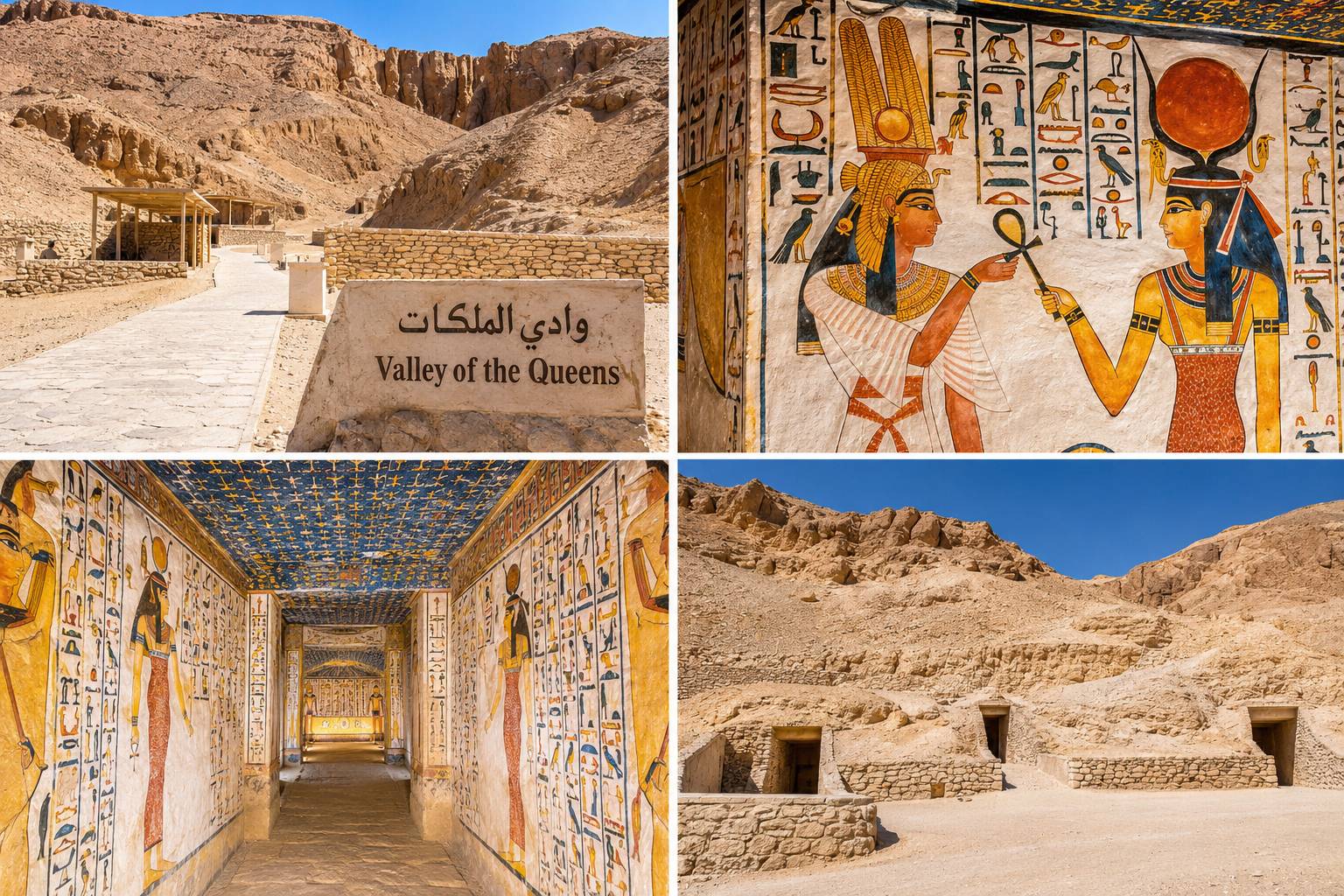
Valley of the Queens, Luxor: Complete Visitor Guide, Tombs, History & Tickets
The Valley of the Queens is one of the most fascinating archaeological sites on Luxor's West Bank in Egypt. Known as the burial place of royal wives, princes, and members of the royal family, this remarkable necropolis offers visitors a different perspective on ancient Egyptian history and funerary traditions.
Located near the famous Valley of the Kings, the Valley of the Queens contains dozens of ancient tombs, including the extraordinary tomb of Queen Nefertari, one of the most beautiful royal tombs in Egypt.
Unlike the grand temples of Karnak and Luxor, this archaeological site takes visitors underground into carefully decorated burial chambers filled with colorful paintings, religious symbols, and ancient inscriptions.
Whether you are interested in Egyptian history, archaeology, or ancient art, visiting the Valley of the Queens is an excellent addition to your Luxor itinerary.
In this complete guide, we explore the history of the Valley of the Queens, its most important tombs, entrance information, location, and practical travel tips.
1. Where Is the Valley of the Queens Located?
The Valley of the Queens is located on the West Bank of the Nile River in Luxor, southern Egypt.
It lies in the desert hills near the Valley of the Kings and the Temple of Hatshepsut.
During the New Kingdom, this area became an important royal burial ground for queens, princes, princesses, and other members of the royal family.
The site is surrounded by dramatic desert landscapes and limestone hills, creating a fascinating historical setting.
The Valley of the Queens can easily be combined with other West Bank attractions during a private sightseeing tour.
2. History of the Valley of the Queens
The Valley of the Queens was used primarily during the New Kingdom, particularly between the Eighteenth and Twentieth Dynasties.
Ancient Egyptians referred to the necropolis as Ta-Set-Neferu, commonly translated as the Place of Beauty.
The valley contains more than 90 known tombs, although not all are open to visitors.
Many royal wives of pharaohs were buried here, along with princes and princesses.
The necropolis became particularly important during the Nineteenth and Twentieth Dynasties.
Several tombs were decorated with detailed religious scenes intended to help the deceased reach the afterlife.
The tombs provide valuable information about royal family life, ancient Egyptian religion, and funerary traditions.
3. Why Is the Valley of the Queens Famous?
The Valley of the Queens is famous for its beautifully decorated royal tombs and its connection to some of ancient Egypt's most important queens.
Its greatest attraction is the tomb of Queen Nefertari, the principal wife of Pharaoh Ramesses II.
The tomb is internationally recognized for its exceptional wall paintings, vibrant colors, and detailed religious scenes.
The valley is also important because it reveals how royal women and children were buried and remembered during the New Kingdom.
For visitors interested in ancient Egyptian art and royal history, this site offers an experience different from the Valley of the Kings.
4. The Most Famous Tombs in the Valley of the Queens
Tomb of Queen Nefertari (QV66)
The tomb of Queen Nefertari is the most famous burial chamber in the Valley of the Queens.
Nefertari was the beloved Great Royal Wife of Ramesses II, one of Egypt's most powerful pharaohs.
Her tomb is famous for its extraordinary decorations, which are among the finest examples of ancient Egyptian funerary art.
The walls feature colorful scenes showing the queen interacting with Egyptian gods and goddesses.
Religious texts and symbolic illustrations describe her journey through the afterlife.
The paintings are remarkable for their detail, artistic quality, and preservation.
Access to this tomb is controlled and requires a separate special ticket when available.
Visitors should check current opening arrangements and ticket availability before planning their visit.
Tomb of Prince Amunherkhepeshef (QV55)
The tomb of Prince Amunherkhepeshef is another important monument in the Valley of the Queens.
He was a son of Ramesses III.
The tomb contains interesting decorations and scenes connected with the prince's royal status and religious beliefs.
It provides insight into the burial traditions of royal children during the New Kingdom.
Tomb of Prince Khaemwaset (QV44)
The tomb of Prince Khaemwaset is associated with a son of Ramesses III.
It contains religious decorations and historical details connected with the royal family.
The tomb is one of the important examples of royal children's burials in the necropolis.
Tomb of Queen Titi (QV52)
The tomb of Queen Titi is another notable burial chamber in the Valley of the Queens.
Its decorations include religious scenes and representations of ancient Egyptian deities.
The tomb helps illustrate the religious beliefs and artistic traditions associated with royal burials.
5. What Can You See Inside the Valley of the Queens?
A visit to the Valley of the Queens allows you to explore several important features of ancient Egyptian funerary architecture.
Highlights include:
-
Underground burial chambers.
-
Colorful wall paintings.
-
Ancient hieroglyphic inscriptions.
-
Religious scenes depicting Egyptian gods.
-
Images connected with the journey to the afterlife.
-
Royal burial architecture.
-
Tombs belonging to queens and princes.
Each tomb has its own layout, decorations, and historical significance.
The most famous tombs are especially valuable for understanding the artistic achievements of ancient Egyptian craftsmen.
6. The Tomb of Queen Nefertari: One of Egypt's Most Beautiful Tombs
The tomb of Queen Nefertari is considered one of the most beautiful tombs in Egypt.
Its decorations are remarkable for their vibrant colors and detailed representations of religious beliefs.
The scenes show Nefertari in the presence of several ancient Egyptian deities, including Osiris, Isis, Hathor, and Anubis.
The tomb's inscriptions and paintings were designed to support the queen's journey into the afterlife.
Because of its delicate decorations, access is restricted and visitor numbers may be controlled.
If you are particularly interested in ancient Egyptian art, this tomb is one of the most extraordinary experiences in Luxor.
7. Valley of the Queens Opening Hours
Opening hours can vary depending on the season and official arrangements.
The archaeological site generally opens in the morning and closes in the late afternoon.
We recommend visiting early in the day, especially during warmer months.
Always check the latest official opening information before traveling.
Special tombs may have separate access arrangements and additional ticket requirements.
8. Valley of the Queens Entrance Fees and Tickets
Entrance fees depend on the visitor's nationality and applicable ticket categories.
The standard site ticket and special tomb tickets may be sold separately.
The tomb of Queen Nefertari generally requires a separate special ticket and may have limited availability.
Ticket prices can change, so visitors should confirm the current fees through the official Egyptian Ministry of Tourism and Antiquities or the archaeological site's ticket office.
Students who qualify for discounted admission should bring valid identification.
9. How Long Does It Take to Visit the Valley of the Queens?
Most visitors should allow approximately one to two hours to explore the Valley of the Queens.
If you plan to visit the tomb of Queen Nefertari, allow additional time for ticket arrangements and the experience itself.
The total duration depends on how many tombs are open and your interest in their decorations and history.
For travelers combining the valley with other West Bank attractions, it is best to plan the schedule carefully.
10. Best Time to Visit the Valley of the Queens
The best time to visit the Valley of the Queens is generally from October to April.
During these months, temperatures in Luxor are more comfortable for outdoor sightseeing.
November, December, January, and February are particularly popular travel months.
Summer temperatures can exceed 40°C, so visitors traveling between May and September should arrive early in the morning.
For more information, read our complete guide:
Best Time to Visit Luxor, Egypt: Weather, Seasons & Travel Tips.
11. How to Get to the Valley of the Queens
The Valley of the Queens is located on Luxor's West Bank.
Visitors can reach the site through several transportation options.
Private Transportation
A private air-conditioned vehicle is one of the most comfortable ways to visit the Valley of the Queens.
You can combine the site with other archaeological attractions without arranging separate transfers.
Taxi
Taxis are available in Luxor, although it is advisable to agree on the fare and return arrangements before starting your journey.
Organized Guided Tour
A guided tour provides transportation and historical explanations from a professional Egyptologist.
This option is especially useful for travelers visiting several West Bank attractions in one day.
12. Best Attractions Near the Valley of the Queens
The Valley of the Queens is close to several of Luxor's most important historical monuments.
Valley of the Kings
The Valley of the Kings is the royal burial ground of numerous New Kingdom pharaohs.
It contains famous tombs, including that of Tutankhamun.
Temple of Hatshepsut
Located at Deir el-Bahari, this impressive temple is dedicated to Queen Hatshepsut.
Its magnificent terraces and dramatic mountain setting make it one of Luxor's essential attractions.
Medinet Habu Temple
Medinet Habu is the mortuary temple of Ramesses III.
It is particularly famous for its military reliefs and well-preserved architecture.
Read our detailed guide:
Medinet Habu Temple, Luxor: Complete Visitor Guide.
Colossi of Memnon
These two enormous statues of Amenhotep III are among the most recognizable monuments on Luxor's West Bank.
Deir el-Medina
This ancient settlement was home to the craftsmen who built and decorated royal tombs.
It offers fascinating insights into everyday life in ancient Egypt.
13. Suggested Luxor West Bank Itinerary
If you want to explore several historical attractions in one day, consider the following itinerary.
Morning:
-
Valley of the Kings.
-
Temple of Hatshepsut.
Late Morning:
-
Valley of the Queens.
-
Optional visit to the Tomb of Nefertari, subject to availability.
Afternoon:
-
Medinet Habu Temple.
-
Colossi of Memnon.
-
Optional Deir el-Medina visit.
The schedule can be adjusted depending on ticket availability, opening hours, and your personal interests.
14. Photography Tips for the Valley of the Queens
The Valley of the Queens is especially interesting for visitors who appreciate ancient Egyptian art.
However, photography regulations vary between tombs.
Before taking photographs, check the current rules and any additional photography ticket requirements.
We recommend:
-
Respecting all photography restrictions.
-
Avoiding flash where prohibited.
-
Never touching painted walls.
-
Following the instructions of site staff.
-
Taking time to observe the details of the ancient paintings.
The tomb of Nefertari is particularly sensitive because of its exceptional decorations.
15. Is the Valley of the Queens Worth Visiting?
Absolutely.
The Valley of the Queens is one of the most fascinating archaeological sites in Luxor.
Although it is less famous than the Valley of the Kings, it offers a unique perspective on the lives and burial traditions of ancient Egyptian royal women and children.
Its beautifully decorated tombs, particularly the tomb of Nefertari, make it an exceptional destination for history and art enthusiasts.
We recommend including it in your Luxor West Bank itinerary if you have enough time.
16. Frequently Asked Questions About the Valley of the Queens
What is the Valley of the Queens famous for?
It is famous for its royal tombs, particularly the beautifully decorated tomb of Queen Nefertari.
Who was buried in the Valley of the Queens?
The valley contains the tombs of queens, princes, princesses, and other members of the royal family, mainly from the New Kingdom.
How many tombs are in the Valley of the Queens?
More than 90 tombs have been identified in the necropolis, although not all are accessible to visitors.
Is the tomb of Nefertari open to visitors?
The tomb may be open under special arrangements and requires a separate ticket. Availability and visitor access can change, so check before your visit.
How long should I spend at the Valley of the Queens?
Most visitors should allow one to two hours, with additional time if visiting special tombs.
Can I visit the Valley of the Queens and Valley of the Kings in one day?
Yes. Both sites are located on Luxor's West Bank and can be included in a private full-day sightseeing itinerary.
Is the Valley of the Queens worth visiting?
Yes. It is especially recommended for travelers interested in royal history, ancient Egyptian art, and beautifully decorated tombs.
17. Discover the Valley of the Queens with Let's Explore Egypt Travel
Explore the fascinating royal history of ancient Egypt with Let's Explore Egypt Travel.
We organize private Luxor sightseeing tours designed to help visitors discover the most important archaeological attractions on the West Bank.
Our experiences can include:
-
Private air-conditioned transportation.
-
Professional licensed Egyptologist guides.
-
Valley of the Queens.
-
Valley of the Kings.
-
Temple of Hatshepsut.
-
Medinet Habu Temple.
-
Colossi of Memnon.
-
Personalized sightseeing itineraries.
Whether you are visiting Luxor for one day or planning a longer Egyptian holiday, we can help organize a private experience based on your interests and schedule.
Discover the royal tombs of ancient Egypt with Let's Explore Egypt Travel and experience the extraordinary history of Luxor!
Related Luxor Travel Guides
-
Valley of the Kings Visitor Guide.
-
Karnak Temple Visitor Guide.
-
Temple of Hatshepsut Visitor Guide.
-
Deir el-Medina Visitor Guide.