


Ramesseum Temple, Luxor: Complete Visitor Guide to the Temple of Ramesses II
Ramesseum Temple, Luxor: Complete Visitor Guide to the Temple of Ramesses II
The Ramesseum Temple is one of the most impressive ancient monuments on the West Bank of Luxor, Egypt. Built by Pharaoh Ramesses II during the New Kingdom, this magnificent mortuary temple was designed to celebrate the king's achievements, honor the gods, and preserve his memory for eternity.
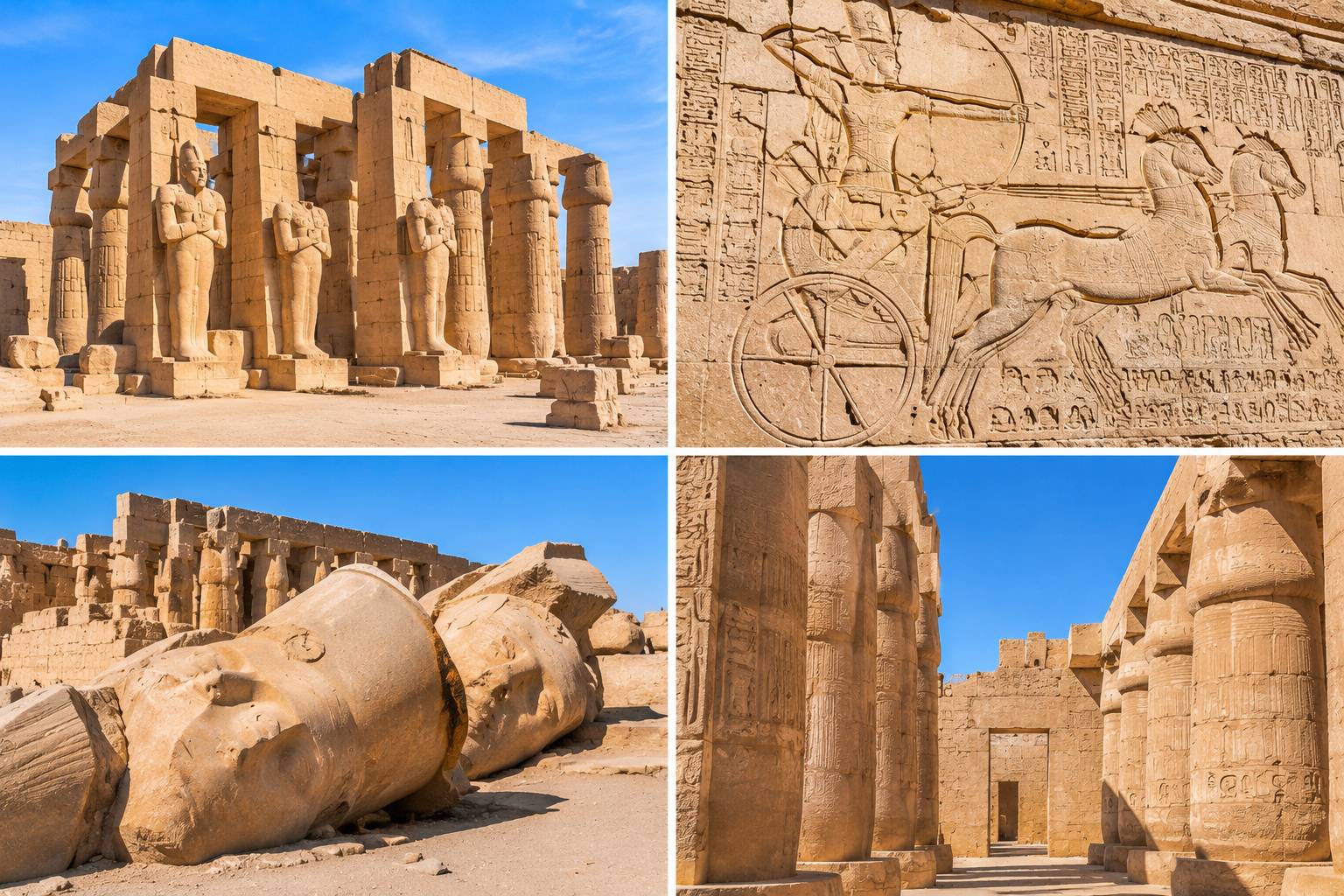
Although parts of the temple now lie in ruins, the Ramesseum remains an extraordinary archaeological site. Visitors can explore its monumental entrance, fallen colossus of Ramesses II, decorated walls, impressive columns, and remains of ancient religious and administrative buildings.
Unlike the more crowded attractions in Luxor, the Ramesseum often offers a quieter opportunity to discover ancient Egyptian architecture and history.
Whether you are interested in the reign of Ramesses II, ancient Egyptian temples, or the archaeological heritage of Thebes, this visitor guide will help you plan your visit.
Where Is the Ramesseum Temple?
The Ramesseum is located on the West Bank of the Nile River in Luxor, southern Egypt. It stands within the ancient Theban necropolis, an area famous for its royal tombs, mortuary temples, and archaeological sites.
The temple is situated near several important attractions, including:
-
Valley of the Kings
-
Valley of the Queens
-
Deir el-Medina
-
Medinet Habu Temple
-
Hatshepsut Temple
-
Colossi of Memnon
Its location makes it easy to include in a full-day West Bank sightseeing itinerary.
If you are planning a longer stay in the city, explore our Luxor Travel Guide for more information about the main attractions, sightseeing areas, and experiences in Luxor.
Who Built the Ramesseum Temple?
The Ramesseum was built by Pharaoh Ramesses II, one of the most famous and powerful rulers of ancient Egypt.
Ramesses II ruled during the 19th Dynasty, approximately 1279–1213 BC. His long reign was marked by major building projects, military campaigns, diplomatic achievements, and extensive artistic activity.
He commissioned enormous temples, statues, and monuments throughout Egypt and Nubia.
The Ramesseum was his mortuary temple, created to maintain his royal funerary cult and commemorate his reign. It was also dedicated to important Egyptian deities, particularly Amun-Ra.
The complex was known in ancient times as a temple or mansion of millions of years, reflecting its purpose of preserving the king's divine association and memory.
History of the Ramesseum
Construction of the Ramesseum began during the early years of Ramesses II's reign and continued as the complex was developed and decorated.
The temple was designed as a place where religious ceremonies and offerings could be performed in honor of the king and the gods.
Its walls were decorated with scenes illustrating royal achievements, religious rituals, and important events from the reign of Ramesses II.
One of the most famous subjects represented at the temple is the Battle of Kadesh, fought between the Egyptian army and the Hittite Empire.
Over the centuries, the temple experienced periods of damage, reuse, and abandonment. Some of its stone blocks and architectural elements were damaged or reused in later periods.
Despite this, the surviving remains still reveal the scale and ambition of the original complex.
The Battle of Kadesh: A Famous Story Carved in Stone
One of the most important historical subjects represented at the Ramesseum is the Battle of Kadesh.
The battle took place around 1274 BC between the forces of Ramesses II and the Hittite Empire, near the city of Kadesh in present-day Syria.
Ramesses II presented the battle as a great royal victory, and scenes describing the campaign appeared on several of his monuments.
At the Ramesseum, visitors can examine surviving reliefs that depict the king in battle, his army, and the conflict with the Hittites.
These carvings are valuable historical sources, although they should also be understood as royal propaganda designed to celebrate the pharaoh's power and achievements.
The battle eventually contributed to a long period of conflict and diplomacy between Egypt and the Hittites. The two powers later concluded a famous peace agreement.
Architecture of the Ramesseum
The Ramesseum was designed according to the traditional layout of New Kingdom mortuary temples.
Its architectural plan included monumental gateways, courtyards, columned halls, sanctuaries, chapels, and storage buildings.
Although several sections are now damaged, visitors can still identify important parts of the original complex.
1. The First Pylon
The first pylon formed the monumental entrance to the temple.
This massive gateway once welcomed visitors into the religious complex and displayed scenes celebrating the achievements of Ramesses II.
The decoration included representations of the Battle of Kadesh and the king's military power.
Although much of the structure is damaged, its surviving remains help visitors imagine the impressive appearance of the original entrance.
2. The First Courtyard
Beyond the first pylon was a large open courtyard.
The courtyard once contained columns and statues arranged around the central space. Parts of this area have collapsed, but surviving architectural elements still reveal its original scale.
This courtyard formed an important transition between the entrance and the more sacred sections of the temple.
3. The Second Pylon
The second pylon separated the first courtyard from the next section of the temple.
It provided another monumental entrance and originally included architectural and decorative elements associated with Ramesses II.
Near this area, visitors can see important remains of the colossal statue of the king.
4. The Colossal Statue of Ramesses II
One of the most famous features of the Ramesseum is the enormous fallen statue of Ramesses II.
The statue was originally a monumental representation of the pharaoh seated on his throne. It was made from a single massive block of stone and once stood more than 17 meters high.
Today, its fragments lie among the ruins, offering visitors a powerful impression of the scale of royal sculpture in ancient Egypt.
The fallen statue is particularly interesting because it demonstrates the ambition and technical skill involved in creating colossal monuments thousands of years ago.
5. The Second Courtyard
The second courtyard was another important architectural space within the complex.
It contained rows of columns and Osirian pillars representing the king in association with Osiris, the god of the afterlife.
Although much of the courtyard is damaged, some columns and architectural remains are still visible.
6. The Hypostyle Hall
The hypostyle hall was one of the most important interior spaces of the Ramesseum.
It contained several rows of columns supporting the roof and creating an impressive architectural environment.
The hall was decorated with religious scenes and inscriptions, reflecting the temple's role as a sacred place dedicated to the gods and the royal funerary cult.
7. Chapels and Sacred Areas
The temple complex included additional chapels and religious spaces dedicated to different deities.
These areas were part of the larger religious system that connected the king with the gods and maintained his cult after death.
The surviving remains help archaeologists understand the organization and religious functions of the complex.
The Ramesseum's Ancient Storage Buildings and Workshops
The Ramesseum was not only a religious monument. It was also part of a much larger institution that required staff, supplies, workshops, and administrative facilities.
Archaeological investigations have identified remains of buildings associated with storage, food preparation, and other activities.
The complex included areas used for storing provisions and materials, as well as facilities connected with the daily operation of the temple.
These discoveries demonstrate that large ancient Egyptian temples functioned as important economic and administrative centers, not simply places of worship.
Recent Archaeological Discoveries at the Ramesseum
Archaeological research continues to reveal new information about the Ramesseum and its surrounding area.
Egyptian and international archaeological missions have investigated the temple complex and its surrounding structures, uncovering evidence of activities connected with the temple.
Reported discoveries in the wider complex include:
-
Structures associated with temple administration and religious learning.
-
Remains of drawings and objects connected with daily life.
-
Storage areas and evidence of food preparation.
-
Workshops connected with textiles and other crafts.
-
Tombs and archaeological remains from later periods.
These discoveries show that the Ramesseum was part of a wider religious, economic, and community environment.
They also demonstrate that archaeological exploration at Luxor continues to add important details to our understanding of ancient Egyptian society.
Why Is the Ramesseum Important?
The Ramesseum is important for several reasons.
First, it is one of the major monuments associated with Ramesses II and provides valuable information about his royal image and religious beliefs.
Second, its architecture demonstrates the scale and sophistication of New Kingdom temple construction.
Third, its reliefs provide historical and artistic evidence about military campaigns, royal ceremonies, and religious traditions.
Finally, archaeological discoveries around the temple reveal how large religious complexes supported communities through workshops, storage facilities, education, and administration.
For visitors interested in ancient Egyptian civilization, the Ramesseum offers much more than a collection of ruins.
The Ramesseum and the Story of Ozymandias
The Ramesseum is sometimes connected with the famous poem Ozymandias by Percy Bysshe Shelley.
The poem describes the remains of a once-powerful ruler whose enormous monument has fallen into ruins.
The name Ozymandias is associated with the Greek form of one of Ramesses II's royal names.
The fallen colossus at the Ramesseum has often been linked with the image of a mighty king whose monument was eventually overcome by time.
This literary connection has helped make the Ramesseum famous among visitors interested in both Egyptian history and world literature.
Best Time to Visit the Ramesseum
The best time to visit the Ramesseum is generally between October and April, when the weather in Luxor is more comfortable for outdoor sightseeing.
During these months, temperatures are usually milder, making it easier to explore the temple and other West Bank attractions.
Summer temperatures can be extremely high, particularly in June, July, and August.
If you visit during summer, consider arriving early in the morning, wearing comfortable clothing, and carrying enough drinking water.
For detailed seasonal information, read our guide: Best Time to Visit Luxor, Egypt: Weather, Seasons & Travel Tips.
How Long Do You Need at the Ramesseum?
Most visitors should allow approximately 45 minutes to 1 hour to explore the Ramesseum.
If you are particularly interested in ancient Egyptian architecture, royal inscriptions, and archaeological history, you may want to spend longer.
A professional Egyptologist guide can help you understand the stories behind the reliefs, the temple's architectural layout, and the importance of Ramesses II.
How to Get to the Ramesseum Temple
The Ramesseum is located on Luxor's West Bank and can be reached by private vehicle, taxi, or organized sightseeing tour.
For many visitors, a private tour is the most convenient option because it allows several archaeological sites to be explored in one day.
A private air-conditioned vehicle also makes it easier to travel between the different monuments without relying on local transportation.
You can combine the Ramesseum with the Valley of the Kings, Hatshepsut Temple, Medinet Habu, and other West Bank attractions.
Suggested West Bank Luxor Itinerary Including the Ramesseum
If you want to explore the major historical attractions on Luxor's West Bank, consider this suggested full-day itinerary.
Morning
1. Valley of the Kings
Discover the royal burial place of many New Kingdom pharaohs and explore selected decorated tombs.
2. Hatshepsut Temple
Visit the impressive terraced mortuary temple of Queen Hatshepsut, built against the cliffs of Deir el-Bahari.
3. Colossi of Memnon
Stop to see the two monumental statues that once guarded the entrance to the mortuary temple of Amenhotep III.
Afternoon
4. Ramesseum Temple
Explore the mortuary temple of Ramesses II and see the remains of its famous colossal statue.
5. Medinet Habu Temple
Discover the impressive mortuary temple of Ramesses III, known for its detailed reliefs and well-preserved architectural sections. Read our complete Medinet Habu Temple visitor guide before your visit.
6. Deir el-Medina
Explore the ancient workers' village and learn about the craftsmen who built and decorated the royal tombs.
The order of visits can be adjusted according to opening hours, ticket arrangements, and your personal interests.
What to Wear When Visiting the Ramesseum
Luxor's West Bank can be very hot and sunny, especially during summer.
For a comfortable visit, we recommend:
-
Lightweight and breathable clothing.
-
Comfortable walking shoes.
-
A hat or cap.
-
Sunglasses.
-
Sunscreen.
-
Drinking water.
The archaeological site includes uneven ground, stones, and exposed outdoor areas, so suitable footwear is important.
Practical Visitor Tips
Before visiting the Ramesseum, keep these useful tips in mind:
-
Arrive early: Morning visits are usually more comfortable, especially in warmer months.
-
Bring water: The site has exposed outdoor areas with limited shade.
-
Hire an Egyptologist: A knowledgeable guide can explain the historical meaning of the temple's inscriptions and reliefs.
-
Respect the monuments: Avoid touching ancient carvings and damaged architectural surfaces.
-
Check ticket information: Admission prices and opening hours may change, so confirm them before your visit.
-
Combine nearby attractions: Visiting several West Bank monuments in one trip can save travel time.
Is the Ramesseum Worth Visiting?
Yes. The Ramesseum is absolutely worth visiting if you are interested in the history of Ramesses II and ancient Egyptian architecture.
Its fallen colossal statue, decorated walls, columned halls, and historical significance make it one of the most interesting monuments on Luxor's West Bank.
It may not be as famous as Karnak Temple or the Valley of the Kings, but it offers a different perspective on the power and ambitions of one of Egypt's greatest pharaohs.
The Ramesseum is also an excellent stop for travelers who want to explore beyond the most popular tourist attractions.
Explore the Ramesseum with Let's Explore Egypt Travel
Discover the ancient monuments of Luxor with Let's Explore Egypt Travel.
We organize private Luxor sightseeing tours with comfortable transportation and professional Egyptologist guides.
Explore the Ramesseum, Valley of the Kings, Hatshepsut Temple, Medinet Habu, and other remarkable sites on the West Bank.
Whether you are visiting Luxor for one day or planning a longer Egypt holiday, we can help you create an itinerary based on your interests and travel schedule.
Explore more attractions and travel advice through our Luxor Travel Guide.
Contact Let's Explore Egypt Travel to plan your private Luxor experience.
Frequently Asked Questions About the Ramesseum Temple
1. What is the Ramesseum Temple?
The Ramesseum is the mortuary temple of Pharaoh Ramesses II, located on the West Bank of the Nile in Luxor, Egypt.
2. Who built the Ramesseum?
The temple was commissioned by Ramesses II, who ruled Egypt during the 19th Dynasty of the New Kingdom.
3. Where is the Ramesseum located?
It is located on Luxor's West Bank, within the ancient Theban necropolis.
4. What is the Ramesseum famous for?
The temple is famous for its connection with Ramesses II, its monumental architecture, decorated reliefs, and the remains of a huge fallen statue of the king.
5. How tall was the statue of Ramesses II at the Ramesseum?
The colossal seated statue originally stood more than 17 meters high. Today, its remains lie among the temple ruins.
6. What does the Ramesseum mean?
The Ramesseum is the modern name given to the mortuary temple of Ramesses II. The temple was originally known by a longer religious name associated with the king's eternal cult.
7. How much time do you need at the Ramesseum?
Most visitors should allow around 45 minutes to 1 hour, although history enthusiasts may want additional time.
8. Can I visit the Ramesseum and Valley of the Kings on the same day?
Yes. Both sites are located on Luxor's West Bank and can be included in the same private sightseeing itinerary.
9. Is the Ramesseum crowded?
It is often less visited than some of Luxor's most famous attractions, making it an appealing option for travelers who want to explore additional historical sites.
10. Is the Ramesseum worth visiting?
Yes. It is an important monument of Ramesses II and offers a fascinating combination of history, architecture, sculpture, and ancient Egyptian religious traditions.