


Colossi of Memnon, Luxor: Complete Visitor Guide
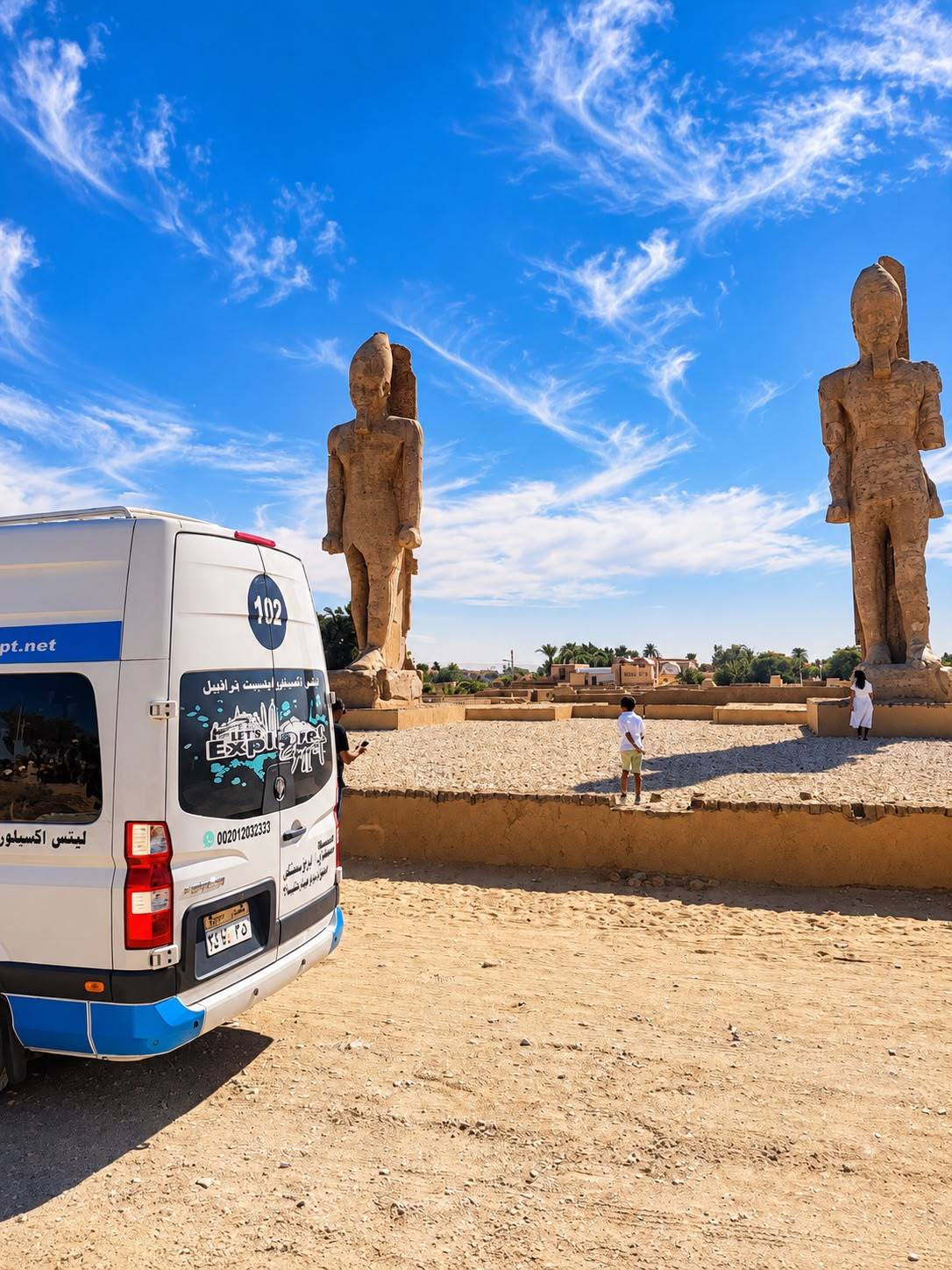
Colossi of Memnon, Luxor: Complete Visitor Guide, History & Facts
The Colossi of Memnon are among the most recognizable ancient monuments in Luxor, Egypt. Standing on the West Bank of the Nile River, these two enormous stone statues have welcomed visitors for thousands of years.
The statues represent Pharaoh Amenhotep III, one of the most powerful rulers of ancient Egypt's 18th Dynasty. Originally, they stood at the entrance to his magnificent mortuary temple, which was once one of the largest religious complexes in ancient Egypt.
Today, the Colossi of Memnon are a popular stop for travelers exploring the West Bank of Luxor. Their impressive size, fascinating history, and connection with ancient Egyptian civilization make them an essential attraction for anyone visiting the city.
In this complete guide, discover the history of the Colossi of Memnon, who built them, why they are famous, what happened to the original temple, and how to include them in your Luxor itinerary.
Where Are the Colossi of Memnon?
The Colossi of Memnon are located on the West Bank of the Nile River in Luxor, southern Egypt.
They stand in the Theban Necropolis, an archaeological area that contains some of the most important ancient Egyptian monuments.
The statues are situated near several famous attractions, including:
-
Valley of the Kings
-
Valley of the Queens
-
Hatshepsut Temple
-
Ramesseum Temple
-
Medinet Habu Temple
-
Tombs of the Nobles
-
Deir el-Medina
Their location makes them an easy stop during a West Bank sightseeing tour.
If you are planning your visit to the city, explore our Luxor Travel Guide for more information about the temples, tombs, attractions, and experiences you can enjoy.
What Are the Colossi of Memnon?
The Colossi of Memnon are two massive seated statues carved from blocks of quartzite sandstone.
They represent Pharaoh Amenhotep III, who ruled Egypt during the 18th Dynasty, approximately 1390–1353 BC.
Each statue originally stood around 18 meters high, including its stone base, and weighs hundreds of tons.
The statues show the pharaoh seated on a throne, with his hands resting on his knees. Smaller figures representing members of the royal family appear beside the legs of the main statues.
Both monuments originally guarded the entrance to the mortuary temple of Amenhotep III.
Although the temple was largely destroyed over time, the two statues survived and remain impressive examples of ancient Egyptian royal sculpture.
Who Built the Colossi of Memnon?
The statues were commissioned by Pharaoh Amenhotep III, one of the most important rulers of the New Kingdom.
Amenhotep III ruled during a period of prosperity, international diplomacy, and impressive architectural development.
His reign was marked by:
-
Large-scale temple construction.
-
Monumental royal statues.
-
Diplomatic relationships with neighboring kingdoms.
-
Artistic and cultural achievements.
-
Economic prosperity and international trade.
He commissioned enormous monuments throughout Egypt, including his mortuary temple on the West Bank of Thebes.
The two Colossi of Memnon were created as part of this impressive royal building project.
History of the Colossi of Memnon
The history of the statues begins during the reign of Amenhotep III, when they were installed at the entrance to his mortuary temple.
The temple was originally an enormous religious complex dedicated to the king and the gods.
It included courtyards, statues, pylons, chapels, and other religious structures.
However, the temple was built on low ground near the Nile floodplain. Over the centuries, flooding, erosion, earthquakes, and the reuse of stone contributed to its destruction.
Many of its architectural elements disappeared or were reused in later construction projects.
The two statues survived, although both experienced significant damage.
Despite their damaged condition, they remain among the most famous monuments of ancient Thebes.
Why Are They Called the Colossi of Memnon?
The name Colossi of Memnon comes from an ancient Greek legend.
After the Greek period began in Egypt, travelers associated the northern statue with Memnon, a legendary hero from Greek mythology.
According to the story, Memnon was the son of the goddess Eos and was killed during the Trojan War.
Ancient visitors believed that one of the statues produced a mysterious sound at sunrise.
They associated this sound with Memnon greeting his mother, the goddess of dawn.
As a result, the statues became known as the Colossi of Memnon.
The name remained popular, even though the statues actually represent the Egyptian pharaoh Amenhotep III.
The Singing Statue of Memnon
One of the most fascinating stories connected with the Colossi of Memnon is the legend of the singing statue.
In ancient times, visitors reported hearing a strange sound coming from the northern statue, particularly around sunrise.
The phenomenon became famous during the Roman period, attracting travelers, scholars, and even Roman emperors.
Several ancient inscriptions were left by visitors who claimed to have heard the mysterious sound.
Modern explanations suggest that the sound was associated with changes in temperature and moisture affecting cracks in the damaged stone.
The phenomenon may also have been influenced by environmental conditions and the statue's physical structure.
During the Roman period, repairs were carried out on the northern statue, and the mysterious sound reportedly stopped.
Today, visitors can admire the statues, but the ancient singing phenomenon is no longer heard.
The Mortuary Temple of Amenhotep III
The Colossi of Memnon once stood at the entrance to the mortuary temple of Amenhotep III.
This temple was one of the largest religious complexes ever built in ancient Egypt.
It was dedicated to the king's funerary cult and his divine association with the gods.
The complex originally contained:
-
Monumental entrance structures.
-
Large open courtyards.
-
Colossal royal statues.
-
Religious chapels.
-
Sacred spaces.
-
Numerous decorative reliefs.
Archaeological discoveries have revealed that the original temple was much larger than the surviving statues might suggest.
Although much of the structure has disappeared, excavations in the area continue to provide information about its original appearance and organization.
The Colossi of Memnon and the Royal Family
The statues are not simply enormous representations of the pharaoh.
Smaller figures appear beside the legs of Amenhotep III, representing members of the royal family.
These figures provide important information about the king's family and the way royal authority was represented in ancient Egyptian art.
The decoration of the thrones also includes symbolic imagery connected with the unification of Upper and Lower Egypt.
Such artistic details helped communicate the pharaoh's power, legitimacy, and divine role.
What Can You See at the Colossi of Memnon?
The site is relatively compact, but there are several interesting details to observe.
1. The Two Seated Statues
The most obvious attraction is the pair of enormous seated statues.
Both depict Amenhotep III wearing the royal headdress and seated on a throne.
Their monumental scale demonstrates the artistic and engineering achievements of ancient Egyptian sculptors.
2. Royal Family Figures
Look closely at the lower sections of the statues.
Smaller carved figures appear beside the pharaoh's legs, representing members of the royal family.
These details are particularly interesting for visitors who enjoy ancient Egyptian sculpture and symbolism.
3. Hieroglyphic Inscriptions
The statues and their bases contain carved inscriptions and decorative details.
These provide information about royal titles, religious symbolism, and the identity of the pharaoh.
4. Remains of the Ancient Temple
The surrounding archaeological area contains evidence of the enormous mortuary temple that once stood behind the statues.
Although much of the original complex has disappeared, the site remains important for understanding the history of Amenhotep III and ancient Thebes.
5. Views of the Theban Mountains
The statues stand against the dramatic desert landscape of Luxor's West Bank.
The surrounding hills and open archaeological landscape create excellent opportunities for photography.
How Long Do You Need at the Colossi of Memnon?
Most visitors spend approximately 15 to 30 minutes at the Colossi of Memnon.
The site is relatively easy to explore, and the main attraction is the two monumental statues.
Visitors who enjoy photography or ancient Egyptian history may want to spend additional time examining the details and inscriptions.
The Colossi of Memnon are also a convenient stop between other West Bank attractions.
Best Time to Visit the Colossi of Memnon
The best time to visit the Colossi of Memnon is generally between October and April.
During these months, the weather in Luxor is usually more comfortable for outdoor sightseeing.
Early morning visits are particularly pleasant because temperatures are generally lower and the sunlight creates beautiful conditions for photography.
Summer can be extremely hot, especially in June, July, and August.
If you are planning a summer trip, consider visiting early in the day and carrying drinking water.
For more seasonal information, read our guide:
Best Time to Visit Luxor, Egypt: Weather, Seasons & Travel Tips.
How to Get to the Colossi of Memnon
The Colossi of Memnon are located on Luxor's West Bank, across the Nile from the main city.
You can reach the site by:
-
Private air-conditioned vehicle.
-
Taxi.
-
Organized sightseeing tour.
-
Bicycle, if you are comfortable cycling around the West Bank.
A private vehicle is a convenient choice if you plan to visit several archaeological attractions during the same day.
The statues are commonly included in West Bank sightseeing itineraries, making them an easy stop between the major temples and tombs.
Can You Visit the Colossi of Memnon with Other Luxor Attractions?
Yes. The Colossi of Memnon are ideally located for combining with other major archaeological sites on the West Bank.
A suggested full-day itinerary includes:
Morning
1. Valley of the Kings
Explore the royal burial place of several New Kingdom pharaohs and discover the beautifully decorated tombs.
2. Hatshepsut Temple
Visit the impressive terraced temple of Queen Hatshepsut, built against the cliffs of Deir el-Bahari.
3. Colossi of Memnon
Stop to admire the two enormous statues of Amenhotep III and learn about the history of the ancient mortuary temple.
Afternoon
4. Ramesseum Temple
Explore the mortuary temple of Ramesses II and see the remains of his famous colossal statue.
5. Medinet Habu Temple
Discover the impressive mortuary temple of Ramesses III, known for its detailed reliefs and surviving architectural features.
Read our Medinet Habu Temple Complete Visitor Guide to learn more about this important monument.
6. Deir el-Medina
Explore the ancient workers' village and discover how the craftsmen responsible for building and decorating royal tombs lived.
The itinerary can be adjusted according to your interests, available time, and ticket arrangements.
Photography Tips at the Colossi of Memnon
The Colossi of Memnon are among the most recognizable photographic landmarks in Luxor.
For memorable photographs, consider these tips:
-
Visit early in the morning for softer natural light.
-
Photograph both statues together to show their impressive scale.
-
Include the desert mountains in the background.
-
Capture close-up details of the hieroglyphs and royal figures.
-
Respect any site photography regulations.
The statues are particularly impressive when photographed from a distance, allowing visitors to appreciate their enormous size.
What to Wear When Visiting the Colossi of Memnon
Luxor's West Bank can be very hot and sunny, particularly during summer.
We recommend wearing:
-
Lightweight and breathable clothing.
-
Comfortable walking shoes.
-
A hat or cap.
-
Sunglasses.
-
Sunscreen.
-
Drinking water.
Although the visit is relatively short, sun protection is important because much of the site is exposed.
Practical Visitor Tips
Before visiting the Colossi of Memnon, keep these recommendations in mind:
-
Visit early: Morning temperatures are usually more comfortable.
-
Bring your camera: The statues offer excellent photography opportunities.
-
Combine nearby attractions: Add the site to a full-day West Bank itinerary.
-
Hire an Egyptologist: A guide can explain the history of Amenhotep III and the ancient temple.
-
Respect the monuments: Avoid climbing on the statues or touching damaged surfaces.
-
Check current access information: Site arrangements and visitor regulations may change.
Are the Colossi of Memnon Worth Visiting?
Absolutely. The Colossi of Memnon are worth visiting for anyone interested in ancient Egyptian history and monumental sculpture.
Although the original mortuary temple has largely disappeared, the two surviving statues provide an impressive reminder of the power and artistic achievements of Amenhotep III.
Their connection with the legend of Memnon also adds an interesting Greek and Roman dimension to the history of Luxor.
Because the site is easy to access and close to other important monuments, it is an excellent addition to almost any West Bank sightseeing itinerary.
Explore the Colossi of Memnon with Let's Explore Egypt Travel
Discover the ancient monuments of Luxor with Let's Explore Egypt Travel.
We organize private Luxor sightseeing tours with comfortable transportation and professional Egyptologist guides.
Explore the Colossi of Memnon, Valley of the Kings, Hatshepsut Temple, Ramesseum, Medinet Habu, and other remarkable historical sites.
Whether you are visiting Luxor for one day or planning a longer Egypt holiday, we can arrange a private itinerary based on your interests and travel schedule.
Explore more attractions and travel advice through our Luxor Travel Guide.
Contact Let's Explore Egypt Travel to plan your private Luxor experience.
Frequently Asked Questions About the Colossi of Memnon
1. What are the Colossi of Memnon?
The Colossi of Memnon are two enormous seated statues representing Pharaoh Amenhotep III. They are located on the West Bank of Luxor, Egypt.
2. Who built the Colossi of Memnon?
The statues were commissioned by Pharaoh Amenhotep III during the 18th Dynasty of ancient Egypt.
3. How tall are the Colossi of Memnon?
Each statue originally stood approximately 18 meters high, including its base.
4. Why are they called the Colossi of Memnon?
The name comes from a Greek legend connecting the northern statue with Memnon, a hero from Greek mythology.
5. Did the Colossi of Memnon really sing?
Ancient visitors reported hearing a mysterious sound from the northern statue around sunrise. The sound was probably caused by environmental conditions affecting cracks in the damaged stone. It stopped after repairs during the Roman period.
6. What temple did the Colossi of Memnon belong to?
They originally stood at the entrance to the mortuary temple of Amenhotep III, one of the largest temple complexes in ancient Egypt.
7. How long should I spend at the Colossi of Memnon?
Most visitors spend approximately 15 to 30 minutes exploring the statues and taking photographs.
8. Are the Colossi of Memnon free to visit?
The statues have traditionally been accessible as a roadside archaeological attraction. However, visitors should check current official access and ticket arrangements before traveling.
9. Can I visit the Colossi of Memnon and Valley of the Kings on the same day?
Yes. Both attractions are located on Luxor's West Bank and can easily be combined in a private sightseeing itinerary.
10. Are the Colossi of Memnon worth visiting?
Yes. They are among Luxor's most recognizable ancient monuments and provide a fascinating introduction to the history of Amenhotep III and the Theban Necropolis.