


Avenue of Sphinxes, Luxor: Complete Visitor Guide
Avenue of Sphinxes, Luxor: Complete Visitor Guide, History & Walking Route
The Avenue of Sphinxes in Luxor, Egypt, is one of the most remarkable archaeological attractions in the country. Stretching approximately 2.7 kilometers between Karnak Temple and Luxor Temple, this ancient processional road was once used for important religious ceremonies and royal celebrations.
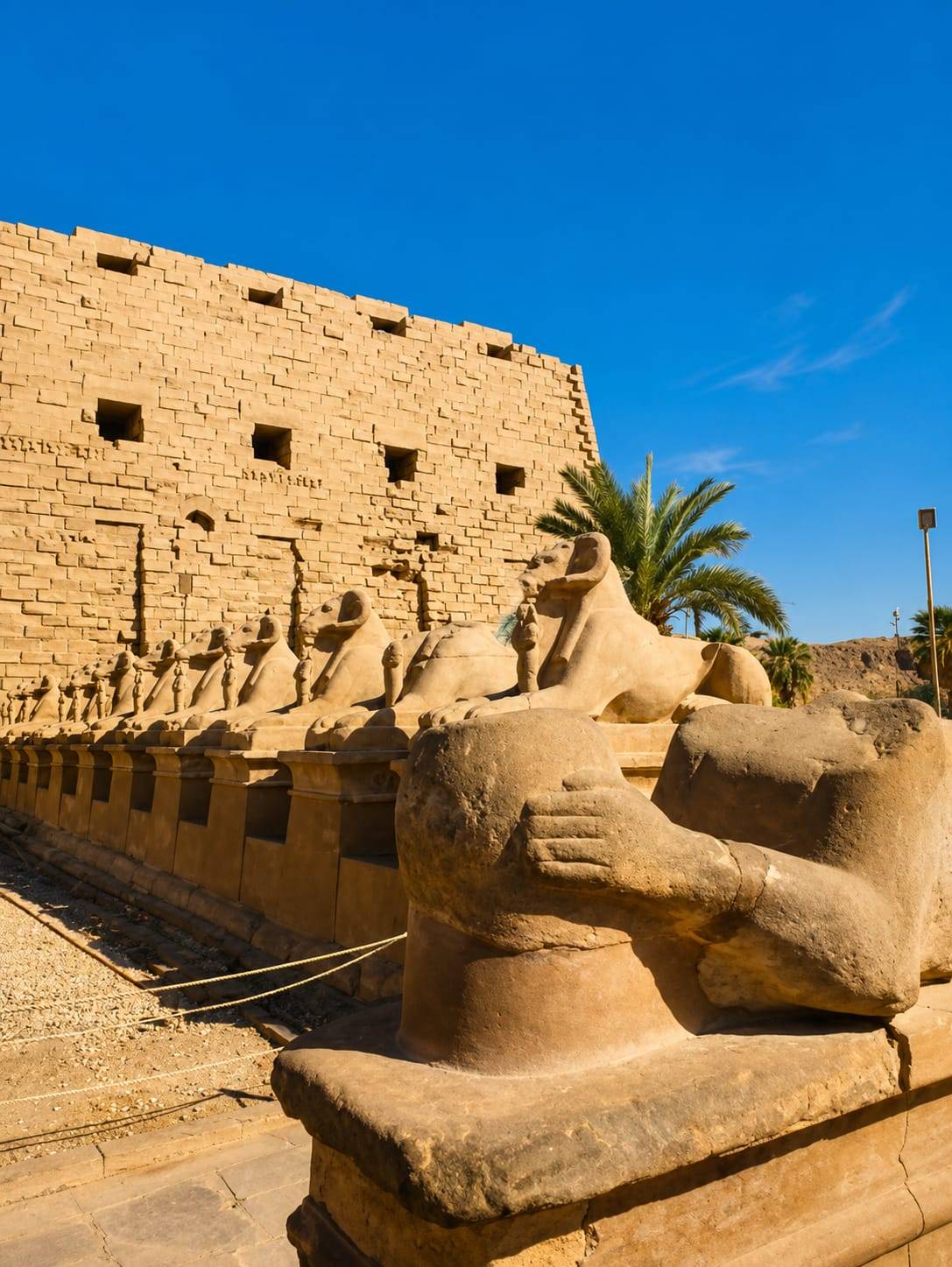
Also known as the Rams Road or the Road of the Sphinxes, this historic route is lined with hundreds of ancient statues featuring human heads and ram heads. These statues once watched over religious processions that connected two of the most important temples in ancient Thebes.
Today, visitors can explore this extraordinary archaeological site and walk along a route that played an important role in ancient Egyptian religious life.
In this complete guide, you will discover the history of the Avenue of Sphinxes, its statues, its connection with the Opet Festival, the restoration project, and practical tips for visiting.
1. Where Is the Avenue of Sphinxes Located?
The Avenue of Sphinxes is located in the center of Luxor, on the East Bank of the Nile River in southern Egypt.
It connects two major ancient Egyptian monuments:
-
Karnak Temple to the north.
-
Luxor Temple to the south.
The ancient route extends for approximately 2.7 kilometers and forms an important part of the archaeological landscape of ancient Thebes.
The avenue is easily accessible from central Luxor. Visitors can explore sections of the route and combine the experience with visits to Karnak Temple and Luxor Temple.
For more information about the city's attractions, accommodation, and sightseeing options, visit our Luxor Travel Guide.
2. What Is the Avenue of Sphinxes?
The Avenue of Sphinxes is an ancient ceremonial road that connected the religious complexes of Karnak and Luxor.
It was designed as a processional route for religious ceremonies, particularly the annual Opet Festival.
Along both sides of the avenue, ancient Egyptian rulers placed rows of stone statues. Some have human heads with lion bodies, while others feature ram heads associated with the god Amun.
The avenue is approximately 2,700 meters long. Official Egyptian sources report that 1,057 statues had been uncovered along the route by the time of its reopening in 2021.
Walking along the avenue today offers a unique opportunity to experience the connection between two of ancient Egypt's most important religious centers.
3. History of the Avenue of Sphinxes
The history of the Avenue of Sphinxes goes back more than 3,000 years.
Its development took place over several periods, with different pharaohs contributing to the construction and decoration of the route.
Queen Hatshepsut and the Early Processional Route
Queen Hatshepsut, one of ancient Egypt's most successful female pharaohs, was associated with early religious developments along the route connecting Karnak and Luxor.
During her reign in the 18th Dynasty, she established important religious structures and stations connected with the ceremonial journey of the sacred boats.
Her building activities helped strengthen the religious importance of the route.
You can learn more about her remarkable reign and architecture in our guide to Hatshepsut Temple in Luxor.
Amenhotep III and the Sphinx Statues
Pharaoh Amenhotep III made important contributions to the development of the avenue.
During the 18th Dynasty, sections of the processional route were decorated with sphinx statues.
These monuments helped create a monumental ceremonial passage between the religious areas of ancient Thebes.
Tutankhamun and Later Pharaohs
The route continued to develop during the reigns of later New Kingdom rulers, including Tutankhamun.
Different sections were modified, decorated, or reconstructed over time.
The avenue was not completed in a single building project. It evolved over several centuries as religious traditions and royal building programs changed.
Nectanebo I and the Major Construction Phase
One of the most important stages in the history of the Avenue of Sphinxes took place during the reign of Nectanebo I, who ruled during the 30th Dynasty.
He is strongly associated with the construction and decoration of the avenue with human-headed sphinx statues.
Many of the statues visible along the route today belong to different historical phases, reflecting the long development of the monument.
4. The Sphinx Statues: Human Heads and Ram Heads
One of the most fascinating features of the avenue is the variety of statues placed along its sides.
The statues are not all identical. They represent different religious symbols and artistic traditions.
Human-Headed Sphinxes
Many statues feature the body of a lion and a human head.
The lion represented strength and protection, while the human face reflected royal or divine associations.
These sphinxes created a symbolic protective passage for religious processions.
Ram-Headed Sphinxes
Other statues have the body of a lion and the head of a ram.
The ram was associated with Amun, one of the most important gods in ancient Egyptian religion.
These statues are particularly connected with the religious traditions of Karnak, where Amun was worshipped as the principal deity.
Why Were the Statues Placed Along the Road?
The sphinxes served symbolic and religious purposes.
They were believed to protect the sacred route and create an appropriate setting for the movement of divine images during important festivals.
Their repeated arrangement also gave the avenue a powerful monumental appearance.
5. The Opet Festival: Why Was the Avenue Important?
The Opet Festival was one of the most important religious celebrations in ancient Thebes.
It was closely connected with the relationship between Karnak Temple and Luxor Temple.
During the festival, sacred images of the Theban divine triad were carried in ceremonial boats.
The main deities included:
-
Amun.
-
Mut.
-
Khonsu.
The procession traveled between Karnak and Luxor, accompanied by priests and religious ceremonies.
The celebration symbolized the renewal of divine power and the relationship between the gods and the pharaoh.
Luxor Temple played an important role in these rituals, making the Avenue of Sphinxes a central part of the ancient religious landscape.
Today, visitors can walk along sections of the same historic route used during these ceremonies.
6. How Long Is the Avenue of Sphinxes?
The Avenue of Sphinxes is approximately 2.7 kilometers long.
It connects Karnak Temple in the north with Luxor Temple in the south.
The route is lined with statues on both sides, creating a long archaeological corridor through the modern city.
Walking the full distance can take approximately 35 to 50 minutes at a relaxed pace, depending on stops, access arrangements, and the visitor's walking speed.
If you plan to explore both temples in detail, allow additional time for the monuments themselves.
7. The Discovery and Excavation of the Avenue
For centuries, large sections of the ancient road were buried beneath accumulated sand, soil, and later urban development.
The modern archaeological discovery of the avenue took place gradually.
Early Discoveries in 1949
In 1949, Egyptian archaeologist Mohammed Zakaria Ghoneim discovered a group of sphinx statues near Luxor Temple.
This discovery helped confirm the existence of the ancient processional route.
Further Excavations
Additional archaeological work took place during the following decades.
Egyptian archaeologists uncovered more statues and sections of the road, gradually revealing its direction and historical importance.
Excavations continued through different phases, including work during the second half of the 20th century and the early 21st century.
Restoration and Reopening in 2021
A major restoration and development project was carried out to uncover and reconnect the historic route.
The Avenue of Sphinxes was officially reopened during a major ceremony on November 25, 2021.
The reopening brought international attention to Luxor and highlighted the importance of preserving Egypt's ancient heritage.
The project helped create a new visitor experience connecting two of the most important monuments in the city.
8. What Can You See Along the Avenue of Sphinxes?
Walking along the avenue allows visitors to discover several interesting archaeological features.
Rows of Ancient Sphinxes
The most obvious attraction is the long sequence of sphinx statues.
Look carefully at their heads and bodies to identify the differences between the human-headed and ram-headed figures.
Ancient Stone Pavement
The avenue includes sections of ancient sandstone pavement.
These surfaces provide evidence of the construction techniques used to create the ceremonial road.
Archaeological Remains
Along the route, visitors may notice archaeological remains and features associated with the ancient religious complex.
These discoveries help explain how the road was used and developed over time.
Views Toward Karnak and Luxor Temples
The avenue connects two major monuments, making it an excellent way to understand the geography of ancient Thebes.
The experience becomes even more meaningful when combined with visits to both temples.
9. Best Time to Visit the Avenue of Sphinxes
The best period to visit Luxor is generally between October and April, when temperatures are more comfortable for outdoor sightseeing.
During these months, visitors can enjoy walking along the avenue without facing the extreme summer heat.
Morning Visits
Morning is a good time for exploring the statues and taking photographs.
The temperatures are usually more comfortable, particularly during the winter season.
Afternoon Visits
Late afternoon can offer pleasant lighting for photography.
However, during warmer months, the heat may still be intense.
Evening Visits
Evening sightseeing can provide a different atmosphere, especially when the surrounding monuments are illuminated.
Check current visitor access and opening arrangements before planning an evening walk.
For more seasonal advice, read our Best Time to Visit Luxor, Egypt guide.
10. How to Walk the Avenue of Sphinxes
Walking along the Avenue of Sphinxes is one of the most interesting experiences in Luxor.
Visitors can explore the historic route between Karnak Temple and Luxor Temple, subject to current access arrangements.
A suggested route is:
Start at Karnak Temple
Explore the main temple complex before beginning your walk.
Continue along the Avenue of Sphinxes
Follow the historic route and observe the statues on both sides.
Stop for photographs
Take time to appreciate the different sphinx designs and the archaeological details.
Finish at Luxor Temple
Explore the temple and its impressive entrance, statues, and ancient columns.
This route allows visitors to experience the connection between the two religious complexes rather than viewing them as separate attractions.
11. Can You Visit Karnak Temple, the Avenue of Sphinxes, and Luxor Temple in One Day?
Yes. Visiting all three attractions in one day is an excellent way to explore the East Bank of Luxor.
Here is a suggested itinerary:
Morning: Karnak Temple
Start your day at Karnak Temple.
Explore the Great Hypostyle Hall, the obelisks, the sacred lake, and the major temple sections.
Allow approximately 2 to 3 hours.
Midday: Avenue of Sphinxes
Continue toward the Avenue of Sphinxes.
Explore the ancient statues and learn about the religious ceremonies that once took place along the route.
Allow approximately 45 minutes to 1 hour for a relaxed walk, depending on access and stops.
Afternoon: Luxor Temple
Finish your East Bank visit at Luxor Temple.
Discover the monumental entrance, the statues of Ramesses II, the obelisk, and the decorated columns.
Allow approximately 1 to 1.5 hours.
This itinerary is ideal for travelers who want to discover the main historical attractions of central Luxor in one day.
12. Photography Tips for the Avenue of Sphinxes
The Avenue of Sphinxes offers many opportunities for memorable photographs.
Here are some useful tips:
-
Photograph the sphinx statues from a low angle to highlight their size.
-
Capture the repeated rows of statues to show the length of the avenue.
-
Look for details on the faces and carved bodies.
-
Visit in the morning for softer natural light.
-
Use a wide-angle lens to capture the archaeological corridor.
-
Include the surrounding landscape to show the relationship between the ancient road and modern Luxor.
Always follow the current photography rules and respect any restricted areas.
13. What Should You Wear When Visiting?
The Avenue of Sphinxes is an outdoor archaeological site, so comfortable clothing is important.
We recommend:
-
Lightweight clothing.
-
Comfortable walking shoes.
-
A hat or cap.
-
Sunglasses.
-
Sunscreen.
-
Drinking water.
During summer, avoid spending long periods walking under direct sunlight during the hottest part of the day.
14. Is the Avenue of Sphinxes Worth Visiting?
Absolutely.
The Avenue of Sphinxes is one of the most distinctive archaeological attractions in Luxor.
It offers more than an opportunity to see ancient statues. It allows visitors to understand how Karnak Temple and Luxor Temple were connected through religious ceremonies and royal traditions.
The avenue is especially interesting for travelers who enjoy ancient Egyptian history, archaeology, architecture, and photography.
Walking along this historic route provides a different perspective on the ancient city of Thebes and its religious importance.
15. Explore the Avenue of Sphinxes with Let's Explore Egypt Travel
Discover the ancient wonders of Luxor with Let's Explore Egypt Travel.
We organize private sightseeing tours with professional Egyptologist guides and comfortable transportation.
Explore the major attractions of Luxor, including:
-
Karnak Temple.
-
Avenue of Sphinxes.
-
Luxor Temple.
-
Valley of the Kings.
-
Hatshepsut Temple.
-
Colossi of Memnon.
-
Medinet Habu Temple.
Our private tours can be arranged according to your schedule, interests, and preferred sightseeing pace.
Whether you have one day in Luxor or several days to explore the ancient city, we can help you plan a memorable experience.
Visit our Luxor Travel Guide to discover more attractions and travel ideas.
Contact Let's Explore Egypt Travel to plan your private Luxor tour.
Frequently Asked Questions About the Avenue of Sphinxes
1. Where is the Avenue of Sphinxes in Egypt?
The Avenue of Sphinxes is located in Luxor, southern Egypt. It connects Karnak Temple with Luxor Temple on the East Bank of the Nile.
2. How long is the Avenue of Sphinxes?
The ancient avenue is approximately 2.7 kilometers long.
3. How many statues are along the Avenue of Sphinxes?
Egyptian official sources reported 1,057 statues uncovered along the route by its reopening in 2021. These include human-headed sphinxes and ram-headed sphinxes.
4. Why is it called the Avenue of Sphinxes?
The route is named after the rows of sphinx statues that line both sides of the ancient road.
5. What is the Rams Road in Luxor?
Rams Road is another name for the Avenue of Sphinxes. It refers particularly to the ram-headed statues associated with the god Amun.
6. Who built the Avenue of Sphinxes?
The avenue developed over several centuries. Early sections are associated with New Kingdom rulers, while Nectanebo I of the 30th Dynasty played an important role in its construction and decoration.
7. What was the Avenue of Sphinxes used for?
It was used as a ceremonial processional route connecting Karnak Temple and Luxor Temple, particularly during the annual Opet Festival.
8. When was the Avenue of Sphinxes reopened?
The Avenue of Sphinxes was officially reopened on November 25, 2021, following a major restoration and development project.
9. Can visitors walk along the Avenue of Sphinxes?
Visitors can explore the accessible sections of the avenue. The available walking route and access arrangements should be checked before visiting.
10. How long does it take to walk the Avenue of Sphinxes?
Walking the full 2.7-kilometer route may take approximately 35 to 50 minutes without extended stops. Allow additional time for photographs and sightseeing.
11. Can I visit the Avenue of Sphinxes and Karnak Temple together?
Yes. They are directly connected, making it convenient to combine a visit to Karnak Temple with a walk along the avenue.
12. Is the Avenue of Sphinxes worth visiting?
Yes. It is an important archaeological attraction that offers a fascinating look at ancient Egyptian religious ceremonies and the historic connection between Karnak and Luxor temples.