


Solo Female Travel in Abu Simbel
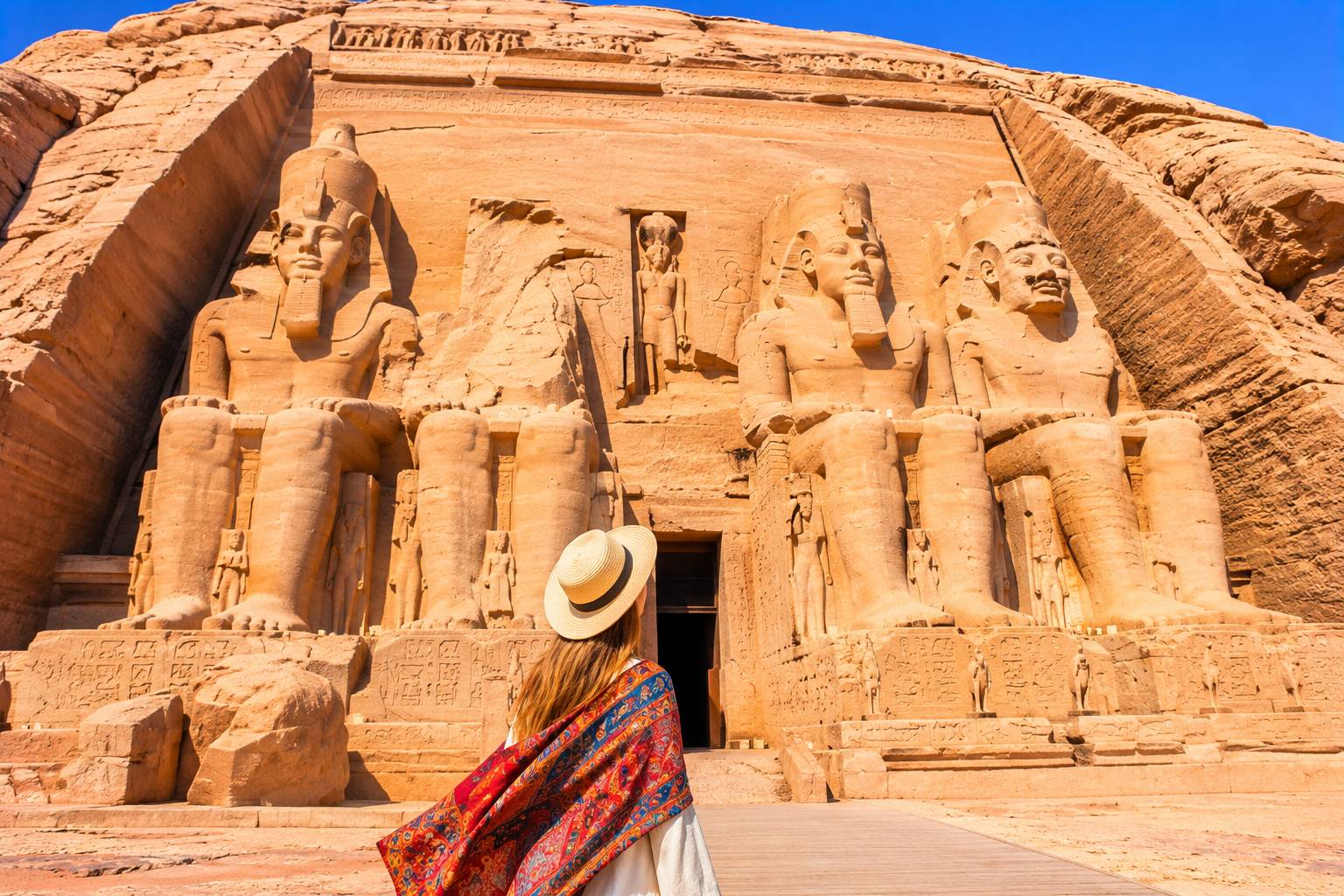
Solo Female Travel in Abu Simbel: Safety, Tips & Things to Do (2027)
Introduction: Discover Abu Simbel, Egypt
Abu Simbel is one of the most extraordinary archaeological destinations in Egypt. Located in Nubia, south of Aswan near the Sudanese border, it is famous for its enormous rock-cut temples built during the reign of Pharaoh Ramesses II.
The destination is particularly impressive because it combines ancient Egyptian architecture, Nubian heritage and the dramatic landscape of Lake Nasser.
For travellers interested in ancient history, Abu Simbel is an unforgettable experience. Its monumental statues, decorated interiors and remarkable construction make it one of the most recognisable archaeological sites in the world.
However, travelling to Abu Simbel requires more preparation than visiting many other Egyptian tourist destinations. Its remote location and proximity to the Sudanese border mean that visitors must check current travel advice and arrange an appropriate organised journey.
If you are planning a wider trip around Egypt, begin with our complete guide to Solo Female Travel in Egypt.
Is Abu Simbel Suitable for Solo Female Travelers?
Abu Simbel is a major archaeological attraction, but it is not a typical independent-travel destination.
The temples are approximately 290 kilometres south of Aswan, and the journey passes through a remote part of southern Egypt.
For solo female travellers, the most important consideration is not simply how to explore the temples. It is how to arrange the journey responsibly.
Important Travel and Security Advice
Travel advisories differ according to nationality.
The Australian Government's Smartraveller advice specifically warns that road travel to Abu Simbel can be dangerous because of its proximity to the Sudanese border. It advises travellers who visit to use an organised tour with police escorts.
The UK Foreign, Commonwealth & Development Office lists Abu Simbel among the exceptions to its broader warning covering much of the Western Desert. However, that does not mean every journey or transport arrangement is automatically safe.
Before booking:
-
Check your own government's latest Egypt travel advice.
-
Ask the tour operator how the journey is authorised and organised.
-
Confirm whether any security escort or other official arrangement is required for your trip.
-
Do not attempt an unplanned independent road journey.
-
Avoid travelling at night.
-
Share your itinerary and transport details with someone you trust.
-
Confirm your travel insurance covers the destination and planned activities.
Do not assume that an ordinary private transfer is equivalent to an approved organised excursion. Get clear confirmation of the arrangements before paying.
Useful official resources:
Best Things to Do in Abu Simbel Alone
1. Visit the Great Temple of Ramesses II
The Great Temple of Abu Simbel is the area's most famous attraction.
It was commissioned by Pharaoh Ramesses II during the 19th Dynasty and carved directly into the sandstone mountain around 1264 BC.
The temple's façade is dominated by four enormous seated statues of Ramesses II. Each statue represents the power and authority of the pharaoh.
One of the statues was damaged by an ancient earthquake, and its fallen fragments can still be seen near the entrance.
Inside, visitors can explore a series of halls decorated with historical scenes and monumental statues.
The sanctuary at the rear contains figures representing:
-
Amun-Ra.
-
Ra-Horakhty.
-
Ptah.
-
The deified Ramesses II.
The scale and engineering of the temple make it one of Egypt's most impressive ancient monuments.
Solo travel tip: Allow enough time to explore the interior rather than rushing through the main hall. Follow site rules and check photography restrictions before taking pictures.
Official information: Great Temple of Abu Simbel – Egyptian Ministry of Tourism and Antiquities.
2. Explore the Temple of Queen Nefertari
To the north of the Great Temple stands the smaller temple dedicated to Queen Nefertari and the goddess Hathor.
It is particularly important because Queen Nefertari is represented in statues on the façade at almost the same scale as Ramesses II.
This is an unusual feature in ancient Egyptian monumental architecture.
The temple's interior contains beautifully decorated halls, pillars and scenes associated with the queen and the goddess Hathor.
For travellers interested in ancient Egyptian queens and royal history, this temple is one of the highlights of Abu Simbel.
Solo travel tip: Visit both temples during the same excursion and allow time to appreciate their different architectural styles.
3. Discover the Famous Sun Alignment
One of the most remarkable features of the Great Temple is its solar alignment.
Twice a year, traditionally on 22 February and 22 October, sunlight travels through the temple's main axis and illuminates statues in the inner sanctuary.
The event attracts visitors interested in ancient Egyptian astronomy, architecture and religious symbolism.
The engineering behind this alignment demonstrates the extraordinary knowledge and planning of the temple's builders.
Planning tip: These dates are especially popular, so accommodation, transport and organised excursions should be arranged well in advance. Confirm the current event schedule rather than assuming that the experience will operate exactly as expected.
The Egyptian Ministry of Tourism and Antiquities explains the phenomenon in its official Abu Simbel monument guide.
4. Admire the Monumental Statues
The four seated statues of Ramesses II are among the most recognisable images of ancient Egypt.
Standing at the entrance to the Great Temple, they dominate the surrounding landscape.
Spend time observing the details of their faces, crowns, clothing and the smaller figures represented around the royal statues.
The scale becomes particularly impressive when compared with the visitors standing nearby.
This is also one of the best places to take photographs of the archaeological complex.
5. Discover the UNESCO Rescue Project
Abu Simbel's modern history is almost as extraordinary as its ancient construction.
When Egypt began building the Aswan High Dam, rising water levels threatened to submerge the temples.
An international campaign led by UNESCO helped save the monuments.
The temples were carefully cut into large sections, dismantled and relocated to higher ground. The relocation was completed in 1968.
The achievement became one of the most famous international heritage-preservation projects of the 20th century.
It is also a fascinating example of how international cooperation can protect archaeological treasures.
Read more: UNESCO World Heritage Centre – Nubian Monuments from Abu Simbel to Philae.
6. Enjoy Views of Lake Nasser
The temples overlook Lake Nasser, one of the world's largest artificial lakes.
Created following the construction of the Aswan High Dam, the lake transformed the surrounding Nubian landscape.
Its deep blue water contrasts beautifully with the sandy desert and sandstone cliffs.
The lakeside scenery is an important part of the Abu Simbel experience, particularly for visitors arriving early in the morning.
Stay within permitted visitor areas and follow local instructions near the water.
7. Discover Nubian Heritage
Abu Simbel is located in the historic Nubian region of southern Egypt.
Nubian heritage is an important part of the area's identity, with distinctive traditions, languages, architecture, music and food.
Visitors can learn more through reputable local cultural experiences, subject to availability and access arrangements.
Choose experiences that are organised respectfully and involve local communities directly.
Solo travel tip: Confirm the exact programme and transport arrangements before booking a cultural visit.
8. Photograph the Temples at Sunrise
Early morning can be a wonderful time to photograph Abu Simbel.
The changing light creates beautiful contrasts between the sandstone façade and the desert landscape.
The monumental statues are particularly striking when illuminated by the morning sun.
Photography rules can vary inside and around archaeological monuments, so check the current site regulations before taking photographs.
9. Explore the Surrounding Desert Landscape
The area around Abu Simbel is characterised by desert scenery, sandstone formations and the vast waters of Lake Nasser.
The landscape offers a different experience from the Nile Valley around Luxor and Aswan.
Photography and sightseeing can be enjoyable from approved public areas, but visitors should not wander into remote desert locations independently.
For any additional desert excursion, use an approved operator and confirm access arrangements.
10. Learn More About Ancient Egyptian Engineering
Abu Simbel is a destination where architecture, astronomy, art and political history come together.
The positioning of the temples, the scale of the statues and the solar alignment all demonstrate the sophistication of