


Dimai Fayoum: Explore Ancient Soknopaiou Nesos, Egypt's Crocodile City
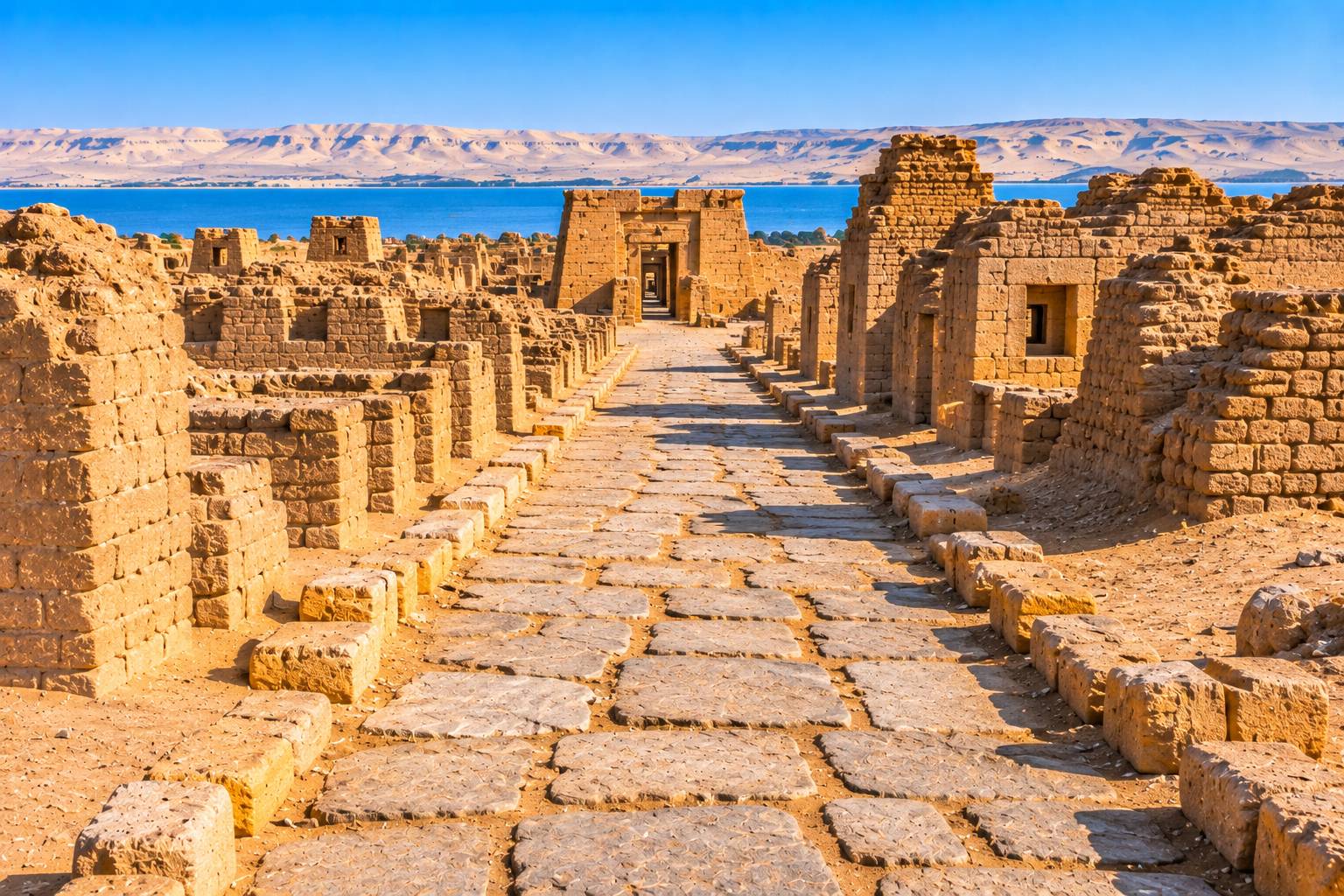
Dimai (Soknopaiou Nesos): The Ultimate Visitor Guide to Fayoum's Ancient Crocodile City
Introduction: Discover Dimai, the Ancient City of the Crocodile God
In the northern desert of Fayoum, overlooking the landscape near Lake Qarun, lies one of Egypt's most fascinating archaeological sites: Dimai, the ancient city of Soknopaiou Nesos.
Known for its impressive mudbrick walls, ancient temples, long paved processional road and remarkable archaeological discoveries, Dimai offers a glimpse into life in Egypt during the Ptolemaic and Roman periods.
The ancient Greek name Soknopaiou Nesos is commonly translated as the Island of Soknopaios, referring to the local form of the crocodile god Sobek worshipped in the region.
The city developed around a major religious sanctuary dedicated to Soknopaios and associated deities. Priests, temple workers, administrators and other residents lived in this settlement, which became an important religious and economic center in northern Fayoum.
Today, visitors can explore the remains of its temples, houses, streets and defensive-looking enclosure walls while discovering a lesser-known chapter of Egypt's ancient history.
For travelers interested in archaeology and destinations beyond the traditional tourist route, Dimai is one of Fayoum's most rewarding historical attractions.
1. Where Is Dimai Located?
Dimai is located in the northern part of Fayoum Governorate, in the desert north of Lake Qarun.
The archaeological site is also known as Dimeh El-Seba or Dimeh es-Seba and lies within the wider landscape of the North Lake Qarun Protected Area.
The settlement occupies a raised desert mound overlooking the surrounding terrain. Its remote location helped preserve many of its ancient mudbrick structures.
Dimai is particularly interesting because it was once connected with the lake's changing shoreline and regional trade routes.
The surrounding area combines archaeological remains, desert scenery and geological features, making it an unusual destination for visitors exploring northern Fayoum.
You can combine Dimai with other attractions in the region, depending on access, road conditions and available time.
2. What Was Soknopaiou Nesos?
Soknopaiou Nesos was an ancient settlement that developed during the Ptolemaic period.
Its name refers to Soknopaios, a local form of the Egyptian crocodile god Sobek.
The city became an important religious center, with a large temple complex dedicated to Soknopaios and associated deities.
It was not simply a temple surrounded by empty desert. Archaeological investigations have revealed a substantial settlement containing houses, public buildings, religious structures and evidence of administrative activity.
The population included priests and people connected with the temple's religious and economic activities.
The site flourished particularly during the Ptolemaic and Roman periods, when it served as an important center within the northern Fayoum region.
Its archaeological remains provide valuable information about the interaction between Egyptian religious traditions and Greek and Roman cultural influences.
3. Why Was Dimai Called the Island of the Crocodile God?
The ancient name Soknopaiou Nesos is generally translated as the Island of Soknopaios.
Soknopaios was a local manifestation of Sobek, the ancient Egyptian crocodile god.
Sobek was associated with water, fertility, protection and the power of the Nile. His worship was especially important in Fayoum, where lakes, waterways and agricultural communities shaped the region's history.
At Dimai, Soknopaios was represented in a distinctive form: a crocodile with the head of a falcon, crowned with the double crown of kingship.
This unusual divine image combined the symbolism of Sobek with royal and solar associations.
The ancient name reflects the religious identity of the settlement and its close relationship with the local crocodile cult.
Although the landscape has changed significantly since antiquity, the name continues to preserve the memory of the god who once dominated the city's religious life.
4. The Great Temple of Soknopaios
The main attraction at Dimai is the temple complex dedicated to Soknopaios.
The sacred area was surrounded by an imposing enclosure wall made primarily of mudbrick. Inside were temples, chapels, priests' houses and other buildings connected with religious activities.
Archaeological research has identified several phases of construction within the sanctuary.
The complex includes a Ptolemaic temple built with local stone, later Roman-period architectural additions and a structure known as the contra-temple.
These buildings reveal how the sanctuary developed over time.
The temple was not only a place of worship. It was also the center of a wider institution that played an important role in the economic and social life of the settlement.
Papyri discovered at Dimai provide evidence of religious activities, temple administration and the people who served the sanctuary.
5. The Temple of Sobek: Understanding Soknopaios
Soknopaios was the principal deity associated with Dimai.
His worship reflects the importance of crocodile symbolism in ancient Egyptian religion.
Sobek was a powerful god associated with water, fertility, strength and protection. His connection with the Nile and aquatic environments made him particularly significant in regions such as Fayoum.
At Dimai, Soknopaios developed a distinctive local identity.
The deity was represented as a crocodile with a falcon's head, wearing the double crown. This combination connected him with royal power and solar symbolism.
The temple was also associated with the goddess Isis Nepherses, demonstrating that the sanctuary's religious activities involved more than one divine figure.
Visitors interested in the wider history of Sobek worship can also explore other archaeological sites throughout Fayoum.
6. The Famous 400-Metre Processional Road
One of the most impressive features of Dimai is its long paved processional road, known as the dromos.
The road extended for approximately 400 metres through the settlement, connecting different parts of the city with the sacred temple area.
It divided the town into two main sections and served as an important route for religious processions.
The dromos was more than a street used for everyday movement. It had a ceremonial and social function.
Religious festivals and processions took place throughout the year, bringing priests and members of the community together.
The road also helps visitors understand the original organization of the city.
Walking along its remains provides an opportunity to imagine how people moved between residential areas, public buildings and the temple.
7. The Ancient Houses of Dimai
Dimai contains extensive remains of ancient residential buildings.
Many of these houses were constructed from mudbrick and arranged in blocks along streets connected to the main processional road.
Some buildings had multiple floors, with domestic spaces, storage areas and other rooms serving different purposes.
Archaeological investigations have revealed evidence of everyday activities, including food preparation, storage, household organization and trade.
Objects discovered at the site include pottery, lamps, coins, furniture fragments and agricultural equipment.
These discoveries are important because they help researchers understand how ordinary people lived in a settlement dominated by a major religious institution.
The remains of the houses also demonstrate the architectural techniques used in the Ptolemaic and Roman periods.
8. The Ancient Papyri of Soknopaiou Nesos
One of the most important contributions of Dimai to Egyptology is its remarkable collection of ancient papyri.
Documents discovered at the site were written mainly in Greek and Demotic Egyptian.
They provide valuable information about religious life, administration, legal matters, taxation, trade and everyday activities.
The papyri help researchers reconstruct the lives of people who lived in the settlement more than two thousand years ago.
They also demonstrate that Dimai was connected with wider economic and administrative networks.
Some documents relate to temple activities and the responsibilities of priests, while others provide evidence about transactions and local administration.
For historians, these written records are among the most valuable discoveries associated with the ancient city.
9. Dimai and Ancient Desert Trade Routes
Dimai's location in northern Fayoum gave it an interesting position between the agricultural region around Lake Qarun and the desert routes leading toward Egypt's Western Desert.
The settlement was connected with regional movement and trade.
Archaeological and documentary evidence suggests that it played a role in the movement of goods and people through the area.
Documents discovered at the site include customs-related records, demonstrating its connection with commercial activities.
The location also makes sense when considering the ancient landscape.
The lake, desert routes and settlements formed a network through which people could travel and exchange goods.
Dimai therefore offers an opportunity to explore the relationship between religion, commerce and settlement development in ancient Fayoum.
10. The Lion Statues of Dimai
Dimai is also known for the discovery of large limestone lion statues associated with the entrance of the Ptolemaic temple.
The statues attracted considerable attention when they were discovered by the Italian archaeological mission in 2012.
Lions were important protective symbols in ancient Egyptian and Greco-Roman religious architecture.
They were frequently associated with temple entrances and sacred spaces.
Their presence at Dimai demonstrates the architectural ambition of the sanctuary and its connection with wider temple-building traditions.
The discovery also helped researchers better understand the appearance of the temple entrance.
The lion statues contributed to the later name Dimeh El-Seba, often translated as Dimeh of the Lions or City of the Lions.
11. Why Was Dimai Abandoned?
Dimai flourished during the Ptolemaic and Roman periods, but its importance gradually declined.
The available archaeological and documentary evidence indicates that permanent settlement largely came to an end around the middle of the third century AD.
The precise reasons for its abandonment are not fully established.
Changes in economic conditions, settlement patterns, water management and the wider regional environment may all have played a role.
The site was not necessarily completely forgotten after the main settlement declined. Archaeological evidence indicates that people continued to visit the area and that some activity took place within the temple precinct during later periods.
Over time, desert sand covered parts of the settlement and helped preserve many of its remains.
Today, this preservation allows archaeologists to study buildings and objects that provide an unusually detailed picture of ancient life.
12. What Can You See at Dimai Today?
Dimai is one of Fayoum's most interesting archaeological landscapes.
Unlike some sites where only a few stone foundations remain, the settlement preserves substantial architectural remains.
Depending on the current condition of the site and visitor access, you may be able to explore:
-
The remains of the large temple enclosure.
-
Sections of the ancient Soknopaios temple complex.
-
The paved processional road.
-
Mudbrick residential buildings.
-
Remains of priests' houses and other religious structures.
-
The wider archaeological mound.
-
Desert views across northern Fayoum.
The scale of the settlement is particularly impressive when viewed from elevated areas.
Visitors can better understand the original layout of the ancient city by following the main route through the archaeological remains.
The site is an open archaeological landscape, so comfortable footwear, water and sun protection are important.
13. The North Lake Qarun Protected Area
Dimai is located within the wider northern Lake Qarun landscape, an area known for its natural and cultural heritage.
The protected area combines desert scenery, archaeological remains and important geological features.
Visitors exploring the region can experience a different side of Fayoum, away from its agricultural villages and busy lakeside locations.
The surrounding landscape is particularly attractive for photography, especially during the cooler months when the desert light creates strong contrasts across the ruins.
Dimai is also an interesting destination for travelers who enjoy combining cultural exploration with nature.
14. Best Time to Visit Dimai
The best time to visit Dimai is generally during the cooler months, from October to April.
These months are usually more comfortable for walking around the archaeological site and exploring the surrounding desert.
Summer temperatures can become extremely high, especially in exposed areas with little shade.
For a more comfortable visit:
-
Start your journey early in the morning.
-
Wear comfortable walking shoes.
-
Bring sufficient drinking water.
-
Use sunscreen and wear a hat.
-
Carry a camera for landscape and architectural photography.
-
Follow archaeological site regulations.
-
Avoid walking on fragile walls or entering restricted structures.
The remote location makes good preparation especially important.
15. How to Get to Dimai from Cairo
Dimai is located in northern Fayoum, southwest of Cairo.
Visitors generally travel by road through the Fayoum region before continuing toward the northern Lake Qarun desert area.
A private vehicle is a practical option because the archaeological site is remote and public transportation does not provide convenient direct access.
The route and final approach should be checked before departure, particularly after bad weather or changes in road conditions.
A private Fayoum excursion can include:
-
Pickup from your hotel in Cairo or Giza.
-
Private air-conditioned transportation.
-
A planned visit to Dimai, subject to current site arrangements.
-
Additional stops around Lake Qarun and other accessible attractions.
-
Return transportation to your hotel.
Travel time depends on traffic, the route and the number of sightseeing stops.
For a remote archaeological site such as Dimai, traveling with an experienced local driver is recommended.
16. Attractions to Combine with Dimai
Fayoum offers a fascinating combination of ancient temples, pyramids, archaeological settlements, traditional villages and natural attractions.
You can combine Dimai with other destinations to create a more complete Fayoum itinerary.
Qasr El-Sagha Temple
Discover the unusual stone architecture of this mysterious ancient temple in northern Fayoum.
Read our guide: Qasr El-Sagha Temple Fayoum: Explore Egypt's Ancient Desert Temple.
Lake Qarun
Explore one of Egypt's most famous natural lakes and discover its importance to Fayoum's history.
Read more: Lake Qarun Fayoum: The Ultimate Visitor Guide.
Qasr Qarun Temple
Discover another important ancient temple in Fayoum, known for its distinctive architecture and historical background.
Explore: Qasr Qarun Temple: The Ultimate Visitor Guide.
Karanis (Kom Oshim)
Explore the remains of another ancient Greco-Roman settlement and discover how people lived in the Fayoum region.
Read our guide: Karanis Fayoum: Explore the Ancient City of Kom Oshim.
Medinet Madi
Visit an ancient temple complex with a history extending from the Middle Kingdom into later periods.
Read more: Medinet Madi Fayoum: Explore the Ancient Temple of Egypt.
Hawara Pyramid
Discover the pyramid of Amenemhat III and the history of the legendary Labyrinth.
Explore: Hawara Pyramid: The Ultimate Visitor Guide.
Lahun Pyramid
Explore the pyramid of Senusret II and the nearby ancient settlement of Kahun.
Read more: Lahun Pyramid: The Ultimate Visitor Guide.
Tunis Village
Discover traditional pottery workshops, local crafts and the countryside atmosphere of Fayoum.
Explore: Tunis Village Fayoum: The Ultimate Visitor Guide.
Magic Lake
Enjoy desert scenery and one of Fayoum's best-known natural attractions.
Read more: Magic Lake Fayoum: The Ultimate Visitor Guide.
Wadi El Rayan Waterfalls
Discover the waterfalls, lakes and desert scenery of the Wadi El Rayan area.
Explore: Wadi El Rayan Waterfalls: The Ultimate Travel Guide.
Wadi El Hitan – Valley of the Whales
Visit the UNESCO World Heritage Site famous for its extraordinary ancient whale fossils.
Read more: Wadi El Hitan: The Ultimate Visitor Guide to Egypt's Prehistoric Wonder.
Mudawara Mountain
Enjoy panoramic views and the dramatic desert scenery of Fayoum.
Explore: Mudawara Mountain Fayoum: The Ultimate Visitor Guide.
17. Is Dimai Worth Visiting?
Yes. Dimai is especially rewarding for travelers interested in ancient Egyptian religion, Greco-Roman history and archaeological sites away from the crowded tourist routes.
Its large temple enclosure, long processional road, mudbrick houses and papyrus discoveries make it one of the most informative archaeological sites in Fayoum.
The settlement also offers an opportunity to understand how Egyptian religious traditions continued and developed during the Ptolemaic and Roman periods.
Dimai is not a reconstructed tourist attraction with extensive facilities. It is an archaeological landscape where visitors can explore the remains of a real ancient town.
For travelers who appreciate history and archaeology, the experience is both educational and memorable.
18. Travel Tips Before Visiting Dimai
Before planning your visit, keep these recommendations in mind:
-
Confirm site access: Check current opening arrangements and any permission requirements before departure.
-
Check road conditions: The final approach is through a remote desert area.
-
Choose suitable transportation: A private vehicle and experienced driver are recommended.
-
Bring enough water: The archaeological site has limited shade.
-
Wear comfortable shoes: You will need to walk over uneven desert ground.
-
Respect archaeological remains: Do not climb on walls or remove objects.
-
Allow enough time: Exploring the settlement properly requires more than a brief photo stop.
-
Consider a knowledgeable guide: A professional guide can explain the temple, the crocodile cult and the history of the ancient settlement.
19. Explore Dimai with Let's Explore Egypt Travel
Discover the hidden archaeological treasures and natural beauty of Fayoum with Let's Explore Egypt Travel.
Our private excursions can be arranged around your interests, whether you want to explore ancient temples, discover Greco-Roman settlements, visit traditional villages or enjoy the desert landscapes around Lake Qarun.
A private Fayoum itinerary can be tailored to include Dimai and other selected attractions, subject to site access, road conditions and available time.
Enjoy private transportation and the flexibility to discover Egypt beyond the traditional tourist route.
Ready to explore Fayoum's ancient crocodile city?
Discover our private Egypt tours and travel experiences:
https://letsexploreegypttravel.com/en/egypttourpackages
Contact Let's Explore Egypt Travel to plan your private Fayoum adventure.
Frequently Asked Questions About Dimai (Soknopaiou Nesos)
1. Where is Dimai located?
Dimai is located in the northern Fayoum desert, north of Lake Qarun in Egypt.
2. What was the ancient name of Dimai?
Its ancient Greek name was Soknopaiou Nesos, commonly translated as the Island of Soknopaios.
3. What does Soknopaiou Nesos mean?
The name refers to Soknopaios, a local form of the crocodile god Sobek. The Greek word Nesos means island.
4. Who was Soknopaios?
Soknopaios was a local manifestation of Sobek, represented at Dimai as a crocodile with a falcon's head and associated with royal and solar symbolism.
5. When was Dimai founded?
The settlement was founded during the Ptolemaic period, around the middle of the third century BCE.
6. What is Dimai famous for?
Dimai is famous for its temple of Soknopaios, its long paved processional road, mudbrick houses, archaeological remains and important papyrus discoveries.
7. How long is the ancient processional road?
The dromos extended for approximately 400 metres through the settlement.
8. Why was Dimai abandoned?
Permanent settlement appears to have ended around the middle of the third century CE. The exact reasons are not fully established, although economic, environmental and settlement changes may have contributed.
9. Can I visit Dimai from Cairo?
Yes. Dimai can be included in a private excursion from Cairo to Fayoum. Because it is remote, transportation and site access should be arranged in advance.
10. What other places can I visit near Dimai?
You can explore Qasr El-Sagha Temple, Lake Qarun, Qasr Qarun, Karanis, Medinet Madi, Hawara Pyramid and other attractions in Fayoum, depending on your itinerary.
11. Is Dimai suitable for photography?
Yes. The archaeological ruins, mudbrick walls, temple remains and desert landscape provide excellent opportunities for photography. Visitors should respect site restrictions and avoid climbing on fragile structures.
12. What is the best time to visit Dimai?
The cooler months, generally from October to April, are usually the most comfortable for exploring the archaeological site.
Final Thoughts
Dimai, the ancient city of Soknopaiou Nesos, is one of the most fascinating archaeological destinations in Fayoum.
Its temple dedicated to the crocodile god Soknopaios, long processional road, mudbrick houses and extraordinary papyrus discoveries reveal the religious, social and economic life of a settlement that flourished during the Ptolemaic and Roman periods.
Today, its ruins offer visitors an opportunity to walk through a remarkable ancient landscape and discover a lesser-known chapter of Egypt's history.
For travelers interested in archaeology and authentic cultural experiences, Dimai deserves a place on a Fayoum itinerary.
Discover the ancient treasures of Fayoum with Let's Explore Egypt Travel.
Dimai (Soknopaiou Nesos) – Highlights
-
Discover the ancient city of Soknopaiou Nesos in northern Fayoum.
-
Explore the remains of a major temple dedicated to Soknopaios, a local form of the crocodile god Sobek.
-
Walk along the ancient 400-metre processional road.
-
Discover impressive mudbrick temple walls and ancient residential buildings.
-
Learn about the religious traditions of Ptolemaic and Roman Egypt.
-
Explore the history of ancient priests, temple workers and local communities.
-
Discover the famous papyri documenting everyday life and temple administration.
-
See the archaeological remains of one of Fayoum's most fascinating ancient settlements.
-
Enjoy the remote desert landscape north of Lake Qarun.
-
Combine your visit with Qasr El-Sagha, Lake Qarun and other Fayoum attractions.