


Gebel Qatrani Fayoum: Ancient Fossils and Desert Landscapes
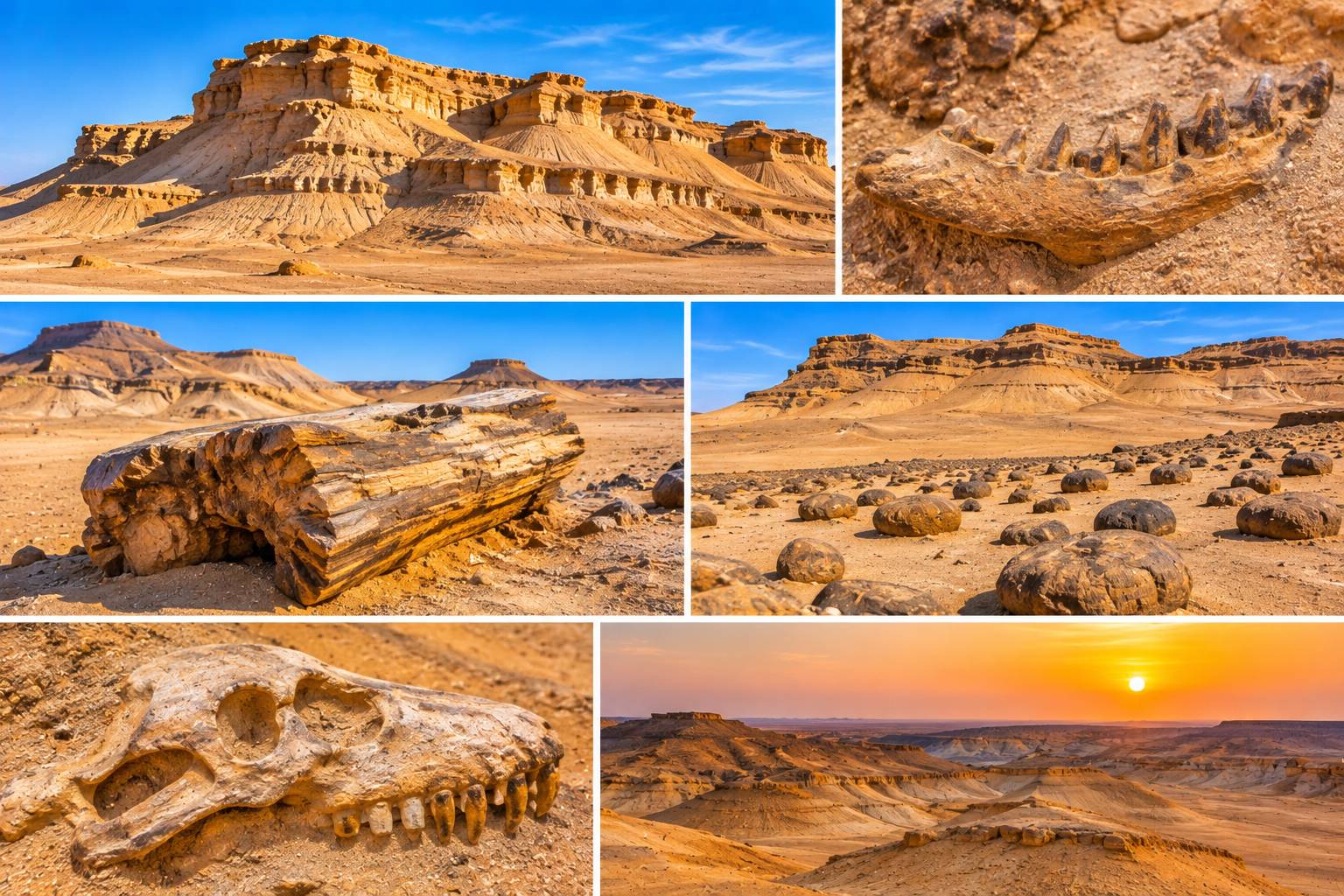
Gebel Qatrani Fayoum: The Ultimate Guide to Egypt’s Ancient Fossil Landscapes
Far from the busy streets of Cairo and the familiar monuments of ancient Egypt, northern Fayoum offers a different kind of journey. Here, desert mountains, layered rock formations and fossil-rich landscapes preserve evidence of environments that existed millions of years ago.
One of the most fascinating places in this region is Gebel Qatrani, an area of exceptional geological and paleontological importance within the wider landscape of the Qarun Protected Area.
The landscape may appear dry and silent today, but its rocks tell a remarkable story. Fossils discovered in the region provide evidence of ancient mammals, reptiles, fish and other animals that lived when the climate and natural environment were very different from those of modern Egypt.
Gebel Qatrani is particularly important to researchers studying the evolution of African mammals and early primates. Its geological formations preserve clues about ancient rivers, wetlands, forests and changing environments.
For visitors interested in nature, geology, prehistoric life and unusual destinations, Gebel Qatrani offers an opportunity to explore a lesser-known side of Fayoum.
In this guide, you will discover where Gebel Qatrani is located, why its fossils are important, what makes its landscape special, and how to plan a responsible visit.
1. Where Is Gebel Qatrani Located?
Gebel Qatrani is situated in the northern part of the Fayoum Depression, north of Lake Qarun in Egypt's Western Desert.
The area forms part of a wider natural and geological landscape associated with Qarun Protected Area. It is known for its sedimentary formations, fossil deposits, desert scenery and archaeological heritage.
Its location makes it particularly interesting for visitors exploring the northern shores of Lake Qarun and the surrounding desert.
The wider region includes several important natural and historical destinations, such as:
-
Lake Qarun
-
Qasr El-Sagha Temple
-
Dimai, the ancient settlement of Soknopaiou Nesos
-
Widan El-Faras ancient basalt quarries
-
Umm es-Sawan gypsum quarries
-
The wider fossil landscapes of northern Fayoum
Gebel Qatrani is not simply a mountain viewpoint or a conventional sightseeing stop. It is part of a much larger scientific landscape where geology, paleontology and human history meet.
Visitors should arrange the journey with someone familiar with the area, as some locations are remote and access conditions can vary.
2. Why Is Gebel Qatrani Famous?
Gebel Qatrani is internationally known for its fossil deposits, especially those belonging to ancient terrestrial mammals and other vertebrates.
The geological formations preserve evidence of life from periods when the Fayoum region had very different environments from the desert seen today.
Researchers have studied the area to understand how African wildlife developed, how ancient landscapes changed and how animals adapted to different environments.
The fossil record includes remains associated with:
-
Early primates
-
Ancient elephants and their relatives
-
Prehistoric mammals
-
Reptiles
-
Fish
-
Other vertebrate animals
-
Ancient plants and petrified wood
The discoveries are important because they help scientists reconstruct the history of life in northeastern Africa.
The Gebel Qatrani Formation has also attracted scientific attention for its fossilized traces of ancient organisms, including structures associated with insects and plants.
This makes the area valuable not only for the bones of prehistoric animals but also for evidence of the environments in which they lived.
3. The Ancient World of Gebel Qatrani: Millions of Years Ago
Imagine northern Fayoum before it became the dry desert landscape we see today.
The region experienced major environmental changes over geological time. Rivers, wetlands, coastal environments and different types of vegetation existed in the wider area.
The rocks of Gebel Qatrani preserve evidence of some of these ancient environments.
Scientists study the different layers of sediment to understand how water systems, vegetation and animal communities changed over time.
The geological record includes deposits associated with the Oligocene Epoch, a period that began approximately 33.9 million years ago and ended around 23 million years ago.
Research on the Jebel Qatrani Formation has identified evidence of ancient river environments and vegetation, including traces of roots, plants and animal activity.
These discoveries help explain why the region is so important to paleontologists.
Rather than representing one single prehistoric moment, Gebel Qatrani preserves evidence from a complex geological history.
4. The Famous Fossils of Gebel Qatrani
One of the main reasons scientists continue to study northern Fayoum is the diversity of its fossil record.
Several important groups of prehistoric animals have been identified in the wider region.
Early Primates
Gebel Qatrani is especially important for the study of early African primates.
Among the best-known discoveries associated with the area is Aegyptopithecus zeuxis, an extinct primate that lived during the Oligocene.
Its fossils have helped researchers investigate the evolutionary history of early anthropoid primates and understand the diversity of ancient primate communities in Africa.
The region has also produced fossils belonging to other early primate groups.
These discoveries make Fayoum an important location for researchers studying primate evolution.
Ancient Elephant Relatives
Fossils from the wider Fayoum region include ancient mammals related to the evolutionary history of elephants.
One well-known example is Moeritherium, an extinct mammal that lived during the Eocene.
It was very different in appearance from modern elephants, but its remains help scientists understand the early evolutionary history of proboscideans, the group that includes elephants and their extinct relatives.
Other fossil mammals discovered in the wider northern Fayoum region include members of ancient groups that no longer exist today.
Ancient Reptiles and Fish
The fossil deposits of the wider region also include remains of reptiles and fish.
These discoveries are valuable because they provide evidence of the different habitats that existed across the ancient Fayoum landscape.
They help scientists understand how freshwater, coastal and terrestrial environments interacted over geological time.
Fossilized Plants and Ancient Forest Evidence
The region is also important for its plant-related fossil evidence.
Research on the Gebel Qatrani Formation has identified fossil root structures and other traces that help reconstruct ancient vegetation.
Some areas of northern Fayoum also contain petrified wood and other geological features connected with the region's ancient environments.
Together, these discoveries provide a broader picture of prehistoric ecosystems.
5. Aegyptopithecus: One of Fayoum’s Most Important Prehistoric Discoveries
Among the prehistoric animals associated with Gebel Qatrani, Aegyptopithecus holds a special place.
Its name means Egyptian ape, and it is one of the most significant early primates known from the fossil record of Africa.
Aegyptopithecus lived approximately 30 million years ago, during the Oligocene Epoch.
Its fossils have provided important information about early anthropoid evolution.
Scientists have studied its skull, teeth and other anatomical features to investigate the relationships between early primates and later groups.
The discovery of Aegyptopithecus also demonstrates the importance of Fayoum as a scientific destination.
Although visitors should not expect to see original fossil skeletons displayed in the desert, the geological landscape where such discoveries were made is an important part of the story.
For anyone interested in human origins, primate evolution or prehistoric wildlife, Gebel Qatrani offers a fascinating connection to this scientific history.
6. The Gebel Qatrani Geological Formation
The Gebel Qatrani Formation is one of the most important geological units in the Fayoum region.
It consists of sedimentary deposits that preserve evidence of ancient environmental conditions.
Scientists examine its rock layers, sediment structures and fossil content to reconstruct the landscapes that existed millions of years ago.
Research has identified evidence of ancient river systems, vegetation and animal activity.
The formation is particularly interesting because it preserves fossil traces as well as the remains of organisms themselves.
These traces can include evidence of burrowing, roots and other biological activity.
Studying them helps researchers understand how ancient organisms interacted with their surroundings.
The geology of Gebel Qatrani is therefore more than a collection of attractive desert rocks. It is a record of environmental change.
7. Widan El-Faras: The Ancient Basalt Quarries
One of the most interesting nearby heritage areas is Widan El-Faras, known for its ancient basalt quarries.
The site provides evidence of stone extraction and transportation in ancient Egypt.
Basalt from the northern Fayoum quarries was used in important architectural projects, including floors in Old Kingdom mortuary temples.
The quarries are especially significant because they preserve evidence of ancient industrial activity in a desert environment.
The ancient quarry landscape includes remains associated with stone extraction and transportation routes.
Researchers have studied the area to understand how ancient Egyptians organized quarrying operations and moved heavy materials across the desert.
Widan El-Faras adds an important human dimension to the natural history of northern Fayoum.
It shows that this region was not only valuable for its geological resources but also played a role in the development of ancient Egyptian architecture.
Visitors interested in the ancient quarries can explore the related story in the context of the wider Gebel Qatrani landscape.
8. Umm es-Sawan: The Ancient Gypsum Quarries
Another remarkable location in the northern Fayoum region is Umm es-Sawan.
The area is associated with ancient gypsum extraction.
Gypsum was used in ancient Egypt to produce objects, including stone vessels and other items.
The archaeological evidence from the quarry area provides information about how ancient communities located, extracted and processed natural resources.
Together, Widan El-Faras and Umm es-Sawan demonstrate the importance of northern Fayoum as a source of valuable materials in ancient times.
These quarry sites are particularly interesting for visitors who want to discover a side of ancient Egyptian history beyond temples, tombs and pyramids.
Access to remote quarry locations should always be checked before travelling.
9. Gebel Qatrani and the History of Lake Qarun
Gebel Qatrani is closely connected with the geological history of the wider Fayoum Depression.
Lake Qarun, located south of the northern escarpment, is part of this remarkable landscape.
The lake is the modern remnant of a much larger ancient lake system commonly associated with Lake Moeris in historical discussions of Fayoum.
Over thousands and millions of years, water levels, river systems and environmental conditions changed across the depression.
These changes shaped the region's sedimentary deposits and influenced the habitats of animals and plants.
The northern shores of Lake Qarun are particularly important because geological formations there preserve fossils and evidence of ancient environments.
For visitors, combining a trip to the northern Fayoum desert with a visit to Lake Qarun can provide a more complete understanding of the region.
Read more in our guide:
Lake Qarun Fayoum: The Ultimate Visitor Guide
10. Nearby Places to Explore Around Gebel Qatrani
Gebel Qatrani is part of a wider destination that contains several important natural and archaeological sites.
Depending on road conditions, access permissions and the available time, some of these places may be included in a wider Fayoum itinerary.
Qasr El-Sagha Temple
Qasr El-Sagha is a distinctive ancient stone temple located in the northern Fayoum desert.
Its massive stone blocks and unusual architectural arrangement make it one of the region's most interesting archaeological sites.
The temple is generally associated with the Middle Kingdom, although its precise date and original function remain subjects of discussion.
Its remote desert setting makes it a particularly memorable destination.
Read our complete guide:
Qasr El-Sagha Temple Fayoum: Explore Egypt's Ancient Desert Temple
Dimai: The Ancient City of Soknopaiou Nesos
Dimai, also known as Soknopaiou Nesos, is an ancient settlement north of Lake Qarun.
It flourished during the Ptolemaic and Roman periods and was closely associated with the worship of Soknopaios, a local form of the crocodile god Sobek.
The remains include a temple complex, mudbrick structures and a long ancient processional road.
Dimai provides a fascinating contrast with the much older geological history of Gebel Qatrani.
Read more:
Dimai Fayoum: Explore Ancient Soknopaiou Nesos, Egypt's Crocodile City
Qasr Qarun Temple
Qasr Qarun is another important archaeological destination in western Fayoum.
The surviving temple is associated with the ancient worship of Sobek and the religious history of the region.
It is a worthwhile addition for travellers interested in the ancient temples of Fayoum.
Read our guide:
Qasr Qarun Temple: The Ultimate Visitor Guide
Wadi El-Hitan: The Valley of the Whales
For visitors interested in fossils, Wadi El-Hitan is one of the most important destinations in Egypt.
This UNESCO World Heritage Site preserves fossil remains of ancient whales and provides exceptional evidence of the evolution of whales from land-dwelling ancestors to marine mammals.
Although Wadi El-Hitan and Gebel Qatrani are different fossil landscapes, they complement each other when exploring Fayoum's prehistoric heritage.
Read our complete guide:
Wadi El-Hitan – Valley of the Whales: The Ultimate Visitor Guide
Wadi El-Rayan
Wadi El-Rayan is known for its desert scenery, lakes and waterfalls.
It offers a very different experience from the fossil-rich northern escarpment, making it an attractive addition to a longer Fayoum journey.
Read more:
Wadi El-Rayan Waterfalls: The Ultimate Travel Guide
11. What Can Visitors Expect at Gebel Qatrani?
Gebel Qatrani is best understood as a natural and scientific landscape rather than a conventional tourist attraction with a developed visitor centre.
The experience is primarily about exploring the desert environment and learning how its rocks preserve evidence of ancient life.
Depending on the specific area visited and the access arrangements, visitors may experience:
-
Wide desert views and rocky escarpments
-
Sedimentary layers and geological formations
-
Landscapes associated with ancient fossil discoveries
-
Evidence of ancient quarrying in the wider region
-
Opportunities for landscape photography
-
A deeper understanding of Fayoum's prehistoric history
It is important to understand that fossil discoveries are scientific resources. Visitors should not expect to find exposed, complete skeletons or collect fossils during a normal trip.
Many important specimens have been excavated by scientific teams and transferred for research, conservation and museum study.
The best way to appreciate the destination is through a knowledgeable guide who can explain the geological history and the importance of the surrounding sites.
12. Best Time to Visit Gebel Qatrani
The most comfortable months for exploring the desert landscapes of Fayoum are generally the cooler months.
October to April
This period is usually more suitable for outdoor exploration.
Temperatures are generally more comfortable than during the peak summer months, making it easier to spend time in the desert.
May to September
Summer can bring very high temperatures, particularly in exposed desert locations.
If travelling during this period, visitors should plan carefully, avoid unnecessary midday exposure and carry sufficient water.
Recommended Time of Day
Early morning is often the best time to explore desert landscapes.
The light can be excellent for photography, and temperatures are generally more comfortable.
A local operator can help arrange the timing according to the route, access conditions and weather.
13. How to Get to Gebel Qatrani from Cairo
Gebel Qatrani is located in the northern Fayoum region, and a visit from Cairo requires advance planning.
The journey usually involves travelling from Cairo toward Fayoum before continuing into the northern desert landscape.
The exact route depends on the specific locations included in the trip.
For a comfortable experience, visitors should consider arranging:
-
Private air-conditioned transportation
-
A driver familiar with Fayoum's desert routes
-
A knowledgeable local guide
-
A suitable vehicle for the planned route
-
Advance confirmation of site access
-
Enough drinking water and essential supplies
Some remote locations may require specialized transportation or permission to enter.
Do not assume that every archaeological or geological location can be reached by an ordinary passenger car.
Road conditions, conservation restrictions and local instructions should be checked before departure.
14. Can You Visit Gebel Qatrani on a Day Trip?
A day trip from Cairo may be possible for selected locations in the wider northern Fayoum region, but the feasibility depends on the route and access arrangements.
Gebel Qatrani is not necessarily a simple stop that can be added to any standard Fayoum itinerary.
Travellers interested in several remote locations should allow sufficient time for driving, site visits and possible changes to the route.
A carefully planned trip may combine selected northern Fayoum sites with other attractions around Lake Qarun.
However, trying to visit every major destination in one day can make the experience rushed.
For visitors particularly interested in geology and fossils, a dedicated itinerary is a better choice.
15. Responsible Tourism: Protecting Gebel Qatrani
Gebel Qatrani is valuable because of its natural and scientific heritage.
Fossils and geological formations are non-renewable resources. Once damaged, removed or destroyed, their scientific context may be lost permanently.
Responsible visitors should follow a few important principles:
Do not collect fossils. Even a small fragment may have scientific value.
Do not damage rock formations. Avoid breaking, scratching or removing geological material.
Stay on approved routes. Driving over sensitive terrain can damage fossil deposits and archaeological remains.
Respect protected-area regulations. Follow the instructions of local authorities and conservation staff.
Avoid leaving waste. Carry rubbish away from the desert and dispose of it properly.
Do not disturb archaeological remains. Ancient quarries, structures and artifacts should be treated with care.
Responsible tourism helps preserve the landscape for future generations and supports the scientific value of the region.
16. Is Gebel Qatrani Worth Visiting?
Gebel Qatrani is worth considering for travellers who want to explore a less familiar side of Egypt.
It is especially interesting for:
-
Geology and paleontology enthusiasts
-
Visitors interested in prehistoric animals
-
Students and educational groups
-
Nature and desert photography lovers
-
Travellers looking for unusual Fayoum experiences
-
Visitors who have already explored Egypt's major archaeological attractions
It may be less suitable for travellers expecting a conventional monument with extensive visitor facilities or guaranteed access to visible fossils.
Its value lies in understanding the landscape and the scientific discoveries associated with it.
For travellers who enjoy discovering places beyond the usual tourist route, Gebel Qatrani can be a memorable part of a wider Fayoum adventure.
17. Explore Gebel Qatrani and the Hidden Landscapes of Fayoum with Let’s Explore Egypt Travel
Fayoum is one of Egypt's most rewarding regions for travellers interested in nature, archaeology, desert landscapes and ancient history.
From the prehistoric fossil heritage of Gebel Qatrani to the ancient temples of Qasr El-Sagha and the archaeological remains of Dimai, the region offers a remarkable variety of experiences.
Let’s Explore Egypt Travel can help you plan a private Fayoum experience with transportation and local guidance according to your interests and the locations that can be visited.
Whether you are interested in geological landscapes, ancient Egyptian history, photography or a full-day desert adventure, we can help you organize a suitable itinerary.
Explore our Egypt tour options:
https://letsexploreegypttravel.com/en/egypttourpackages
Contact Let’s Explore Egypt Travel to plan your private Fayoum adventure.
Frequently Asked Questions About Gebel Qatrani Fayoum
1. Where is Gebel Qatrani located?
Gebel Qatrani is located in northern Fayoum, north of Lake Qarun, in Egypt's Western Desert.
2. Why is Gebel Qatrani important?
It is internationally important for its fossil deposits, geological formations and evidence of ancient environments. Its fossil record has contributed significantly to research into African mammals and early primates.
3. What fossils have been discovered in Gebel Qatrani?
The wider area is known for fossils of early primates, ancient mammals, reptiles, fish and evidence of ancient plants and other organisms.
4. Is Aegyptopithecus connected with Gebel Qatrani?
Yes. Aegyptopithecus zeuxis is an important extinct primate associated with the Oligocene fossil record of the Gebel Qatrani area.
5. How old are the fossils?
The region preserves fossils from different geological periods. Many important discoveries from the Gebel Qatrani Formation are associated with the Oligocene, approximately 33.9 to 23 million years ago. Other fossil-bearing formations in the wider Fayoum region are older.
6. Can visitors see dinosaur fossils at Gebel Qatrani?
Gebel Qatrani is especially known for ancient mammals and other vertebrates, rather than being a major dinosaur destination. Visitors should not expect to see complete dinosaur skeletons at the site.
7. Can visitors collect fossils?
No. Visitors should not remove or collect fossils. These are scientifically important natural resources and must be protected.
8. Can Gebel Qatrani be visited from Cairo?
A visit from Cairo may be possible as part of a planned Fayoum excursion. The exact route and duration depend on the sites included and current access conditions.
9. What other places can be visited near Gebel Qatrani?
The wider region includes Lake Qarun, Qasr El-Sagha Temple, Dimai, Widan El-Faras and other geological and archaeological locations. Wadi El-Hitan and Wadi El-Rayan are also important destinations in the wider Fayoum region, although they are separate sites.
10. What is the best time to visit Gebel Qatrani?
The cooler months, generally from October to April, are more comfortable for desert exploration. Early morning visits are often preferable.
11. Is Gebel Qatrani suitable for families?
It may suit families with an interest in nature and science, but remote desert travel requires planning. The route should be selected according to the ages and needs of the participants.
12. Do I need a guide to visit Gebel Qatrani?
A knowledgeable local guide and an experienced driver are strongly recommended, particularly for remote locations and routes where access arrangements may change.
Final Travel Tip
Gebel Qatrani is not just a desert mountain. It is part of a remarkable natural archive that preserves evidence of ancient life and environmental change in Egypt.
Explore it responsibly, plan your route in advance and combine it with other selected Fayoum destinations to discover one of the country's most fascinating regions.