


Widan El-Faras Fayoum: Ancient Quarries and Oldest Paved Road
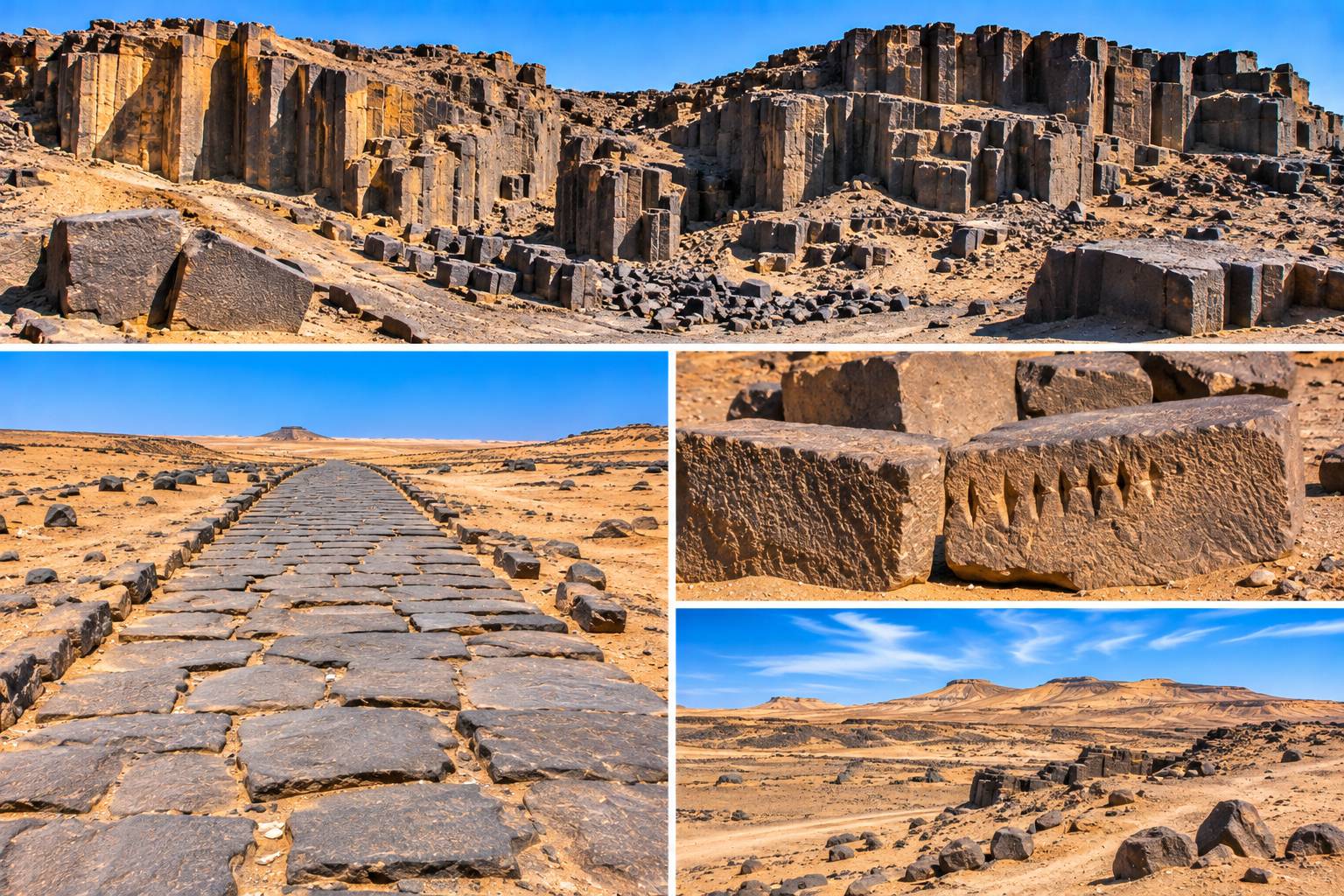
Widan El-Faras Fayoum: Ancient Basalt Quarries and the World's Oldest Paved Road
Northern Fayoum is home to some of Egypt's most fascinating archaeological landscapes. Beyond its famous temples, lakes and desert scenery lies a remarkable industrial heritage connected to the construction of the pyramids.
One of the most important places in this landscape is Widan El-Faras, an ancient basalt quarry located in the northern Fayoum Desert, near Gebel Qatrani.
Thousands of years ago, Egyptian workers travelled into this remote landscape to extract hard volcanic stone. The basalt was transported toward the Nile Valley, where it was used in important royal and religious building projects, particularly the floors of Old Kingdom pyramid temples.
But the quarries are only part of the story.
The area also preserves an ancient paved road connecting the quarry landscape with a loading area near the former shoreline of Lake Moeris. This road provides extraordinary evidence of how ancient Egyptians organized large-scale stone extraction and transportation.
Today, Widan El-Faras is an important destination for understanding ancient engineering, industrial archaeology and the relationship between the natural resources of Fayoum and the monumental architecture of ancient Egypt.
In this guide, discover where Widan El-Faras is located, why its basalt was valuable, how the ancient quarry road worked, and what visitors should know before exploring this remote archaeological landscape.
1. Where Is Widan El-Faras Located?
Widan El-Faras is situated in the northern part of the Fayoum Depression, in Egypt's Western Desert.
The quarry landscape lies near Gebel Qatrani and north of Lake Qarun, within the wider geological and archaeological region of northern Fayoum.
The location is particularly interesting because it combines several different types of heritage:
-
Ancient basalt extraction areas
-
Remains of an Old Kingdom quarry road
-
Evidence of stone processing and transportation
-
Ancient settlement and working areas
-
Geological formations and desert landscapes
-
Nearby archaeological sites
Widan El-Faras is part of a wider landscape that includes the ancient gypsum quarries of Umm es-Sawan and the archaeological area around Qasr El-Sagha.
Unlike famous Egyptian monuments, the quarry is not a conventional tourist attraction with large temples or decorated tombs. Its importance lies in the remains of ancient industrial activity and the evidence they provide about pyramid construction.
Visitors interested in this subject can also explore our related guide:
Gebel Qatrani Fayoum: Ancient Fossils and Desert Landscapes
2. What Is Widan El-Faras Famous For?
Widan El-Faras is famous for being one of the most important known sources of basalt used in ancient Egyptian royal architecture.
Basalt is a dark, dense volcanic rock. It is considerably harder than many common building stones and was valued for its durability and distinctive appearance.
During the Old Kingdom, Egyptian builders used basalt in important architectural projects, particularly for paving the floors of mortuary temples associated with pyramid complexes.
The quarries at Widan El-Faras supplied basalt for projects connected with the Fourth and Fifth Dynasties.
This makes the site important for understanding how ancient Egyptians obtained and transported materials for monumental construction.
The area is also known for its ancient paved quarry road, which is often described as one of the oldest known paved roads in the world.
Together, the quarry and road preserve evidence of an organized production and transportation system dating back approximately 4,500 years.
3. The History of Widan El-Faras During the Old Kingdom
The Old Kingdom was one of the most important periods in ancient Egyptian history.
It included the great pyramid-building age, when royal construction projects transformed the landscape around Memphis, Giza, Saqqara and Abusir.
Large building projects required enormous quantities of stone and specialized materials.
Limestone was widely used in pyramid construction, while granite, basalt and other hard stones were selected for particular architectural and decorative purposes.
Widan El-Faras became an important source of basalt during this period.
Archaeological research indicates that quarrying took place during the Old Kingdom, particularly in connection with Fourth and Fifth Dynasty pyramid complexes.
The work required more than simply breaking stones from the mountain.
Workers needed to identify suitable rock, extract large blocks, prepare them for transport and move them through a difficult desert landscape.
This required technical knowledge, organized labour and careful planning.
The remains at Widan El-Faras help researchers investigate how these operations were organized and how ancient Egyptian construction projects depended on distant natural resources.
4. Why Was Basalt Important in Ancient Egypt?
Basalt was a valuable material in ancient Egyptian architecture.
Its dark colour and hard surface made it particularly suitable for selected architectural features.
One of its best-known uses was paving the floors of mortuary temples.
These temples were important parts of royal funerary complexes, where religious rituals and offerings were performed in connection with the deceased king.
Basalt flooring could provide a durable and visually distinctive surface in important temple spaces.
The stone was not used everywhere because extracting and transporting it required considerable effort.
Its use was therefore selective and connected with significant architectural projects.
The quarries at Widan El-Faras provide evidence of how ancient Egyptians developed specialized extraction and transportation systems to obtain this valuable material.
5. The Ancient Paved Road of Widan El-Faras
One of the most remarkable features of the Widan El-Faras landscape is its ancient paved road.
The road connected the basalt quarry area with a loading or quay area near the former shoreline of Lake Moeris.
It is commonly described as approximately 11 kilometres long, although different archaeological descriptions may give slightly different measurements depending on which sections are included.
The road was constructed using stone paving and represents an extraordinary achievement in ancient Egyptian transportation infrastructure.
It was designed to help move heavy basalt blocks down from the quarry landscape toward the lake.
From there, water transport could be used when environmental conditions allowed.
This system reduced the need to move every block over long distances across difficult desert terrain.
Why Is the Road So Important?
The road is important because it provides physical evidence of the planning required for ancient stone transportation.
It was not simply a track made by workers walking through the desert.
It formed part of a wider industrial landscape that included quarries, working areas, transport routes and a loading location.
Its construction demonstrates the importance of infrastructure in the development of ancient Egyptian monumental architecture.
The road is frequently described as the world's oldest known paved road, although such superlative claims should be treated carefully because archaeological discoveries and definitions of paved roads vary.
What is certain is that it is an exceptionally early and significant example of an engineered stone transport route.
6. How Did Ancient Egyptians Transport Basalt from Widan El-Faras?
Transporting basalt from Widan El-Faras was a major logistical challenge.
The quarry was located in a desert area far from the principal pyramid-building centres in the Nile Valley.
Moving large blocks entirely overland would have required considerable effort.
Archaeological research suggests that ancient Egyptians developed a system that combined road transport and water transport.
The process can be understood in several stages.
Stage One: Extracting the Basalt
Workers extracted suitable basalt from the natural rock formations.
The stone needed to be separated into blocks that could be prepared for their intended architectural use.
Stage Two: Preparing the Blocks
The extracted stone was likely shaped or dressed to make transportation and later installation more practical.
Evidence from the quarry landscape helps researchers understand the organization of these activities.
Stage Three: Moving the Stone Along the Quarry Road
The paved road provided a route from the quarry area toward the lower landscape near the ancient lake.
The road was an important part of the transportation system because it helped connect the extraction area with the water route.
Stage Four: Transporting the Stone by Water
During periods when water levels were sufficiently high, basalt blocks could be transported by boat or barge across the ancient lake system.
The stone could then be moved toward the Nile Valley and the pyramid-building areas.
This combination of land and water transport demonstrates how ancient Egyptians adapted their engineering methods to the natural environment.
7. The Connection Between Widan El-Faras and Ancient Lake Moeris
The ancient quarry road was connected to the former shoreline of Lake Moeris, the historical name commonly associated with the ancient lake system in Fayoum.
Lake Moeris played an important role in the history of the Fayoum Depression.
Its water levels and extent changed over time, influencing agriculture, settlement and transportation.
During the Old Kingdom, higher lake levels helped make water transportation from the northern Fayoum region more practical.
Researchers have suggested that quarrying and transportation activities at Widan El-Faras were closely connected with these environmental conditions.
As lake levels changed, transporting heavy basalt by water became more difficult.
This helps explain why the natural environment was so important to the economic and logistical organization of the ancient quarry.
Read our related guide:
Lake Qarun Fayoum: The Ultimate Visitor Guide
8. What Did the Ancient Quarry Workers' Settlement Look Like?
Widan El-Faras is important not only for its quarries and road but also for the archaeological evidence connected with the people who worked there.
Extracting stone in a remote desert location required workers to spend time away from major settlements.
Archaeological investigations have identified remains associated with working areas and possible habitation or camp locations.
Researchers have studied stone structures, pottery and other archaeological evidence to understand how quarry workers organized their activities.
These remains provide a rare opportunity to investigate the lives of people involved in ancient industrial production.
The workers were part of a much larger system that supplied materials for royal building projects.
Their work required practical knowledge of geology, stone extraction, transportation and construction.
The remains at Widan El-Faras remind us that the pyramids and temples depended not only on architects and royal officials but also on skilled workers operating in distant resource areas.
9. Umm es-Sawan: The Ancient Gypsum Quarries Near Widan El-Faras
The northern Fayoum desert contains another important ancient quarry landscape: Umm es-Sawan.
While Widan El-Faras is known for its basalt, Umm es-Sawan is associated with the extraction of gypsum.
Gypsum was used in ancient Egypt for producing stone vessels and other objects.
Archaeological evidence from Umm es-Sawan includes extraction areas, working spaces and unfinished products.
The site is particularly interesting because it demonstrates that ancient Egyptian quarrying involved different materials and specialized production systems.
The two quarry landscapes provide complementary evidence of how natural resources from northern Fayoum contributed to ancient Egyptian craftsmanship and construction.
Visitors interested in ancient industry can learn about both areas as part of the wider history of the northern Fayoum desert.
10. Widan El-Faras and the Construction of the Pyramids
The importance of Widan El-Faras becomes clearer when we consider the scale of pyramid construction during the Old Kingdom.
Royal pyramid complexes were not isolated monuments.
They included temples, causeways, courtyards and other structures that required different building materials.
Some architectural features required durable hard stone rather than ordinary limestone.
Basalt from Widan El-Faras was used mainly for flooring in selected mortuary temple complexes.
Research has connected the quarry's production with pyramid projects of the Fourth and Fifth Dynasties.
This provides an important link between the remote Fayoum desert and the major royal construction centres of ancient Egypt.
It also demonstrates that pyramid construction depended on sophisticated supply networks extending far beyond the immediate building sites.
The ancient quarry road and the evidence for water transport show that the ancient Egyptians developed practical solutions to move heavy materials across long distances.
11. Archaeological Research at Widan El-Faras
Modern archaeological research has helped reveal the importance of Widan El-Faras.
Studies by Elizabeth Bloxam and Per Storemyr examined the quarry layout, its associated infrastructure and the use of basalt in Old Kingdom pyramid complexes.
Their research, published in the Journal of Egyptian Archaeology in 2002, highlighted the relationship between the quarry, the ancient road and transportation through the former Lake Moeris system.
Further research has examined the wider industrial landscape of northern Fayoum, including the relationship between Widan El-Faras and Umm es-Sawan.
These investigations are important because quarry sites often preserve evidence that is very different from the monumental remains usually associated with ancient Egypt.
Instead of royal inscriptions and decorated walls, the archaeological evidence may include extraction surfaces, stone tools, unfinished blocks, working areas and transport infrastructure.
Together, these remains help reconstruct the practical organization of ancient Egyptian industry.
12. What Can Visitors See at Widan El-Faras?
Widan El-Faras is best understood as an archaeological landscape rather than a conventional monument.
Visitors should not expect a large temple, museum or extensive visitor facilities.
The experience is focused on the desert environment and the remains of ancient stone extraction and transportation.
Depending on the route and areas that can be accessed, visitors may encounter:
-
Natural basalt formations
-
Ancient quarry extraction areas
-
Sections of the historic paved road
-
Desert escarpments and wide landscapes
-
Archaeological remains connected with stone production
-
Views toward the wider northern Fayoum region
The visible remains can be subtle, so having someone who understands the archaeological importance of the area can make the visit much more rewarding.
It is also important to remember that not every section of the archaeological landscape is necessarily accessible to visitors.
Access should be confirmed before departure.
13. Nearby Attractions to Explore Around Widan El-Faras
A visit to Widan El-Faras can be part of a wider journey through northern Fayoum.
The region contains several important natural and archaeological destinations.
Qasr El-Sagha Temple
Qasr El-Sagha is an unusual ancient stone temple located in the northern Fayoum desert.
Its massive stone blocks and distinctive architectural arrangement make it an interesting destination for visitors exploring the area's ancient history.
It is also closely connected geographically with the wider quarry landscape and the ancient transport route.
Read more:
Qasr El-Sagha Temple Fayoum: Explore Egypt's Ancient Desert Temple
Gebel Qatrani
Gebel Qatrani is known for its geological formations and fossil heritage.
The wider area contains evidence of ancient environments and important fossil discoveries.
It offers a very different experience from the ancient basalt quarries, making it an interesting addition to a northern Fayoum itinerary.
Read more:
Gebel Qatrani Fayoum: Ancient Fossils and Desert Landscapes
Dimai: Soknopaiou Nesos
Dimai is an ancient settlement north of Lake Qarun, known for its temple complex and remains from the Ptolemaic and Roman periods.
It provides a fascinating contrast with the much older Old Kingdom quarry landscape.
Read more:
Dimai Fayoum: Explore Ancient Soknopaiou Nesos, Egypt's Crocodile City
Lake Qarun
Lake Qarun is one of the most recognizable natural landmarks in Fayoum.
Its landscape and long history make it an excellent addition to a trip exploring the northern desert.
Read more:
Lake Qarun Fayoum: The Ultimate Visitor Guide
Wadi El-Hitan
For travellers interested in ancient geological history and fossils, Wadi El-Hitan is another remarkable destination in Fayoum.
The UNESCO World Heritage Site is famous for its fossilized whale remains and evidence of whale evolution.
Read more:
Wadi El-Hitan – Valley of the Whales: The Ultimate Visitor Guide
14. Best Time to Visit Widan El-Faras
The cooler months are generally the most comfortable time to explore the northern Fayoum desert.
October to April
These months usually offer more pleasant temperatures for outdoor exploration.
The cooler weather makes it easier to spend time walking around archaeological and geological locations.
May to September
Summer temperatures can become extremely high in exposed desert areas.
Visitors planning a summer trip should consider an early departure, suitable transportation and sufficient drinking water.
Best Time of Day
Early morning is generally preferable for desert exploration.
It can offer more comfortable temperatures and attractive natural light for photography.
The final schedule should always take account of weather conditions and access arrangements.
15. How to Get to Widan El-Faras from Cairo
Widan El-Faras is located in a remote part of northern Fayoum.
Travellers normally begin by travelling from Cairo toward Fayoum before continuing toward the northern desert.
The final route depends on the exact quarry locations and the access conditions on the day.
For a safe and well-organized visit, it is advisable to arrange:
-
Private transportation
-
A driver familiar with Fayoum
-
A guide knowledgeable about the region
-
A suitable vehicle for the planned route
-
Advance confirmation of access permissions
-
Drinking water and essential supplies
Some parts of the northern desert may require specialized vehicles or local authorization.
An ordinary road journey should not be assumed to provide direct access to every quarry or archaeological feature.
16. Can You Visit Widan El-Faras on a Day Trip?
A day trip from Cairo may be possible for selected northern Fayoum locations, but Widan El-Faras requires more planning than many standard tourist attractions.
The journey should account for travel time, the condition of desert roads and the locations that are actually accessible.
Travellers who want to explore several sites, such as Qasr El-Sagha, Gebel Qatrani and the ancient quarry landscape, should allow enough time to enjoy each location.
It may be better to focus on a smaller number of sites rather than trying to cover the entire region in a rushed itinerary.
A private itinerary can be arranged around the visitor's interests, available time and current access conditions.
17. Responsible Tourism at Widan El-Faras
Widan El-Faras is an important archaeological landscape that deserves protection.
The quarry remains, ancient road and associated features provide valuable evidence about the history of Egyptian engineering.
Visitors should follow responsible tourism practices:
-
Do not remove basalt blocks, stone tools or archaeological objects.
-
Do not damage the ancient road or quarry surfaces.
-
Avoid driving over sensitive archaeological areas.
-
Follow local instructions and protected-area regulations.
-
Do not leave rubbish in the desert.
-
Respect any restricted or protected sections.
-
Avoid disturbing archaeological remains.
Even small pieces of archaeological material can have scientific importance when studied in their original context.
Protecting the site helps preserve its history for future research and responsible visitors.
18. Is Widan El-Faras Worth Visiting?
Widan El-Faras is an excellent destination for visitors who want to understand how ancient Egypt worked behind the scenes.
It is particularly suitable for:
-
Ancient Egyptian history enthusiasts
-
Visitors interested in pyramid construction
-
Archaeology and engineering enthusiasts
-
Students and educational groups
-
Geology and industrial heritage enthusiasts
-
Travellers looking for unusual destinations in Fayoum
It may be less suitable for visitors expecting a traditional monument with decorated walls, large statues or extensive tourist facilities.
Its appeal is different: the site allows visitors to explore the landscape where important building materials were extracted and to understand the transportation systems that supported ancient royal construction.
For anyone interested in the practical achievements of ancient Egyptian civilization, Widan El-Faras offers a fascinating experience.
19. Explore the Ancient Landscapes of Fayoum with Let’s Explore Egypt Travel
Fayoum is much more than lakes and desert scenery.
Its northern region preserves a remarkable combination of geological history, ancient industry, archaeological remains and natural landscapes.
From the basalt quarries of Widan El-Faras to the fossil discoveries of Gebel Qatrani and the ancient architecture of Qasr El-Sagha, this region offers a deeper perspective on Egypt's past.
Let’s Explore Egypt Travel can help you plan a private Fayoum experience with transportation and local guidance according to your interests and the locations that can be visited.
Whether you are interested in ancient engineering, archaeological landscapes, fossils or a wider desert adventure, we can help organize a suitable itinerary.
Explore our Egypt tour packages:
https://letsexploreegypttravel.com/en/egypttourpackages
Contact Let’s Explore Egypt Travel to plan your private Fayoum adventure.
Frequently Asked Questions About Widan El-Faras Fayoum
1. Where is Widan El-Faras located?
Widan El-Faras is located in the northern Fayoum Desert, near Gebel Qatrani and north of Lake Qarun in Egypt.
2. What is Widan El-Faras famous for?
It is famous for its ancient basalt quarries, which supplied stone for Old Kingdom pyramid temple projects, and for its ancient paved quarry road.
3. How old are the Widan El-Faras quarries?
The quarry landscape was exploited during the Old Kingdom, particularly in connection with Fourth and Fifth Dynasty building projects, approximately 4,500 years ago.
4. What was basalt used for in ancient Egypt?
Basalt was used in selected architectural projects, particularly for paving the floors of mortuary temples associated with pyramid complexes.
5. Is Widan El-Faras connected to the pyramids of Giza?
Yes. Research connects basalt from the northern Fayoum quarries with Old Kingdom pyramid temple construction, including projects in the Giza and Abusir areas.
6. Where does the ancient paved road lead?
The road connected the basalt quarry area with a loading or quay area near the former shoreline of Lake Moeris.
7. How long is the ancient quarry road?
It is commonly described as approximately 11 kilometres long, although measurements can vary depending on the sections included.
8. Is Widan El-Faras home to the world's oldest paved road?
It is frequently described as the world's oldest known paved road. This is a commonly used archaeological description, although comparisons depend on how ancient paved roads are defined.
9. What is the connection between Widan El-Faras and Lake Moeris?
The ancient quarry road led toward the former shoreline of Lake Moeris. Higher water levels during parts of the Old Kingdom may have allowed basalt blocks to be transported by boat or barge.
10. Can tourists visit Widan El-Faras?
A visit may be possible with appropriate planning, but access to remote quarry areas should be confirmed with local authorities and knowledgeable operators before travelling.
11. What other places can I visit near Widan El-Faras?
Nearby destinations in the wider northern Fayoum region include Qasr El-Sagha, Gebel Qatrani, Dimai and Lake Qarun.
12. What is the best time to visit Widan El-Faras?
The cooler months, generally October to April, are usually more comfortable for exploring the desert.
13. Do I need a guide to visit Widan El-Faras?
A knowledgeable local guide and an experienced driver are strongly recommended because the site is remote and access conditions can vary.
14. Can I collect basalt or archaeological objects from the site?
No. Visitors should not remove stone, tools or archaeological material. These remains are part of an important historical landscape and should be protected.
Final Travel Tip
Widan El-Faras reveals an extraordinary part of ancient Egyptian history: the engineering, labour and transportation systems that helped make monumental construction possible.
When you explore its ancient quarries and paved road, you are discovering not only where the stone came from, but also how ancient Egyptians organized the resources needed to build their civilization.
Widan El-Faras Fayoum – Article Highlights
-
Ancient basalt quarries dating back to Egypt's Old Kingdom.
-
Important source of basalt used in ancient Egyptian pyramid temple construction.
-
Famous for its approximately 11-kilometre ancient paved quarry road.
-
One of the world's oldest known engineered stone roads.
-
Evidence of ancient Egyptian stone extraction and transportation techniques.
-
Connected to the former shoreline of ancient Lake Moeris.
-
Basalt blocks were transported toward the Nile Valley using land and water routes.
-
Archaeological remains reveal how ancient quarry workers operated in the desert.
-
Located near Gebel Qatrani in northern Fayoum.
-
Close to Umm es-Sawan's ancient gypsum quarries.
-
Nearby attractions include Qasr El-Sagha, Dimai and Lake Qarun.
-
An exceptional destination for archaeology, ancient engineering and desert exploration.
-
Best explored during the cooler months, from October to April.
-
Advance access confirmation and suitable desert transportation are recommended.