


Tebtunis Fayoum: Ancient City, Sobek Temple and Papyrus Library
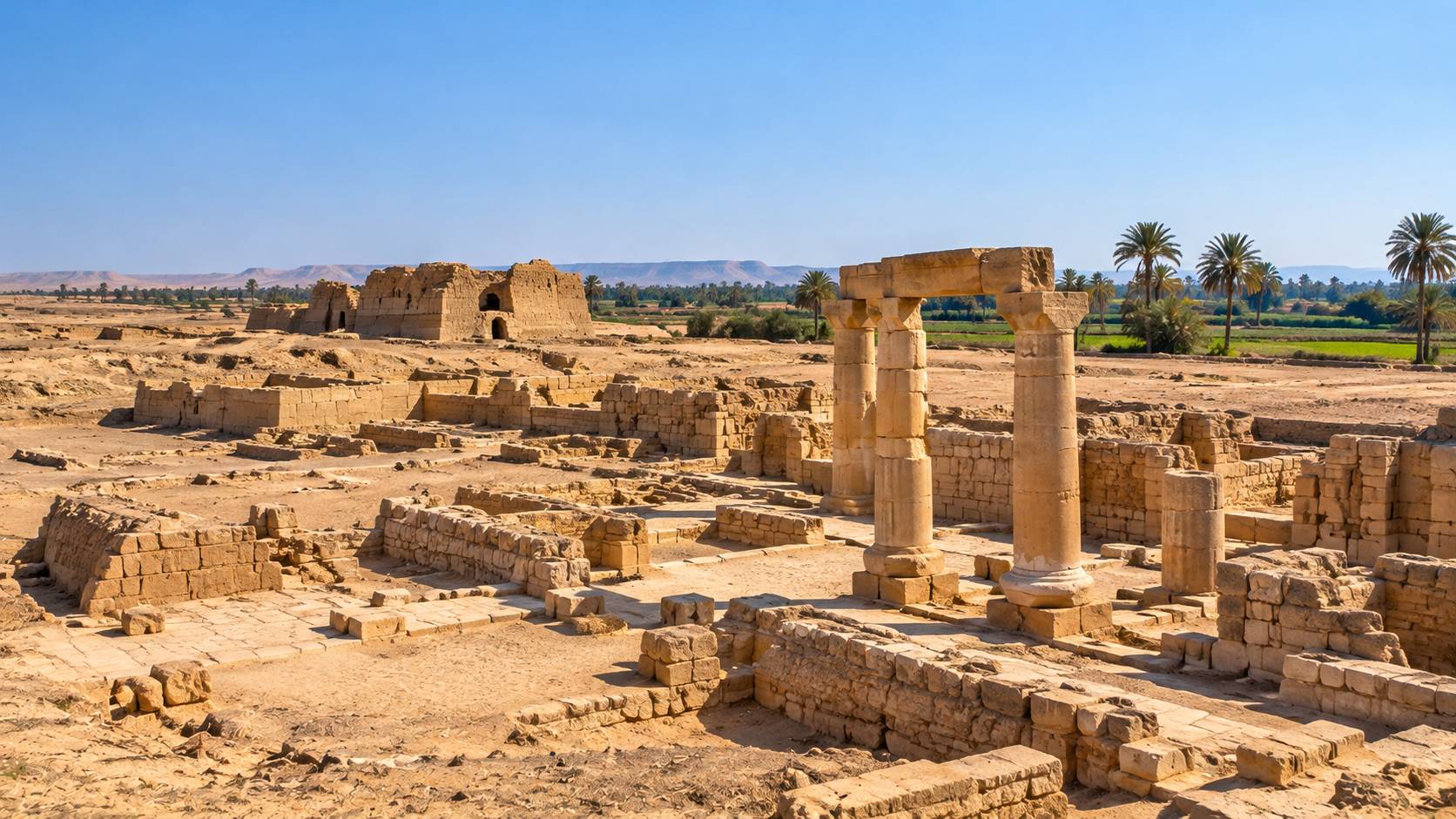
Tebtunis Fayoum: Discover the Ancient City of Sobek, Crocodile Mummies and the Lost Temple Library
Hidden in the southern part of the Fayoum oasis lies one of Egypt's most fascinating archaeological settlements: Tebtunis, also known as Tebtynis or Umm el-Breigat.
This ancient town preserves an extraordinary history that stretches from the Middle Kingdom through the Ptolemaic, Roman and Byzantine periods and into the medieval era.
Tebtunis is particularly famous for its magnificent temple dedicated to Soknebtynis, a local form of the crocodile god Sobek. Archaeological discoveries have also revealed a remarkable collection of papyrus manuscripts, ancient residential districts, public baths, bakeries, granaries and a large cemetery containing human and animal burials.
Among its most fascinating discoveries is a cemetery associated with thousands of crocodile mummies, reflecting the religious importance of crocodiles in ancient Fayoum.
Unlike the famous temples of Luxor or the pyramids of Giza, Tebtunis offers a different perspective on Egyptian history. It reveals how ordinary communities lived, worshipped, worked and preserved their religious traditions across many centuries.
In this guide, discover the location, history, temples, papyri, crocodile mummies and archaeological importance of ancient Tebtunis.
1. Where Is Tebtunis Located?
Tebtunis is located at Kom Umm el-Breigat, on the southern edge of the Fayoum Depression in Egypt.
The archaeological site lies where cultivated land meets the desert, creating a landscape that helped shape the settlement's history.
The ancient town is situated approximately 170 kilometres southwest of Cairo.
Its location was important because it connected agricultural communities with desert routes and the wider network of settlements throughout the Fayoum oasis.
Tebtunis formed part of the ancient Arsinoite region, which became an important administrative and agricultural area during the Ptolemaic and Roman periods.
The wider Fayoum region includes several other fascinating archaeological destinations:
-
Medinet Madi
-
Dimai (Soknopaiou Nesos)
-
Karanis (Kom Oshim)
-
Bacchias (Kom Umm el-Atl)
-
Philadelphia (Darb Gerza)
-
Qasr Qarun Temple
-
Hawara Pyramid
Tebtunis is especially important for visitors interested in ancient Egyptian religion, papyrus documents and the development of Greco-Roman settlements.
2. The Ancient History of Tebtunis
Tebtunis has one of the longest documented histories among the ancient settlements of Fayoum.
According to the French Institute for Oriental Archaeology (IFAO), the village was founded around 1800 BC during Egypt's Twelfth Dynasty.
This places its origins in the Middle Kingdom, when the Fayoum region experienced important developments in settlement, agriculture and water management.
The town continued to develop over subsequent centuries.
During the Ptolemaic period, Tebtunis became an important settlement with religious, agricultural and administrative functions.
It continued to flourish during Roman rule and remained inhabited through Byzantine times.
Archaeological evidence documents occupation and activity from the Middle Kingdom through approximately the twelfth century AD.
This long history makes Tebtunis particularly valuable because it preserves evidence from several major periods of Egyptian civilization.
3. Tebtunis During the Middle Kingdom
The Middle Kingdom was a period of significant development in Egyptian history.
During the Twelfth Dynasty, Egyptian rulers invested in the Fayoum region, improving agricultural opportunities and encouraging settlement.
The development of irrigation systems and the management of water resources helped transform parts of the depression into productive agricultural land.
Tebtunis was among the settlements established during this period.
Its original foundation demonstrates that the region was important long before the arrival of the Ptolemies and Romans.
The Middle Kingdom remains of Tebtunis also provide evidence of the long relationship between Egyptian communities and the natural environment of the Fayoum oasis.
4. The Temple of Soknebtynis: The Sacred Heart of Tebtunis
One of the most important archaeological monuments at Tebtunis is the temple dedicated to Soknebtynis, a local form of the crocodile god Sobek.
Sobek was associated with water, fertility, protection and royal power.
In Fayoum, where water management and agriculture were essential to life, crocodile-related religious traditions held particular significance.
The temple of Soknebtynis became the principal religious centre of the settlement.
Archaeological investigations have revealed several phases of construction.
Research by the French-Italian archaeological mission indicates that an early sanctuary was established under Ptolemy I and his successors.
The temple was later rebuilt and modified during subsequent periods.
This discovery was important because it corrected an earlier assumption about the date of the surviving temple remains.
What Made the Temple Important?
The temple was not simply a building for religious ceremonies.
It formed the centre of a much wider sacred complex that included:
-
An outer enclosure
-
A processional road
-
Temple courts
-
Storage and service rooms
-
Areas associated with priests
-
Sacred spaces for religious activities
The temple complex provides important evidence of how religious institutions were organized in ancient Fayoum.
5. Soknebtynis: The Local Crocodile God of Tebtunis
The name Soknebtynis refers to a local manifestation of Sobek worshipped at Tebtunis.
Sobek was one of the most important deities associated with the Fayoum region.
He was represented as a crocodile or as a human figure with a crocodile head.
His religious associations included:
-
Water and the Nile
-
Fertility and agricultural prosperity
-
Protection
-
Royal authority
-
Strength and regeneration
The worship of Sobek was particularly significant in areas where crocodiles lived in natural water environments.
In ancient Egyptian religious traditions, the crocodile could be both feared and respected.
The animal represented power and danger but was also associated with divine protection.
At Tebtunis, the local form of Sobek became central to the town's religious identity.
The temple and associated papyrus documents provide valuable information about the cult and its ceremonies.
6. The Sacred Processional Road of Tebtunis
Another remarkable feature of ancient Tebtunis was the processional road leading toward the temple of Soknebtynis.
Known archaeologically as a dromos, this route formed part of the sacred landscape.
The main processional road was approximately 210 metres long, according to archaeological descriptions.
It connected the temple complex with other areas of the settlement and provided a ceremonial approach to the sacred building.
The road was associated with the religious organization of the town.
It also helped define the relationship between the temple and its surrounding enclosure.
The discovery of the dromos has provided important information about ancient religious architecture and ceremonial movement.
It demonstrates that the temple was part of a carefully organized sacred environment rather than an isolated structure.
7. The Famous Tebtunis Temple Library
One of the greatest archaeological treasures associated with Tebtunis is its ancient temple library.
During excavations in the early twentieth century, archaeologists discovered large collections of papyrus manuscripts in rooms and cellars associated with the temple complex.
These documents transformed our understanding of ancient Egyptian religion, literature and administration.
The library contained texts written in several languages and scripts, including Egyptian hieratic, Demotic, hieroglyphic and Greek.
The manuscripts included religious, astronomical, medical and literary material.
Some texts preserve important information about ancient Egyptian religious knowledge and temple traditions.
What Was Written in the Tebtunis Library?
The collection included:
-
Religious manuscripts
-
Temple rituals
-
Hymns dedicated to Sobek
-
Astronomical texts
-
Medical knowledge
-
Literary compositions
-
Administrative records
-
Religious and mythological documents
One particularly important work is the Book of the Fayum, which contains religious material associated with the region and its principal deity.
The manuscripts provide an extraordinary picture of the knowledge preserved by temple institutions during the Greco-Roman period.
Why Is the Library Important?
The Tebtunis library demonstrates that ancient Egyptian temples were not only places of worship.
They also preserved and transmitted knowledge.
Priests and temple personnel maintained religious texts, ritual instructions and scholarly traditions.
The discovery is particularly valuable because many of the documents survived in a dry archaeological environment.
Today, these manuscripts are studied by researchers around the world.
8. Thousands of Papyri and Ancient Documents
Tebtunis has produced an extraordinary number of papyrus documents and inscribed pottery fragments.
The French Institute for Oriental Archaeology reports that approximately 10,000 texts written on papyrus and pottery sherds have been collected through modern archaeological research.
These documents were written in several languages, including:
-
Ancient Egyptian
-
Greek
-
Aramaic
-
Coptic
-
Arabic
They cover a long period of occupation and provide evidence about religious life, administration, agriculture, trade and everyday activities.
The documents are important because they allow researchers to reconstruct the lives of people who lived in the settlement.
Some manuscripts contain religious material, while others provide practical information about economic and social relationships.
Together, they demonstrate that Tebtunis was a centre of written culture and knowledge for many centuries.
9. The Crocodile Mummies of Tebtunis
One of the most fascinating aspects of Tebtunis is its animal necropolis, particularly the large number of crocodile burials.
Crocodiles were deeply connected with the religious traditions of Fayoum.
As animals associated with Sobek, they could be mummified and buried as sacred offerings.
The crocodile necropolis at Tebtunis contains evidence of large-scale animal burial practices.
The archaeological record includes more than a thousand mummified crocodiles documented in the wider cemetery landscape.
These burials demonstrate the importance of animal cults during the Late Period and Greco-Roman periods.
Why Were Crocodiles Mummified?
Crocodiles were associated with Sobek, and their mummification formed part of religious practices connected with the god.
Some animals were treated as sacred manifestations of the deity.
Others were prepared as votive offerings by worshippers seeking divine favour or protection.
The practice of animal mummification was widespread in ancient Egypt, particularly during later periods.
Different sacred animals were associated with particular gods and religious centres.
At Tebtunis, crocodile mummies provide an important link between the town's religious identity and its surrounding natural environment.
10. The Ancient Cemetery of Tebtunis
The wider archaeological landscape includes a large cemetery containing both human and animal burials.
Human burials provide evidence of the community's funerary traditions and social organization.
Animal burials reflect the religious importance of sacred creatures, particularly crocodiles.
Archaeological research has also identified burials of other animals, including ibises and falcons.
These discoveries demonstrate the diversity of animal cults in ancient Fayoum.
The cemetery is important because it helps researchers understand how religious practices developed and changed over time.
It also provides evidence of the relationship between temples, priests, worshippers and sacred animals.
11. Ancient Houses and Residential Districts
Tebtunis was not simply a temple settlement.
It contained extensive residential districts where people lived and worked.
Archaeological investigations have uncovered entire sections of the ancient town.
The buildings were constructed using local materials, particularly mudbrick.
Residential architecture included different types of rooms and domestic spaces.
Excavations have revealed evidence of:
-
Houses and courtyards
-
Storage areas
-
Residential streets
-
Domestic installations
-
Workshops
-
Agricultural buildings
These remains provide valuable information about everyday life in ancient Fayoum.
The town's residential districts also demonstrate how its urban layout developed over different historical periods.
Modern excavations have revealed Ptolemaic, Roman and Byzantine buildings, helping researchers reconstruct the settlement's long history.
12. Ancient Public Baths in Tebtunis
Among the important discoveries at Tebtunis are public bath complexes.
Archaeological investigations have identified bath buildings dating to different periods.
Some baths date to the third century BC, while others belong to the second century BC.
The presence of these buildings reveals the adoption and adaptation of bathing traditions within the ancient community.
Public baths were important social and practical facilities in many Greco-Roman settlements.
They provided spaces for washing and bathing and could also function as places of social interaction.
The archaeological remains at Tebtunis help researchers understand how public facilities developed within a provincial Egyptian town.
13. Ancient Granaries and Agricultural Life
Agriculture was essential to the prosperity of ancient Tebtunis.
The settlement was surrounded by cultivated land and formed part of the wider agricultural system of the Fayoum oasis.
Archaeological research has identified a large granary dating to the second century BC.
Granaries were important for storing grain and managing agricultural supplies.
They also provide evidence of organized food production and distribution.
The discovery of storage facilities helps researchers understand the relationship between the settlement and the surrounding agricultural landscape.
It demonstrates that Tebtunis was an important productive community as well as a religious centre.
14. Ancient Bakeries and Food Production
Archaeological excavations have revealed large bakery buildings at Tebtunis.
One bakery dates to the fourth century AD, while another, larger structure belongs to the following century.
These discoveries provide evidence of food production during the later occupation of the settlement.
Bread was a fundamental part of the ancient Egyptian diet.
Large-scale bakeries could supply food for households, workers and other members of the community.
The buildings reveal how the settlement continued to function economically during late antiquity.
They also demonstrate that Tebtunis remained an active place long after its original Ptolemaic development.
15. The Byzantine Period and the Long Life of Tebtunis
Tebtunis continued to develop after the Roman period.
During Byzantine times, the settlement contained new buildings and religious structures.
Archaeologists have identified a Byzantine district that was previously buried beneath sand.
Among the discoveries was a chapel dedicated to Thermouthis, an Egyptian goddess associated with fertility and agricultural prosperity.
The site also contained buildings connected with administration and local activities.
The archaeological record shows that the community continued to evolve rather than disappearing immediately after the Roman period.
According to the IFAO research, the settlement remained occupied until approximately the twelfth century AD.
Eventually, the advancing desert and changes in the availability of cultivated land contributed to the relocation of its inhabitants.
A new settlement was established farther north and retained the ancient name in a later form.
This provides an important example of how communities in Fayoum adapted to environmental and economic changes.
16. Archaeological Excavations at Tebtunis
Tebtunis has been investigated by several generations of archaeologists.
The first major excavations took place in 1899–1900, when British papyrologists Bernard Grenfell and Arthur Hunt worked at the site.
Their discoveries included large collections of papyri.
Other archaeologists subsequently investigated the settlement, including Italian teams during the 1930s.
The temple of Soknebtynis and its processional road were among the major discoveries of this period.
After several decades without systematic archaeological work, excavations resumed in October 1988.
The Franco-Italian mission of the IFAO and the University of Milan began a new program of archaeological research.
The mission has continued investigating the settlement for decades.
Modern research has uncovered previously unknown residential districts, public buildings, temple structures and thousands of additional documents.
The discoveries have significantly expanded our understanding of ancient Tebtunis.
17. What Can Visitors See at Tebtunis Today?
Tebtunis is an archaeological landscape rather than a fully reconstructed ancient town.
Visitors should not expect complete streets, restored houses or extensive museum facilities.
The experience is about exploring the remains and understanding the importance of the ancient settlement.
Depending on the areas that can be accessed, visitors may encounter:
-
Archaeological mounds
-
Remains of ancient residential districts
-
Temple-related structures
-
Mudbrick architectural remains
-
Evidence of ancient streets
-
The wider desert and agricultural landscape
-
Areas associated with ancient funerary activity
The papyrus library and many of the important archaeological objects are not displayed at the site.
They are held in collections or studied by museums and research institutions.
The best way to appreciate Tebtunis is through an informed visit that explains its archaeological history.
Visitors should confirm access arrangements and any local restrictions before travelling.
18. Nearby Attractions to Explore Around Tebtunis
Tebtunis can be included in a wider journey through the archaeological and natural landscapes of Fayoum.
Several important destinations are located across the region.
Medinet Madi
Medinet Madi is an ancient temple complex with a history extending from the Middle Kingdom into the Ptolemaic and Roman periods.
Its temples provide a fascinating comparison with the religious architecture of Tebtunis.
Read our guide:
Medinet Madi Fayoum: Explore the Ancient Temple of Egypt
Dimai – Soknopaiou Nesos
Dimai is another important ancient settlement in Fayoum.
It contains the remains of a temple dedicated to Soknopaios and an ancient processional road.
Like Tebtunis, it provides evidence of the importance of Sobek-related religious traditions.
Read more:
Dimai Fayoum: Explore Ancient Soknopaiou Nesos, Egypt's Crocodile City
Karanis – Kom Oshim
Karanis was an important Greco-Roman settlement in northern Fayoum.
Its archaeological remains include temples, houses and evidence of everyday activities.
Read our guide:
Karanis Fayoum: Explore the Ancient City of Kom Oshim
Bacchias – Kom Umm el-Atl
Bacchias was another ancient settlement with temples, houses and agricultural buildings.
It offers an interesting comparison with the religious and residential landscape of Tebtunis.
Lake Qarun
Lake Qarun is one of the most recognizable natural landmarks in Fayoum.
It provides an important connection to the region's environmental history and ancient settlement patterns.
Read our guide:
Lake Qarun Fayoum: The Ultimate Visitor Guide
Wadi El-Hitan
For visitors interested in natural history and fossils, Wadi El-Hitan is one of Egypt's most remarkable destinations.
Its fossilized whale remains provide exceptional evidence of the evolution of whales.
Read more:
Wadi El-Hitan – Valley of the Whales: The Ultimate Visitor Guide
19. Best Time to Visit Tebtunis
The cooler months are generally the most comfortable time to explore the archaeological sites of Fayoum.
October to April
These months usually provide more pleasant conditions for outdoor sightseeing.
Visitors can spend more time exploring archaeological remains without the intense summer heat.
May to September
Summer temperatures can become very high, particularly in exposed archaeological areas.
Visitors should plan early departures, carry enough drinking water and avoid unnecessary midday exposure.
Best Time of Day
Morning is generally preferable for exploring Tebtunis.
Temperatures are often more comfortable, and the natural light can be suitable for photography.
20. How to Get to Tebtunis from Cairo
Tebtunis is located in southern Fayoum, and the journey from Cairo requires travelling toward the Fayoum region before continuing to Kom Umm el-Breigat.
The final route and travel time depend on traffic and road conditions.
For a comfortable journey, visitors should consider arranging:
-
Private air-conditioned transportation
-
An experienced driver familiar with Fayoum
-
A knowledgeable local guide
-
A planned itinerary including selected nearby attractions
-
Drinking water and suitable outdoor clothing
Tebtunis is less developed for tourism than Egypt's major archaeological destinations.
Access should be confirmed before departure, particularly if the visit involves combining several remote sites.
21. Is Tebtunis Worth Visiting?
Tebtunis is one of the most rewarding archaeological destinations for travellers interested in the long history of ancient Egypt.
It is particularly suitable for:
-
Ancient Egyptian history enthusiasts
-
Archaeology lovers
-
Visitors interested in Sobek and crocodile worship
-
Students and educational groups
-
Visitors interested in papyri and ancient manuscripts
-
Travellers exploring Greco-Roman Egypt
-
People interested in ancient animal mummification
It may be less suitable for visitors expecting a restored temple or a large visitor centre.
Its real value lies in its remarkable archaeological discoveries and its long history as a living community.
For travellers who want to understand how ancient Egyptian towns developed across different historical periods, Tebtunis offers a fascinating experience.
22. Explore Ancient Tebtunis and Fayoum with Let's Explore Egypt Travel
Fayoum is one of Egypt's most rewarding destinations for travellers interested in archaeology, ancient religion and natural landscapes.
From the ancient city of Tebtunis and its remarkable papyrus library to the temples of Medinet Madi and Dimai, the region offers a unique journey through thousands of years of history.
Let's Explore Egypt Travel can help you plan a private Fayoum experience with transportation and local guidance according to your interests and the locations that can be visited.
Whether you want to discover ancient temples, explore archaeological settlements or enjoy the natural scenery of the Fayoum oasis, we can help organize a suitable itinerary.
Explore our Egypt tour packages:
https://letsexploreegypttravel.com/en/egypttourpackages
Contact Let's Explore Egypt Travel to plan your private Fayoum archaeological adventure.
Frequently Asked Questions About Tebtunis Fayoum
1. Where is Tebtunis located?
Tebtunis is located at Kom Umm el-Breigat on the southern edge of the Fayoum Depression in Egypt.
2. How old is Tebtunis?
The settlement was founded around 1800 BC during the Twelfth Dynasty and remained inhabited until approximately the twelfth century AD.
3. What is Tebtunis famous for?
It is famous for its temple dedicated to Soknebtynis, its ancient papyrus library, crocodile mummies and extensive archaeological remains.
4. Who was Soknebtynis?
Soknebtynis was a local form of the crocodile god Sobek worshipped at Tebtunis.
5. What was discovered in the Tebtunis temple library?
The library produced religious, astronomical, medical, literary and administrative manuscripts written in different ancient languages and scripts.
6. How many crocodile mummies were found at Tebtunis?
The wider cemetery is documented as containing more than a thousand mummified crocodiles. The exact number of surviving specimens and their distribution should not be confused with the total number of ancient burials.
7. Why were crocodiles mummified in Fayoum?
Crocodiles were associated with Sobek and were mummified as sacred animals or religious offerings.
8. Who excavated Tebtunis?
The first major excavations were conducted by Bernard Grenfell and Arthur Hunt in 1899–1900. Italian archaeologists worked there during the 1930s, and a Franco-Italian archaeological mission resumed systematic excavations in 1988.
9. What languages were used in ancient Tebtunis?
The archaeological documents include Egyptian languages, Greek, Aramaic, Coptic and Arabic.
10. Did Tebtunis have public baths?
Yes. Archaeologists identified public bath complexes dating to different periods, including the Ptolemaic era.
11. Did Tebtunis have a temple library?
Yes. The temple complex produced an important collection of papyrus manuscripts containing religious and scholarly material.
12. Can tourists visit Tebtunis?
A visit may be possible with advance planning, but current access arrangements should be confirmed before travelling.
13. What is the best time to visit Tebtunis?
The cooler months, generally October to April, are usually more comfortable for exploring the archaeological landscape.
14. Can Tebtunis be combined with other Fayoum attractions?
Yes. Depending on the route and available time, visitors can combine Tebtunis with selected sites such as Medinet Madi, Dimai and Lake Qarun.
Final Travel Tip
Tebtunis is much more than an ancient settlement. It is a remarkable historical archive preserved in the desert of Fayoum.
Its temple, crocodile cemetery, papyrus manuscripts and residential districts reveal a community where Egyptian religious traditions continued and developed across many centuries.
Explore Tebtunis as part of a wider Fayoum journey and discover one of the most fascinating archaeological landscapes in Egypt.