


Crocodile Mummies of Fayoum: Ancient Egypt's Cult of Sobek
Crocodile Mummies of Fayoum: The Ancient Egyptian Cult of Sobek
Ancient Egypt is famous for its pyramids, temples, royal tombs and elaborate human mummies. However, one of its most fascinating religious traditions involved an animal that inspired both fear and respect: the crocodile.
In ancient Egypt, crocodiles were closely associated with Sobek, a powerful deity connected with water, fertility, protection and strength. In the Fayoum region, where wetlands and waterways once provided suitable habitats for Nile crocodiles, the worship of Sobek became particularly important.
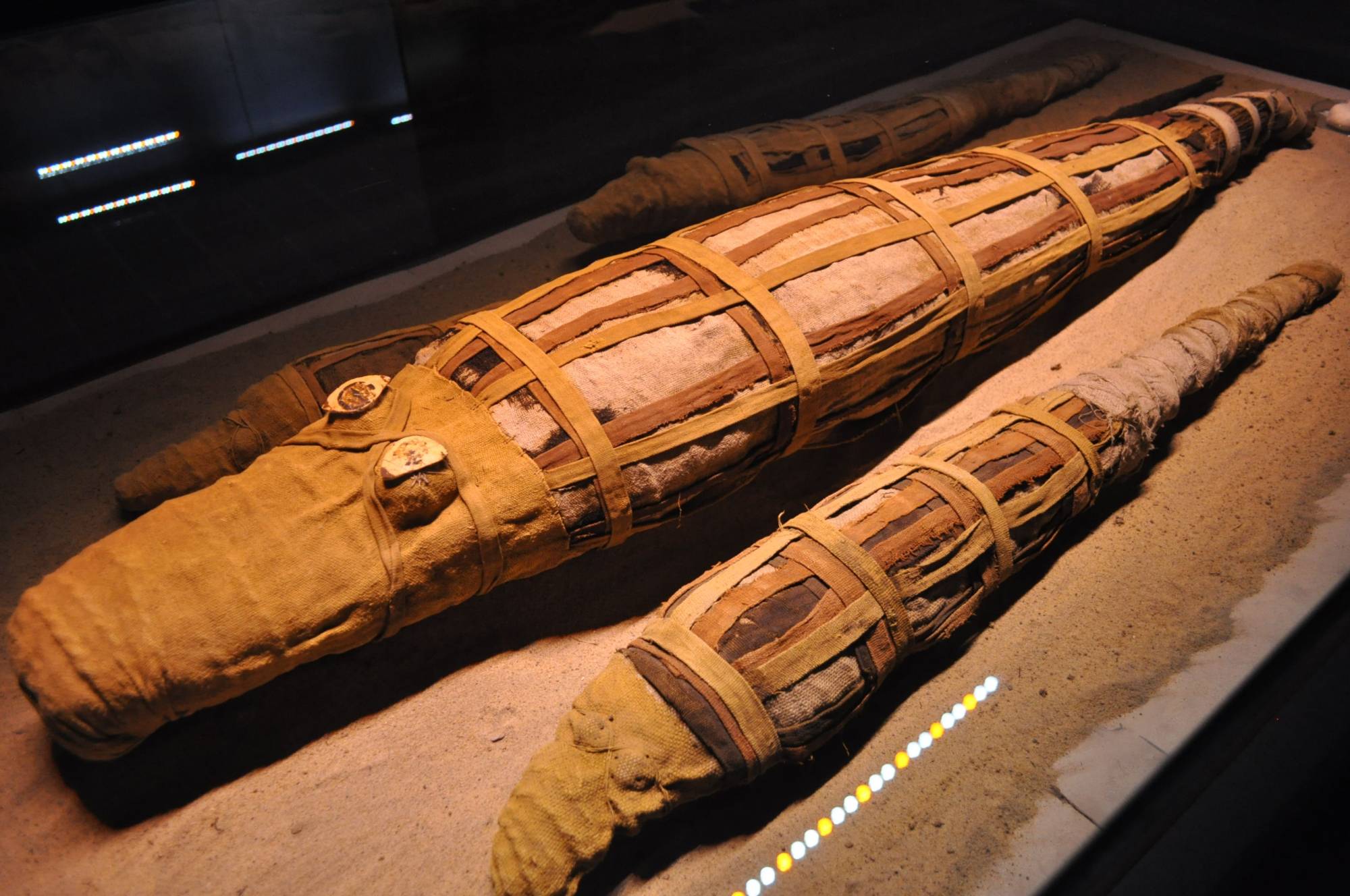
Thousands of crocodile mummies have been discovered in Egypt, including remarkable groups from the Fayoum region. Some were carefully wrapped in linen, others were placed in pottery containers, and some were buried with eggs or young crocodiles.
These discoveries reveal a complex religious tradition involving sacred animals, temple ceremonies, votive offerings and specialized burial practices.
One of the most important places connected with this tradition is Tebtunis, an ancient settlement near modern Umm el-Breigat in Fayoum. Its archaeological remains include a crocodile cemetery and important evidence of the worship of Soknebtynis, a local form of Sobek.
In this guide, explore the history of crocodile mummies in Fayoum, the mythology of Sobek, the religious significance of sacred crocodiles and the archaeological discoveries that continue to reveal the beliefs of ancient Egyptians.
1. Why Were Crocodiles Sacred in Ancient Egypt?
The Nile crocodile was one of the most powerful animals in the ancient Egyptian environment.
It lived in the Nile and its surrounding waterways, where it represented both danger and natural strength.
For communities that depended on the river, the crocodile was a creature that could not be ignored.
It was feared because of its ability to attack humans and animals, but it was also respected for its strength and association with the water that sustained Egyptian life.
Ancient Egyptians connected the crocodile with the god Sobek.
Through this association, the animal became a symbol of divine power, fertility, protection and the natural forces of the Nile.
The crocodile was therefore more than an ordinary animal. In certain religious settings, it became a sacred creature connected with one of Egypt's important deities.
2. Who Was Sobek? The Crocodile God of Ancient Egypt
Sobek was an ancient Egyptian god usually represented as a crocodile or as a human figure with a crocodile head.
His religious importance developed over many centuries, and his character included several powerful associations.
Sobek was connected with:
-
Water and the Nile
-
Fertility and agricultural prosperity
-
Protection and strength
-
Royal authority
-
Military power
-
Regeneration and creation
The connection between Sobek and water was particularly important in agricultural Egypt.
The annual Nile flood deposited fertile soil across the valley and helped sustain crops and communities. Sobek's association with water and fertility made him an important deity in regions where agriculture depended on the river and its waterways.
Sobek was also associated with the dangerous and protective aspects of nature.
Like the crocodile itself, he could represent both destructive power and divine protection.
How Was Sobek Represented?
Sobek appeared in Egyptian art in two principal forms:
-
A crocodile, sometimes shown resting or standing.
-
A human body with the head of a crocodile.
Some representations also show Sobek wearing a headdress associated with solar symbolism.
His imagery varied across different periods and religious centres.
3. Why Was Fayoum an Important Centre of Sobek Worship?
Fayoum was one of the most important regions associated with Sobek worship.
Its ancient landscape included lakes, marshes, irrigation channels and waterways that supported agriculture and wildlife.
These environmental conditions helped establish a strong connection between the region and crocodiles.
The ancient city of Shedet, later known by the Greek name Crocodilopolis, became one of the principal centres of the crocodile god.
The city was closely associated with the worship of Sobek, and its religious traditions influenced the wider region.
Other Fayoum settlements also developed important local forms of crocodile worship.
These included:
-
Tebtunis
-
Karanis
-
Dimai (Soknopaiou Nesos)
-
Medinet Madi
-
Hawara
Each settlement had its own religious history and archaeological characteristics.
The presence of Sobek-related temples and crocodile burials across the region demonstrates how important this deity became in the religious life of ancient Fayoum.
4. Crocodilopolis: The Ancient City of the Crocodile God
One of the most famous centres of Sobek worship was ancient Shedet, known to the Greeks as Crocodilopolis.
The settlement was located in the Fayoum region and became a major religious centre dedicated to the crocodile god.
Its name reflects the strong relationship between the city and crocodile worship.
The Greek name Crocodilopolis means the City of Crocodiles.
In ancient religious traditions, a sacred crocodile could be kept and cared for within a temple environment.
Some accounts describe crocodiles being decorated with jewellery and receiving food offerings.
These animals were treated with special respect because they were associated with the deity.
The sacred crocodile was not simply an animal kept for entertainment. It formed part of a religious tradition in which the living creature represented the power of Sobek.
The exact practices varied between temples and periods, and not every crocodile associated with the cult was necessarily kept alive in a temple.
5. What Were Crocodile Mummies?
Crocodile mummies were preserved bodies of crocodiles prepared according to ancient Egyptian funerary and religious practices.
Like human mummies, animal mummies could be treated with different methods depending on the period, purpose and available resources.
Some crocodiles were carefully wrapped in linen.
Others were placed in pottery containers or prepared with decorative coverings.
A number of specimens were preserved with remarkable attention to detail, including painted features on the head.
Some crocodile mummies were relatively small, while others contained much larger animals.
Archaeologists have also discovered mummified crocodile eggs, embryos and young crocodiles.
These remains provide important evidence of the variety of animal mummification practices in ancient Egypt.
How Were Crocodiles Mummified?
The process could include several stages:
-
Preparing the animal after death.
-
Treating the body to help preserve it.
-
Wrapping the body in linen.
-
Adding decorative elements in some cases.
-
Placing the mummy in a burial container or designated tomb.
-
Depositing it in a cemetery or sacred burial area.
Not every crocodile mummy was prepared in exactly the same way.
Modern scientific examinations have revealed differences in preservation techniques, wrapping methods and the treatment of internal organs.
These variations help researchers understand how animal mummification developed over time.
6. Why Did Ancient Egyptians Mummify Crocodiles?
There was more than one reason for preserving crocodiles.
Animal mummies in ancient Egypt served different religious and funerary purposes.
In the case of crocodiles, several important categories can be considered.
Sacred Temple Animals
Some crocodiles were treated as sacred animals associated with Sobek.
They could be maintained within a religious environment and receive special care.
When they died, their bodies could be mummified and buried according to local religious traditions.
Votive Offerings
Other crocodile mummies were offered to Sobek by worshippers.
A votive offering was a religious gift presented to a deity as an expression of devotion or in the hope of receiving divine favour.
People could purchase or commission animal offerings through religious institutions.
The crocodile mummy became a physical expression of the worshipper's relationship with the god.
Religious Burial Practices
Some crocodile burials formed part of larger sacred cemeteries.
These burial places were connected with the religious identity of a particular settlement or temple.
The different purposes of crocodile mummification show that animal worship in ancient Egypt was more complex than simply preserving animals considered sacred.
7. The Crocodile Cemetery of Tebtunis
One of the most important places associated with crocodile mummies in Fayoum is Tebtunis, also known as Umm el-Breigat.
The settlement was an important religious and agricultural centre during the Ptolemaic and Roman periods.
Its principal temple was dedicated to Soknebtynis, a local form of Sobek.
Archaeological excavations revealed a large cemetery containing crocodile burials.
Thousands of crocodile mummies were reported in connection with excavations at Tebtunis.
These discoveries attracted international attention because they provided an extraordinary opportunity to study the relationship between animal mummification and local religious institutions.
The cemetery is particularly important for understanding how crocodile worship operated in a settlement where Sobek was the principal deity.
Why Is Tebtunis Important?
Tebtunis offers more than evidence of animal burials.
Its archaeological remains include:
-
The temple of Soknebtynis
-
A sacred processional road
-
Residential districts
-
Public baths
-
Agricultural and storage buildings
-
Important papyrus collections
-
Human and animal burial areas
The combination of these discoveries allows researchers to understand the religious, social and economic life of the settlement.
Read our complete guide:
Tebtunis Fayoum: Ancient City, Sobek Temple and Papyrus Library
8. Soknebtynis: The Local Form of Sobek Worshipped at Tebtunis
The crocodile god worshipped at Tebtunis was known as Soknebtynis.
He was a local manifestation of Sobek and became the central deity of the settlement.
The temple dedicated to Soknebtynis was the principal religious building at Tebtunis.
It formed part of a larger sacred complex that included a processional road and other structures.
The temple's history reflects several stages of construction and development.
Religious documents discovered at Tebtunis provide important information about local rituals, temple administration and the cult of Sobek.
These documents help researchers reconstruct the beliefs and activities of priests and worshippers.
The local form of Sobek at Tebtunis demonstrates that ancient Egyptian religion was not identical everywhere.
Different settlements developed their own divine traditions, names and religious practices while remaining connected to broader Egyptian beliefs.
9. The Papyrus Connection: Ancient Documents Reused in Crocodile Mummies
One of the most extraordinary discoveries connected with animal mummification in Fayoum is the reuse of ancient papyrus documents.
Researchers have identified papyrus fragments that were reused as part of the material employed in the preparation of certain crocodile and human mummies.
This practice is especially important because the documents can preserve written information from the Ptolemaic period.
The fragments may contain:
-
Private correspondence
-
Official letters
-
Contracts
-
Administrative records
-
Lists and registers
-
Petitions
-
Financial documents
Some papyri were written in Greek and date to between the third and first centuries BC.
The reuse of these documents creates an unusual connection between ancient daily life and religious burial practices.
A document originally produced for administration or personal communication could eventually become part of a funerary object.
Why Is This Discovery Important?
The papyrus fragments are valuable for two reasons.
First, they provide evidence about the practical and economic life of ancient Fayoum.
Second, their reuse helps researchers understand how materials were obtained and employed in the production of mummy coverings.
The discovery also demonstrates that ancient written documents sometimes survived because they were reused in contexts unrelated to their original purpose.
10. Did Ancient Egyptians Breed Crocodiles for Mummification?
One of the most interesting questions surrounding crocodile mummies concerns how the animals were obtained.
Were they captured in the wild, raised in temple facilities or bred specifically for religious offerings?
Archaeological and textual evidence suggests that more than one method may have been used.
Some research has investigated the possibility of organized crocodile breeding connected with the animal cults of Greco-Roman Fayoum.
However, the surviving evidence is incomplete, and researchers continue to examine the relationship between crocodile management, temple institutions and the production of votive mummies.
Evidence from Medinet Madi
Medinet Madi is another important archaeological site in Fayoum.
Research has reported features interpreted as a crocodile-rearing or nursery installation.
These discoveries have contributed to discussions about how sacred crocodiles may have been managed.
However, the presence of such facilities at a particular site does not prove that every crocodile mummy found in Fayoum came from a breeding operation.
The evidence suggests that crocodile management was an important subject in some religious centres, but practices likely varied.
Read more:
Medinet Madi Fayoum: The Ultimate Visitor Guide
11. Did Every Crocodile Mummy Come from a Temple?
No. Crocodile mummies were associated with different religious practices and burial contexts.
Some were connected with temple cults, while others were deposited as votive offerings.
There is also evidence that crocodiles could be obtained through different methods.
Scientific examination of individual mummies has revealed that some animals may have been captured from the wild.
A 2019 scientific study used advanced imaging to investigate a Roman-period crocodile mummy from Kom Ombo.
The results indicated that the animal had been hunted while alive.
This discovery demonstrates that ancient crocodile mummification did not depend on one single method of obtaining animals.
It also reminds us that the archaeological evidence is more diverse than earlier general explanations sometimes suggested.
12. Other Important Fayoum Sites Connected with Sobek
Tebtunis was not the only settlement in Fayoum associated with crocodile worship.
Several archaeological sites preserve evidence of Sobek-related religious traditions.
Karanis – Kom Oshim
Karanis was an important Greco-Roman settlement in northern Fayoum.
Its temples were associated with different local forms of Sobek, including Pnepheros and Petesouchos.
The site provides valuable evidence of religious life and temple institutions during the Roman period.
Read our guide:
Karanis Fayoum: Explore the Ancient City of Kom Oshim
Dimai – Soknopaiou Nesos
Dimai was an ancient settlement near the northern shore of Lake Qarun.
Its principal temple was dedicated to Soknopaios, another local form of the crocodile god.
The settlement included a temple complex and a long processional road.
It is particularly important for understanding the religious traditions of northern Fayoum.
Read more:
Dimai Fayoum: Explore Ancient Soknopaiou Nesos, Egypt's Crocodile City
Medinet Madi
Medinet Madi contains temples dedicated to Sobek and Renenutet, a goddess associated with harvest and nourishment.
Its archaeological history includes Middle Kingdom foundations and later Ptolemaic and Roman additions.
The site contributes to our understanding of the relationship between religion, agriculture and water in ancient Fayoum.
Hawara
Hawara is famous for the pyramid of Amenemhat III and its associated archaeological landscape.
Crocodile burials have also been reported in the wider Hawara area, demonstrating the geographical spread of Sobek-related practices in Fayoum.
Read our guide:
Hawara Pyramid: The Ultimate Visitor Guide
13. Crocodile Mummies Beyond Fayoum: Kom Ombo and Upper Egypt
Although Fayoum was a major centre of Sobek worship, crocodile mummification was not limited to this region.
Kom Ombo, north of Aswan, was another important religious centre associated with the crocodile god.
The temple of Kom Ombo is especially interesting because it was dedicated to two principal deities:
-
Sobek, the crocodile god
-
Haroeris, a form of Horus
The site contains important religious reliefs and architectural remains.
Next to the temple is the Crocodile Museum, which displays mummified Nile crocodiles and objects connected with Sobek worship.
The museum provides visitors with an opportunity to examine crocodile mummies and learn about the religious traditions associated with them.
The collection includes crocodile remains of different sizes, as well as objects and representations connected with the crocodile god.
For visitors travelling to southern Egypt, Kom Ombo offers one of the clearest museum experiences related to ancient crocodile worship.
14. The Crocodile Museum in Kom Ombo
The Crocodile Museum is located beside the Temple of Kom Ombo in Aswan.
It opened in 2012 and focuses on the religious and cultural importance of crocodiles in ancient Egypt.
The museum's exhibition includes:
-
Mummified Nile crocodiles
-
Crocodile remains of different sizes
-
Representations of Sobek
-
Religious objects
-
Examples of crocodile burial practices
-
Explanations of animal mummification
The museum is particularly useful for visitors who want to understand how crocodiles became part of ancient Egyptian religious traditions.
It also provides a valuable opportunity to see preserved crocodile specimens without needing to visit remote archaeological cemeteries.
For anyone interested in animal mummies, Sobek and ancient Egyptian religion, this museum is an important stop during a visit to Kom Ombo.
15. How Were Crocodile Mummies Discovered and Studied?
The discovery of crocodile mummies has involved archaeological excavation, museum research and modern scientific techniques.
Early excavations in Fayoum uncovered large numbers of animal burials.
Later investigations expanded our understanding of the religious sites and cemeteries associated with Sobek.
Today, researchers can study crocodile mummies using several scientific methods.
X-Ray Examination
X-rays can reveal the internal structure of a mummy without unwrapping it.
They may help identify:
-
The animal's approximate size
-
Bone arrangement
-
The presence of multiple animals
-
Damage to the skeleton
-
Internal structures
CT Scanning
Computed tomography provides more detailed internal images.
It can help researchers examine the anatomy and preservation of a crocodile mummy without physically damaging it.
Digital Imaging
Advanced imaging techniques can reveal details that are difficult to observe through the linen wrappings.
These methods help researchers understand the preparation and preservation of animal mummies.
Scientific Analysis
Depending on the specimen, researchers may also investigate materials, residues, linen, biological remains and other evidence.
The combination of archaeological and scientific research continues to improve our understanding of crocodile mummification.
16. What Do Crocodile Mummies Tell Us About Ancient Egyptian Religion?
Crocodile mummies reveal that ancient Egyptian religion was deeply connected with the natural world.
Animals were not viewed only as sources of food, labour or danger.
Some became symbols of divine power and were incorporated into religious rituals.
The crocodile's connection with Sobek illustrates how an animal's natural characteristics could shape its religious meaning.
Its strength, behaviour and association with water helped make it an appropriate symbol for a deity connected with fertility, protection and power.
The mummies also reveal the role of temples in organizing religious life.
Animal offerings required materials, preparation, storage and burial arrangements.
This suggests that animal cults involved complex systems of religious and economic activity.
17. Were Crocodiles Worshipped as Gods?
It is important to distinguish between Sobek, the deity, and the crocodiles associated with him.
Ancient Egyptians worshipped Sobek as a god.
Certain living crocodiles could be treated as sacred animals or as manifestations of the deity within a particular religious setting.
Other crocodiles were mummified as offerings to the god.
Therefore, the presence of crocodile mummies does not mean that every crocodile was considered an individual god.
The religious meaning depended on the animal's role, its context and the traditions of the temple or community.
This distinction helps explain why crocodile burials could vary so much in size, preparation and location.
18. Can Visitors See Crocodile Mummies in Fayoum Today?
Fayoum is an excellent region for exploring the history of Sobek worship and ancient crocodile cults.
However, visitors should understand that archaeological remains and museum collections are not the same thing.
At sites such as Tebtunis, the archaeological landscape contains the remains of the ancient settlement and its religious environment.
The most famous crocodile mummy discoveries are not necessarily displayed at the excavation site.
Many archaeological objects and manuscripts are preserved in museum or research collections elsewhere.
For visitors who specifically want to see displayed crocodile mummies, the Crocodile Museum at Kom Ombo is a particularly useful destination.
Before planning a visit to remote archaeological sites in Fayoum, it is important to confirm current access arrangements and local conditions.
19. Best Places to Explore the History of Sobek in Egypt
Travellers interested in crocodile worship can explore several important destinations.
| Destination | Why It Matters |
|---|---|
| Tebtunis, Fayoum | Temple of Soknebtynis and crocodile cemetery |
| Crocodilopolis / Shedet | Major historical centre of Sobek worship |
| Karanis, Fayoum | Temples associated with local forms of Sobek |
| Dimai, Fayoum | Temple of Soknopaios |
| Medinet Madi, Fayoum | Temples connected with Sobek and Renenutet |
| Kom Ombo, Aswan | Temple dedicated to Sobek and Haroeris |
| Crocodile Museum, Kom Ombo | Museum collection of crocodile mummies |
These destinations demonstrate how widespread and diverse crocodile worship became in ancient Egypt.
20. Best Time to Explore the Sobek Sites of Fayoum
The most comfortable months for exploring archaeological sites in Fayoum are generally October through April.
During this period, outdoor sightseeing is usually more pleasant than during the hottest summer months.
October to April
This is generally the preferred season for archaeological visits.
Visitors can spend more time exploring ancient settlements and desert landscapes.
May to September
Summer temperatures can become very high.
Early departures, adequate drinking water and protection from the sun are important.
Best Time of Day
Morning is generally the best time to visit exposed archaeological locations.
It offers more comfortable temperatures and suitable natural light for photography.
21. How to Plan a Crocodile and Sobek History Tour in Fayoum
A journey through the ancient crocodile cults of Fayoum can be organized around several archaeological destinations.
A possible historical itinerary could include:
Stop 1: Tebtunis
Explore the ancient settlement, the temple of Soknebtynis and the history of the crocodile cemetery.
Stop 2: Medinet Madi
Discover the temple complex and learn about the religious traditions associated with Sobek and Renenutet.
Stop 3: Karanis
Explore the remains of a Greco-Roman settlement with temples connected to local forms of Sobek.
Stop 4: Dimai
Discover the ancient temple of Soknopaios and the remains of an important settlement near Lake Qarun.
Not every site should automatically be combined into one day. The distances, road conditions, site access and available daylight must be considered when preparing the route.
For a comfortable experience, private transportation and a knowledgeable guide can help visitors understand the history of these locations.
22. Explore Ancient Fayoum with Let's Explore Egypt Travel
Fayoum is one of Egypt's most fascinating destinations for travellers interested in archaeology, ancient religion and natural history.
From the crocodile cemetery of Tebtunis to the temples of Medinet Madi, Karanis and Dimai, the region offers a remarkable journey through the religious traditions of ancient Egypt.
Let's Explore Egypt Travel can help arrange a private Fayoum experience with transportation and local guidance, depending on the destinations you wish to explore and the access arrangements available.
Whether you are interested in ancient temples, crocodile mummies, archaeological settlements or the natural landscapes of the oasis, we can help plan a suitable itinerary.
Explore our Egypt tour packages:
https://letsexploreegypttravel.com/en/egypttourpackages
Contact Let's Explore Egypt Travel to plan your private journey through the ancient history of Fayoum.
Frequently Asked Questions About Crocodile Mummies of Fayoum
1. Why did ancient Egyptians mummify crocodiles?
Crocodiles were associated with Sobek, an important Egyptian deity. Some were preserved as sacred animals, while others were prepared as votive offerings to the god.
2. Who was Sobek?
Sobek was an ancient Egyptian god represented as a crocodile or a human figure with a crocodile head. He was associated with water, fertility, protection and strength.
3. Why is Fayoum famous for crocodile mummies?
Fayoum was one of the principal centres of Sobek worship. Its archaeological sites, including Tebtunis and the area of ancient Shedet, provide important evidence of crocodile-related religious traditions.
4. Where were crocodile mummies discovered in Fayoum?
Important discoveries have been associated with Tebtunis, Hawara and other sites in the region.
5. What is Tebtunis famous for?
Tebtunis is famous for its temple dedicated to Soknebtynis, a large crocodile cemetery, residential remains and important papyrus discoveries.
6. What is Crocodilopolis?
Crocodilopolis was the Greek name for ancient Shedet, a major religious centre associated with the worship of Sobek in the Fayoum region.
7. Were crocodiles considered gods in ancient Egypt?
Sobek was the god. Certain crocodiles could be treated as sacred animals or manifestations of the deity, while others were mummified as religious offerings.
8. Were crocodiles bred in ancient Egyptian temples?
Evidence from some archaeological sites suggests that crocodiles may have been managed or raised in temple environments. However, the exact methods varied and are still being studied.
9. Were all crocodile mummies prepared in the same way?
No. Some were carefully wrapped in linen, others were placed in containers, and preservation methods differed according to the animal, period and religious context.
10. Can tourists see crocodile mummies in Egypt?
Yes. The Crocodile Museum beside the Temple of Kom Ombo in Aswan displays mummified Nile crocodiles and objects connected with Sobek worship.
11. Can visitors see crocodile mummies at Tebtunis?
Tebtunis is an archaeological site associated with crocodile burials, but visitors should not assume that the excavated mummies are displayed there. Many important finds are held in collections elsewhere.
12. What other Fayoum sites are connected with Sobek?
Karanis, Dimai, Medinet Madi and the ancient settlement of Shedet are among the important sites connected with Sobek-related religious traditions.
13. What is the best time to visit Fayoum?
October through April is generally the most comfortable period for outdoor archaeological visits.
14. Can I visit several Sobek-related sites in one trip?
Yes, but the itinerary should be planned around distances, access permissions, road conditions and the time available.
Final Thoughts
The crocodile mummies of Fayoum reveal a remarkable side of ancient Egyptian civilization.
Through the worship of Sobek, crocodiles became symbols of divine power, protection and fertility. Their mummified remains preserve evidence of religious offerings, temple traditions and the relationship between ancient communities and their natural environment.
From the temple of Soknebtynis at Tebtunis to the archaeological remains of Karanis and Dimai, Fayoum offers an extraordinary opportunity to explore the history of the crocodile god.
For travellers interested in ancient Egyptian religion, animal mummies and archaeological discoveries, the story of Sobek is one of the most fascinating chapters in Egypt's history.