


Great Sphinx History
The history of the Great Sphinx of Giza stretches back more than 4,500 years to Egypt’s Fourth Dynasty, when the Giza Plateau became the center of one of the greatest royal building projects in ancient Egypt.
Most Egyptologists associate the Sphinx with Pharaoh Khafre, who ruled during the Fourth Dynasty. The monument was carved directly from the natural limestone bedrock of the Giza Plateau and features the body of a lion with the head of a royal figure.
The lion was associated with strength, protection, and royal power, while the human head represented the authority of the pharaoh.
When Was the Great Sphinx Built?
The exact construction date is not known with absolute certainty, but the Sphinx is generally dated to the Fourth Dynasty, around 2558–2532 BC, during the reign of Khafre.
Its location is particularly important because the Sphinx stands close to the Pyramid of Khafre and the associated Valley Temple. The monument was therefore part of the larger royal complex created on the Giza Plateau.
Visitors exploring the Sphinx can also see the other major monuments of the plateau, including the Great Pyramid of Khufu and the Pyramid of Menkaure.
The Sphinx and Ancient Egyptian Religion
The Great Sphinx was more than a monumental sculpture. Its design had important religious symbolism in ancient Egypt.
Lions represented strength, protection, and royal authority. Combining the body of a lion with the head of a king created a powerful representation of the pharaoh's strength and divine status.
Centuries after the Sphinx was built, it became associated with Horemakhet, a form of the sun god Horus. This later religious connection helped preserve the importance of the monument long after the Fourth Dynasty.
The Dream Stele
One of the most famous stories connected with the Sphinx comes from the Dream Stele, placed between its paws by Pharaoh Thutmose IV during the New Kingdom.
According to the inscription, Thutmose IV rested near the Sphinx while he was still a prince and had a dream in which the Sphinx promised him kingship if he cleared the sand covering the monument.
Thutmose eventually became pharaoh and erected the stele to commemorate the event.
The story demonstrates that the Sphinx continued to have enormous religious and political importance more than a thousand years after its original construction.
The Sphinx Buried Beneath the Sand
For thousands of years, the Great Sphinx was repeatedly covered by desert sand.
At different periods, much of the body disappeared beneath the sand while the head remained visible above the surface. Several attempts were made to clear the monument and protect it from further deterioration.
The famous Dream Stele itself provides evidence of the Sphinx being partially buried during the New Kingdom.
Modern archaeological excavations and restoration projects have helped expose and preserve the monument that visitors see today.
The Missing Nose
The missing nose is one of the most famous mysteries associated with the Great Sphinx.
A popular story claims that Napoleon's soldiers destroyed the nose, but this is not supported by historical evidence. Drawings made before Napoleon's arrival in Egypt already show the Sphinx without its nose.
The exact circumstances surrounding the destruction remain uncertain.
Why Is the Great Sphinx Important?
The Great Sphinx is an essential part of the Giza Plateau, alongside the pyramids, temples, causeways, and ancient cemeteries.
Its enormous size, age, religious symbolism, and connection with Pharaoh Khafre make it one of the most important surviving monuments of ancient Egypt.
For visitors, seeing the Sphinx together with the pyramids provides a better understanding of the scale of the ancient royal complex.
If you want to explore the entire archaeological site, start with our Giza Pyramids Guide for information about the main monuments, visiting tips, and what to expect.
You can also explore the Private Giza Pyramids Tour to experience the Sphinx and pyramids with a professional guide.
For travelers interested in extending their ancient Egypt experience beyond Giza, Saqqara offers another important archaeological site, including the famous Step Pyramid of Djoser.
Continue Exploring
- Giza Pyramids Guide – Explore the pyramids and learn how to plan your visit.
- Private Giza Pyramids Tour – Visit the Sphinx and pyramids with a private guide.
- Camel Ride at Giza Pyramids – Experience the desert landscape around the pyramids.
- Saqqara – Discover the Step Pyramid and the beginnings of pyramid construction.
1. Who Built the Great Sphinx?
The Great Sphinx of Giza is generally believed to have been built during the reign of Pharaoh Khafre, around 4,500 years ago during Egypt’s Fourth Dynasty.
Most Egyptologists believe the monument was carved directly from the natural limestone bedrock of the Giza Plateau. Its human head is traditionally associated with Khafre, while its lion’s body symbolizes strength, protection, and royal power.
The Sphinx stands near the Pyramid of Khafre and its Valley Temple, suggesting that it was an important part of Khafre’s larger funerary complex.
If you want to understand how the Sphinx fits into the wider archaeological site, explore our Giza Pyramids Guide, which covers the Great Pyramid of Khufu, the Pyramid of Khafre, the Pyramid of Menkaure, and the Great Sphinx.
For travelers interested specifically in Khafre and his pyramid complex, you can also learn more about the Pyramid of Khafre during your visit to the Giza Plateau.
Although Khafre is the most widely accepted attribution, the exact circumstances surrounding the Sphinx's construction remain a subject of archaeological research and debate.
Why Is the Sphinx Missing Its Nose?
The missing nose of the Great Sphinx of Giza is one of the monument’s most famous mysteries. Although several theories have been proposed, there is no definitive historical evidence explaining exactly when or how the nose was destroyed.
One popular legend claims that Napoleon’s soldiers damaged the Sphinx’s nose when they arrived in Egypt in the late 18th century. However, this story is not supported by historical evidence. Drawings made by European travelers before Napoleon’s Egyptian campaign already show the Sphinx without its nose.
The damage was therefore likely to have occurred centuries before Napoleon, possibly as a result of deliberate destruction, religious conflict, or other historical events. The exact cause remains uncertain.
The missing nose is only one of the many mysteries surrounding the monument. If you want to understand the Sphinx in its wider archaeological setting, explore our Giza Pyramids Guide, which covers the Great Pyramid of Khufu, Pyramid of Khafre, Pyramid of Menkaure, and the Great Sphinx.
You can also continue exploring the Great Sphinx History to learn about its construction, connection with Pharaoh Khafre, religious significance, and the famous Dream Stele.
Can You Enter the Sphinx?
No, visitors cannot normally enter the Great Sphinx itself. Unlike the Great Pyramid of Khufu, which has interior passages that visitors can access with a separate ticket, the Sphinx is viewed from designated areas around the monument.
Visitors can explore the area around the Sphinx, admire the monument from different viewpoints, and take photographs of its famous face, paws, and surrounding structures.
The Sphinx complex is also closely connected to the Pyramid of Khafre, making it an important part of the wider Giza Plateau archaeological site.
For most visitors, seeing the Sphinx together with the pyramids provides a much better understanding of the scale and design of the ancient royal complex.
1. Great Sphinx vs Great Pyramid
The Great Sphinx and the Great Pyramid of Giza are two of the most famous monuments on the Giza Plateau, but they were built for different purposes and have very different designs.
The Great Pyramid of Khufu was built as a royal tomb and is the largest of the three main pyramids at Giza. The Great Sphinx, by contrast, is a monumental limestone sculpture featuring the body of a lion and the head of a king, traditionally associated with Pharaoh Khafre.
The two monuments are located within the same ancient royal complex, allowing visitors to see both during a single visit to the Giza Plateau.
| Feature | Great Sphinx | Great Pyramid |
|---|---|---|
| Type | Monumental sculpture | Pyramid / royal tomb |
| Main material | Limestone bedrock | Limestone and granite |
| Associated ruler | Khafre | Khufu |
| Main purpose | Religious and royal symbolism | Royal burial |
| Approximate age | 4,500+ years | 4,500+ years |
| Location | Giza Plateau | Giza Plateau |
For first-time visitors, seeing both monuments together provides a better understanding of the scale and importance of ancient Giza.
2. Sphinx Photography Tips
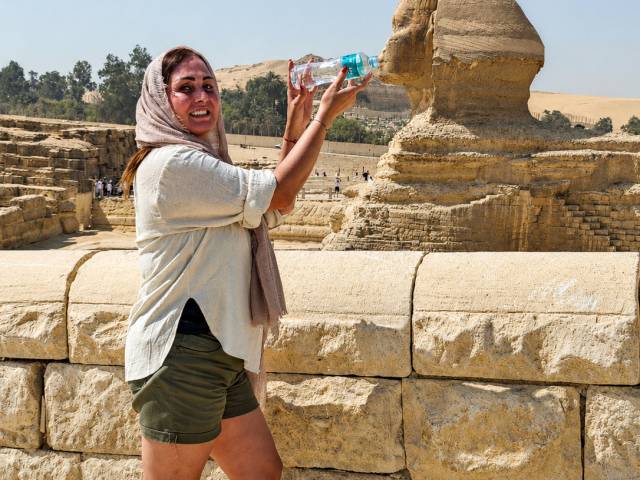
The Great Sphinx offers excellent opportunities for photography, especially when combined with views of the pyramids.
For the best photographs:
- Visit early in the morning for softer light and fewer crowds.
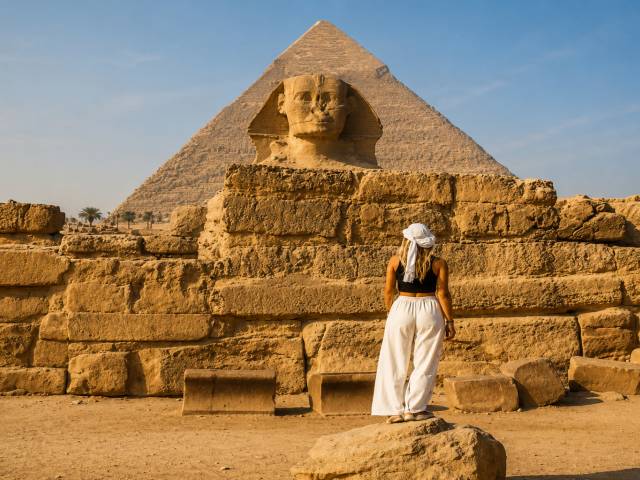
- Use the pyramids as a background to show the relationship between the monuments.
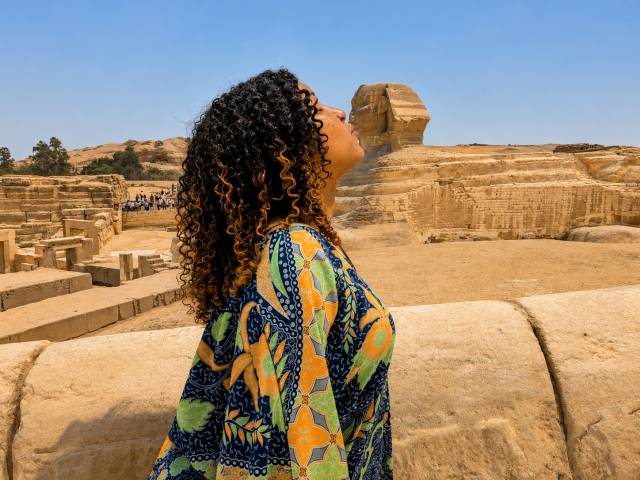
- Try different angles rather than photographing the Sphinx only from the front.
- Include people in some photographs to demonstrate the enormous scale of the monument.
- Use late-afternoon light for warmer tones and longer shadows.
- Bring a wide-angle lens if you want to capture the Sphinx and surrounding monuments in the same frame.
The area around the Sphinx can become busy, so arriving early can make it easier to find clear photography positions.
3. How to Visit the Sphinx with the Pyramids
The Great Sphinx is part of the wider Giza Plateau archaeological complex, so most visitors explore it together with the three main pyramids.
A typical visit can include:
- Great Pyramid of Khufu
- Pyramid of Khafre
- Pyramid of Menkaure
- Panoramic viewpoints
- Great Sphinx
- Valley Temple
Allowing several hours gives you enough time to explore the major monuments without rushing.
If you want to combine sightseeing with a more organized experience, a private Giza tour can include transportation and a professional Egyptologist guide while allowing you to spend more time at the monuments that interest you most.