


Great Sphinx of Giza: The Complete Visitor Guide
The Great Sphinx of Giza is one of the most famous monuments in Egypt and one of the most recognizable archaeological landmarks in the world. Located on the Giza Plateau beside the ancient pyramids, this enormous limestone monument has fascinated travelers, historians, and archaeologists for thousands of years.
With the body of a lion and the head of a king, the Sphinx represents the power and symbolism of ancient Egyptian civilization. Its mysterious history, missing nose, connection to Pharaoh Khafre, and centuries spent buried beneath the sand have made it one of Egypt's most intriguing monuments.
If you are planning your first visit, our Giza Pyramids Guide provides additional information about the pyramids, tickets, visiting times, photography, and what to expect at the Giza Plateau.
Discover the Great Sphinx of Giza
The Great Sphinx was carved directly from the natural limestone bedrock of the Giza Plateau.
The monument combines:
- The body of a lion
- The head of a human king
- A royal headdress
- A monumental scale designed to dominate the surrounding landscape
The lion was associated with strength, protection, and royal power in ancient Egypt, while the human head represented the authority of the pharaoh.
The Sphinx is approximately 73 meters long and 20 meters high, making it one of the largest monumental sculptures of the ancient world.
Today, it stands in front of the Pyramid of Khafre and forms an essential part of any visit to the Giza Plateau.
Where Is the Great Sphinx Located?
The Great Sphinx is located on the Giza Plateau, on the western side of the Nile River near modern Cairo.
It is situated close to the:
- Great Pyramid of Khufu
- Pyramid of Khafre
- Pyramid of Menkaure
- Valley Temple
- Ancient cemeteries and tombs
Because the Sphinx and the pyramids are located within the same archaeological complex, most travelers visit them during the same excursion.
A Private Giza Pyramids Tour can combine the pyramids, Sphinx, Valley Temple, transportation, and professional guiding in one itinerary.
Great Sphinx History
The history of the Great Sphinx stretches back more than 4,500 years to Egypt's Fourth Dynasty.
Although researchers have studied the monument for centuries, several aspects of its history remain debated.
Its connection with Pharaoh Khafre, its religious meaning, the periods when it was buried by sand, and the exact circumstances surrounding the destruction of its nose continue to attract enormous interest.
Who Built the Great Sphinx?
The Great Sphinx is generally believed to have been constructed during the reign of Pharaoh Khafre, one of the rulers of Egypt's Fourth Dynasty.
Khafre was the son of Pharaoh Khufu, the ruler who commissioned the Great Pyramid.
The strongest evidence connecting Khafre with the Sphinx comes from the monument's location within Khafre's pyramid complex and its relationship with the nearby Valley Temple.
The Sphinx was carved directly from a large limestone formation that already existed on the Giza Plateau. Ancient workers removed surrounding rock and then shaped the enormous lion's body and human head.
The face is traditionally believed to represent Pharaoh Khafre, although the precise identity of the individual depicted remains a subject of scholarly discussion.
The monument's design was highly symbolic. The lion represented strength and protection, while the royal human head connected the monument with pharaonic authority.
The Sphinx therefore appears to have been an important part of the royal and religious landscape surrounding the pyramids.
For a broader understanding of the monuments built during this period, explore our Giza Pyramids Guide.
When Was the Great Sphinx Built?
Most Egyptologists date the Great Sphinx to approximately the 26th century BC, during Egypt's Fourth Dynasty.
This places the monument at roughly 4,500 years old.
The Sphinx was created during a period when ancient Egyptian kings were constructing enormous pyramids and elaborate funerary complexes on the Giza Plateau.
Unlike the pyramids, which were primarily royal tombs, the Sphinx was a monumental sculpture integrated into the surrounding religious and funerary landscape.
Its original appearance was probably very different from what visitors see today.
Parts of the monument may once have been painted, and the limestone surface has undergone numerous repairs and restoration campaigns throughout its long history.
The Sphinx and Ancient Egyptian Religion
The Great Sphinx was not simply a giant statue.
Its form had important religious and symbolic meaning.
In ancient Egyptian culture, lions were associated with strength, protection, and royal authority. Combining the lion's body with the head of a king created a powerful image of the pharaoh as a protector of the sacred landscape.
The Sphinx was positioned near the temples and pyramids of Giza, reinforcing its connection with the royal funerary complex.
Over later periods of Egyptian history, the Sphinx became associated with solar worship and the god Horus.
Its religious significance evolved over time, but its connection with kingship and divine protection remained an important part of its identity.
The Dream Stele
One of the most fascinating objects associated with the Great Sphinx is the Dream Stele, which stands between the monument's enormous paws.
The stele was placed there by Pharaoh Thutmose IV during the New Kingdom, many centuries after the Sphinx was originally constructed.
According to the inscription, Thutmose fell asleep near the Sphinx while he was still a young prince.
In his dream, the Sphinx appeared to him and promised him kingship if he cleared away the sand that was covering the monument.
Thutmose later became pharaoh and commemorated the story with the Dream Stele.
The inscription is particularly important because it demonstrates that the Sphinx had become partially buried by sand long before modern archaeological excavations.
It also provides valuable evidence about how later ancient Egyptians understood and revered the monument.
The Sphinx Buried Beneath the Sand
The Great Sphinx has been buried beneath desert sand several times throughout its history.
Because the monument's body sits lower than much of the surrounding plateau, windblown sand could accumulate around it.
Over time, the sand could cover large portions of the body while leaving the head visible above the surface.
The Dream Stele provides evidence that the Sphinx was already heavily affected by sand during the reign of Thutmose IV.
Later restoration campaigns repeatedly removed accumulated sand and worked to protect the monument.
The famous image of the Sphinx with its head rising above the desert is therefore only one part of a much longer history of burial, excavation, and restoration.
Why Is the Sphinx Missing Its Nose?
The missing nose is probably the most famous mystery associated with the Great Sphinx.
For many years, a popular story claimed that Napoleon's soldiers destroyed the nose when they arrived in Egypt.
However, this story is not supported by historical evidence.
Drawings of the Sphinx created before Napoleon's expedition already show the monument without its nose.
The exact circumstances surrounding the damage remain uncertain.
The destruction likely occurred during the medieval period, but historians cannot establish with complete certainty exactly who damaged the monument or why.
The missing nose has nevertheless become one of the defining features of the Sphinx and has contributed to the many legends surrounding it.
Great Sphinx vs Great Pyramid
The Great Sphinx and the Great Pyramid are located only a short distance from one another, but they served different purposes.
The Great Pyramid of Khufu was constructed as a royal funerary monument and was the centerpiece of Khufu's pyramid complex.
The Great Sphinx was a monumental sculpture representing a powerful combination of human kingship and lion symbolism.
The two monuments together demonstrate the extraordinary architectural and religious achievements of Egypt's Fourth Dynasty.
Visitors can explore both during the same trip to the Giza Plateau.
Can You Get Close to the Great Sphinx?
Yes.
Visitors can approach designated viewing areas around the Sphinx and see the monument from several perspectives.
From the viewing area, you can appreciate:
- The enormous lion's body
- The facial features
- The royal headdress
- The paws
- The surrounding temple complex
- The Pyramid of Khafre behind the monument
Access to specific areas can depend on current archaeological-site regulations, restoration work, and visitor restrictions.
A professional guide can help explain the monument and direct you toward the appropriate viewing areas.
Sphinx Photography Tips
The Great Sphinx is one of the best photography subjects on the Giza Plateau.
For the most attractive natural light, consider visiting in the early morning or late afternoon.
Popular photographs include:
Sphinx and Pyramid of Khafre
Positioning the Sphinx with Khafre's Pyramid behind it creates one of the classic Giza compositions.
Close-Up Portraits
A closer viewpoint allows you to capture details of the face, headdress, and weathered limestone.
Wide Desert Landscapes
Wide-angle photographs can show the Sphinx within the enormous Giza Plateau.
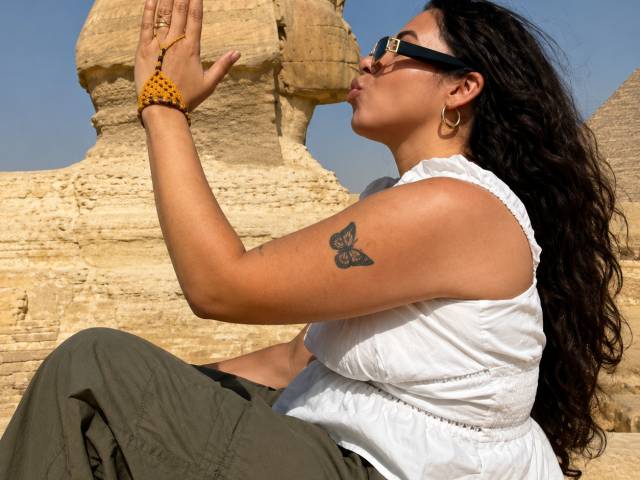
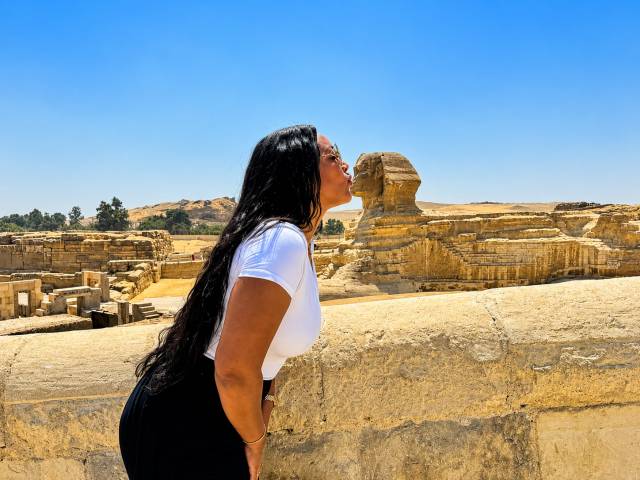
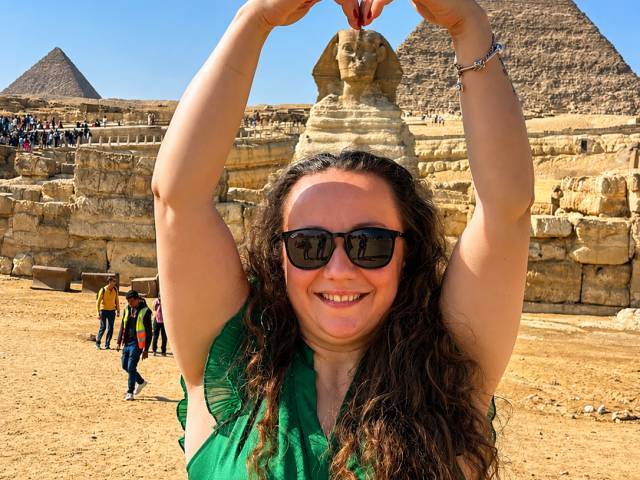
Family and Couple Photos
The Sphinx provides an iconic background for family and honeymoon photographs.
For travelers particularly interested in dramatic natural lighting, consider a Sunrise Giza Pyramids Tour or Sunset Giza Pyramids Tour.
How to Visit the Sphinx with the Pyramids
The easiest way to experience the Sphinx is to visit it as part of your Giza Pyramids itinerary.
A typical visit can include:
- Great Pyramid of Khufu
- Pyramid of Khafre
- Pyramid of Menkaure
- Giza Panorama
- Great Sphinx
- Valley Temple
- Optional camel ride
Depending on your interests, you can also combine Giza with the Grand Egyptian Museum or other archaeological sites.
If you want to experience the desert around the pyramids, a Camel Ride at Giza Pyramids can be added to a suitable itinerary.
What Can You See Near the Great Sphinx?
The Sphinx is surrounded by some of Egypt's most important ancient monuments.
Nearby attractions include:
The Great Pyramid of Khufu
The largest of the three main pyramids and the only surviving Wonder of the Ancient World.
The Pyramid of Khafre
The second-largest pyramid and the monument most closely associated with the Sphinx.
The Pyramid of Menkaure
The smallest of the three main pyramids at Giza.
Valley Temple
A remarkably preserved ancient temple associated with Khafre's pyramid complex and the Sphinx.
Grand Egyptian Museum
A major museum near the Giza Plateau containing an extensive collection of ancient Egyptian artifacts.
Saqqara
Home to the Step Pyramid of Djoser and one of Egypt's most important archaeological areas.
You can learn more about other destinations through our Things to Do in Cairo guide.
Best Time to Visit the Great Sphinx
The best time depends on the season and what you want to experience.
Early Morning
Morning visits offer:
- Cooler temperatures
- Softer natural light
- Better conditions for walking
- Excellent photography opportunities
Late Afternoon
Late afternoon can provide:
- Golden light
- Longer shadows
- Dramatic photographs
- More comfortable temperatures
During Egypt's hottest months, it is generally better to avoid the middle of the day whenever possible.
How Long Should You Spend at the Sphinx?
Most visitors spend approximately 30 minutes to one hour around the Sphinx.
However, the exact time depends on your itinerary.
If you are interested in ancient Egyptian history and want your guide to explain the monument in detail, you may want to spend longer.
If you are visiting the entire Giza Plateau, allow several hours for the pyramids, Sphinx, viewpoints, and optional activities.
Frequently Asked Questions
Who Built the Great Sphinx?
The Great Sphinx is generally attributed to the reign of Pharaoh Khafre during Egypt's Fourth Dynasty, although some details of its construction and original purpose remain debated.
How Old Is the Great Sphinx?
The Sphinx is approximately 4,500 years old and is generally dated to the Fourth Dynasty of ancient Egypt.
When Was the Great Sphinx Built?
Most Egyptologists date its construction to approximately the 26th century BC.
Why Is the Sphinx Missing Its Nose?
The exact cause is uncertain. Historical drawings show that the nose was already missing before Napoleon's expedition to Egypt.
Was the Great Sphinx Buried Under Sand?
Yes. The monument has been partially buried by sand multiple times throughout its history.
What Is the Dream Stele?
The Dream Stele is an inscription placed between the Sphinx's paws by Pharaoh Thutmose IV. It describes a dream in which the Sphinx promised him kingship if he cleared the sand covering the monument.
Can You Enter the Great Sphinx?
Visitors can approach designated areas around the Sphinx, but access to the monument itself is restricted. Visitors should follow the current rules of the archaeological site.
Can You Visit the Sphinx and Pyramids Together?
Yes. The Sphinx and the three main Giza Pyramids are part of the same archaeological complex and can normally be visited during the same excursion.
Is the Great Sphinx Worth Visiting?
Absolutely. The Great Sphinx is one of Egypt's most important ancient monuments and provides a fascinating complement to the pyramids.
How Long Should You Spend at the Sphinx?
Around 30–60 minutes is enough for many visitors, although history enthusiasts and photographers may want more time.
Explore the Great Sphinx with Let's Explore Egypt
The Great Sphinx is best experienced as part of a wider exploration of the Giza Plateau.
With a private tour, you can combine the Sphinx with the pyramids, Valley Temple, panoramic viewpoints, and optional camel riding while traveling comfortably with a professional guide.
Explore our Top Rated Giza Pyramids Tour to discover the Great Sphinx and the pyramids as part of a complete Giza experience.
Explore More
- Giza Pyramids Guide
- Private Giza Pyramids Tour
- Top Rated Giza Pyramids Tour
- Camel Ride at Giza Pyramids
- Sunrise Giza Pyramids Tour
- Sunset Giza Pyramids Tour
- Saqqara
- Things to Do in Cairo
Final Thoughts
The Great Sphinx of Giza is much more than a famous statue.
Its connection with Pharaoh Khafre, its religious symbolism, the Dream Stele, centuries of burial beneath the sand, and the mystery surrounding its missing nose make it one of the most fascinating monuments in Egypt.
When combined with the pyramids, Valley Temple, and surrounding archaeological sites, a visit to the Sphinx provides a deeper understanding of the civilization that created the Giza Plateau more than 4,500 years ago.
For anyone visiting Cairo, seeing the Great Sphinx in person is an experience that should not be missed.
Things to Know Before Visiting Cairo
You May Aslo like
- About Us
- Contact Us
- Cairo Airport Transfer
- Giza Pyramids Guide
- Food in Cairo
- Can Females Wear Shorts in Egypt?
- Is Egypt Safe
People ask Also
Can Females Wear Shorts in Egypt
Explore More