


Solar Eclipse in Egypt 2027: Best Places to Watch, Luxor Travel Guide & Complete Itinerary
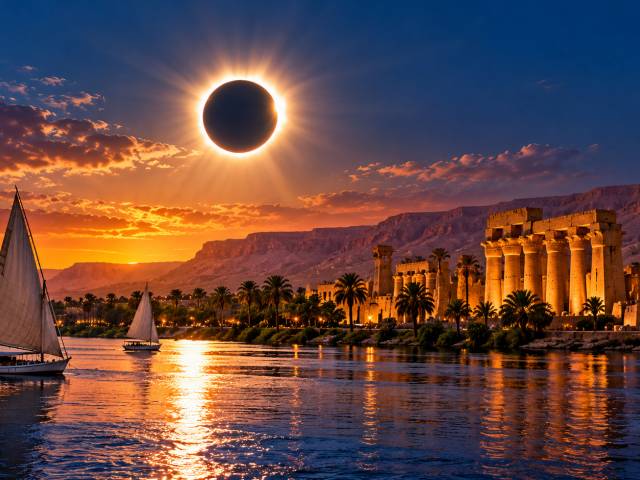
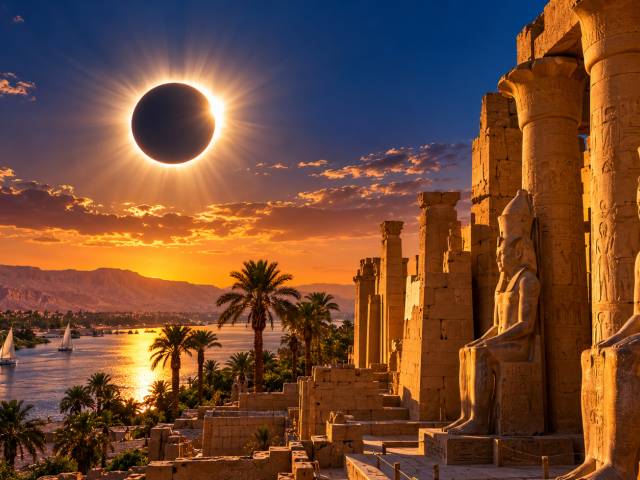
Imagine watching the Egyptian sky darken in the middle of the day as the Moon completely covers the Sun above the ancient landscape of Luxor. On August 2, 2027, Egypt will become one of the world's most exciting destinations for a rare astronomical event: a total solar eclipse.
The 2027 solar eclipse in Egypt offers travelers a unique opportunity to combine astronomy, ancient Egyptian history, private sightseeing, and the beauty of the Nile. Luxor is one of the best-known locations for this event, with totality predicted to last approximately 6 minutes and 22 seconds in the city.
For travelers planning an extraordinary summer vacation, this is an opportunity to explore the temples of ancient Thebes, discover the Valley of the Kings, and witness a spectacular celestial event during the same trip.
At Let's Explore Egypt Travel, we help travelers discover Egypt through private tours and cultural experiences. This guide explains where to see the 2027 solar eclipse in Egypt, when it will happen, what to expect, and how to plan your trip.
Planning to witness the eclipse in Egypt? Explore our Egypt Total Solar Eclipse 2027 experience to review the available tour details and start planning your visit.
Quick Facts About the 2027 Solar Eclipse in Egypt
Date: Monday, August 2, 2027
Event: Total solar eclipse
Featured destination: Luxor, Upper Egypt
Predicted totality in Luxor: Approximately 6 minutes and 22 seconds
Beginning of the partial eclipse in Luxor: Approximately 11:40 a.m. local time
Maximum eclipse in Luxor: Approximately 1:05 p.m. local time
End of the partial eclipse in Luxor: Approximately 2:26 p.m. local time
Other locations within the path: Parts of Upper Egypt and Siwa Oasis
Cairo and Giza: Partial eclipse, not totality
Times are local to Egypt and are astronomical predictions for Luxor. Exact timings and totality duration vary by location. Check Time and Date's Luxor eclipse timetable and the Egyptian National Research Institute of Astronomy and Geophysics for updates.
What Is a Total Solar Eclipse?
A total solar eclipse happens when the Moon passes directly between Earth and the Sun, completely blocking the Sun's bright disk for observers located within a narrow path on Earth's surface.
As the Moon gradually covers the Sun, the daylight changes. During totality, the landscape can appear as though twilight has arrived unexpectedly. The Sun's outer atmosphere, known as the corona, becomes visible around the Moon's dark silhouette.
This rare event is particularly interesting in Egypt because travelers can combine astronomy with one of the world's most extraordinary historical settings.
The 2027 eclipse is expected to attract astronomy enthusiasts, photographers, families, and travelers who want to experience something beyond a conventional sightseeing vacation.
Why Is the August 2, 2027 Solar Eclipse So Special?
The August 2027 eclipse is notable for its unusually long period of totality at locations along its path. In Luxor, the predicted duration is approximately 6 minutes and 22 seconds. The maximum duration along the eclipse path is slightly longer.
During these precious minutes, the Moon completely covers the bright solar disk. The sky darkens, the solar corona becomes visible, and the surrounding environment can feel dramatically different.
Luxor offers an especially appealing setting because the eclipse coincides with an opportunity to explore ancient Thebes, including monumental temples and royal tombs.
For travelers, this means the eclipse can become the centerpiece of a wider Egyptian vacation rather than a standalone event.
Best Places to See the Solar Eclipse in Egypt
The most important decision is choosing a location within the official path of totality. Outside this path, the Sun will be only partially covered.
1. Luxor: A Leading Destination for the 2027 Eclipse
Luxor is one of the most attractive destinations for travelers hoping to witness the 2027 total solar eclipse.
Located on the banks of the Nile in Upper Egypt, Luxor contains some of the world's most significant ancient Egyptian monuments. The city occupies the area of ancient Thebes, once a major center of religion and royal power.
Totality in Luxor is predicted to last approximately 6 minutes and 22 seconds.
Visitors can combine eclipse viewing with:
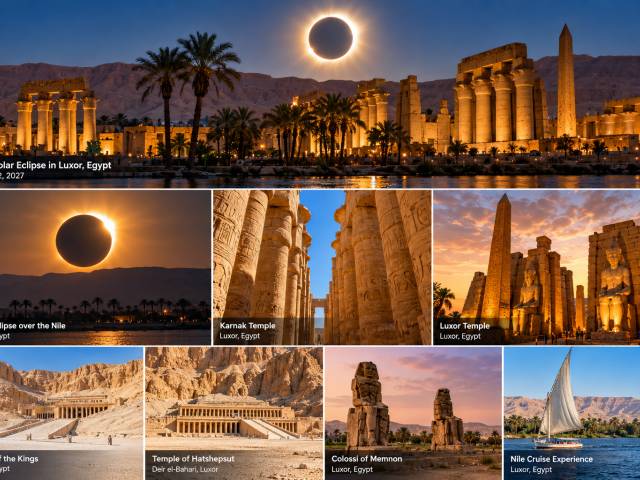
Karnak Temple and its monumental columns.
Luxor Temple and its historic architecture.
The Valley of the Kings and its royal tombs.
The Temple of Hatshepsut at Deir el-Bahari.
The Colossi of Memnon.
Nile scenery, local markets, and cultural experiences.
Before selecting a viewing location, check official access rules, crowd-management arrangements, and any special tickets or permits required for eclipse day. Do not assume that an archaeological site will be open for eclipse viewing simply because it is normally open to tourists.
Explore our Luxor Day Tours to discover sightseeing options that can be arranged before or after the eclipse.
2. Siwa Oasis: A Desert Eclipse Experience
Siwa Oasis offers a different experience for travelers who prefer desert landscapes, remote scenery, and a quieter atmosphere.
Located in Egypt's Western Desert, Siwa is known for its palm groves, salt lakes, traditional architecture, and distinctive local culture. It is also within the predicted path of totality.
Possible experiences include:
Exploring the historic Shali Fortress.
Discovering the Temple of the Oracle area.
Visiting the oasis's salt lakes.
Enjoying the surrounding desert scenery.
Planning an eclipse observation at a suitable location.
|
Eclipse stage |
Approximate local time |
|---|---|
|
Partial eclipse begins |
11:40 a.m. |
|
Totality begins |
Around 1:02 p.m. |
|
Maximum eclipse |
Around 1:05 p.m. |
|
Totality ends |
Around 1:08 p.m. |
|
Partial eclipse ends |
2:26 p.m. |
Siwa requires careful planning for transportation, accommodation, and access to a viewing site. Luxor may be more convenient for travelers who want established tourism services and a large selection of ancient monuments.
3. Asyut: Another Egyptian Location Within the Path
Asyut is another destination expected to experience a total solar eclipse. The predicted duration of totality is approximately 6 minutes and 8 seconds, depending on the exact observation point.
Travelers considering Asyut should research accommodation, transport connections, and local viewing arrangements in advance.
4. Cairo and the Giza Pyramids: A Partial Eclipse
Many travelers ask whether they can watch the total solar eclipse directly from the Great Pyramids of Giza.
Cairo and Giza are outside the path of totality. The eclipse will be visible there as a partial eclipse, meaning the Moon will cover only part of the Sun.
A partial eclipse is still an interesting astronomical event, but it does not provide the complete darkness or the same view of the solar corona experienced during totality.
If your main goal is to see the Sun completely covered, plan to travel to a location within the official path, such as Luxor.
You can still visit the Giza Pyramids before traveling south. Explore our Egypt tour packages to plan a wider Egyptian vacation.
Discover the Best Luxor Attractions During Your Eclipse Trip
The solar eclipse is an excellent reason to visit Luxor, but the city deserves more than a short stop on eclipse day. Allow time to explore its temples, royal tombs, and archaeological treasures.
Karnak Temple
Karnak is an immense temple complex that developed over many centuries. Its famous Hypostyle Hall contains rows of monumental columns decorated with inscriptions and reliefs.
A guided visit helps travelers understand how successive pharaohs expanded the complex and dedicated monuments to the gods of ancient Egypt.
Luxor Temple
Located close to the modern city center, Luxor Temple is known for its monumental entrance, statues, and ancient architectural features.
It can be combined with Karnak Temple in an East Bank sightseeing itinerary.
Valley of the Kings
The Valley of the Kings contains royal tombs created for pharaohs of the New Kingdom. The decorated chambers reveal important details about ancient Egyptian burial traditions and beliefs about the afterlife.
The tombs available to visit and their entry arrangements may vary, so confirm current ticket information before your visit.
Temple of Hatshepsut
The Temple of Hatshepsut stands beneath dramatic limestone cliffs at Deir el-Bahari. Its terraces and distinctive architecture make it one of Luxor's most recognizable monuments.
Colossi of Memnon
These monumental statues stand on Luxor's West Bank and are commonly included in visits to the area's archaeological sites.
What Time Will the Solar Eclipse Happen in Luxor?
The eclipse will occur on Monday, August 2, 2027. The following times are predicted for Luxor and are shown in Egypt's local summer time.
The entire eclipse sequence lasts approximately 2 hours and 46 minutes in Luxor, while totality lasts about 6 minutes and 22 seconds.
Exact contact times vary slightly according to the viewing location. Check an updated local eclipse timetable before traveling.
For the best experience:
Confirm the coordinates of your intended viewing location.
Check the local eclipse timetable.
Arrive at your viewing area well before the partial phase begins.
Prepare your viewing equipment in advance.
Keep transportation arrangements flexible.
Avoid trying to cross the city at the last minute to reach a viewing location.
How to Plan Your Egypt Solar Eclipse Vacation
A successful eclipse trip requires more planning than an ordinary sightseeing vacation because the astronomical event determines the most important day of the itinerary.
Step 1: Choose Your Eclipse Destination
Decide whether Luxor, Siwa, or another location within the official path best suits your interests.
Luxor is attractive for travelers interested in ancient history, established tourism services, and opportunities to extend their trip with a Nile cruise. Siwa is appealing to travelers seeking desert landscapes and oasis culture.
Step 2: Book Accommodation Early
Demand may increase as the eclipse approaches. Research hotels early, compare cancellation policies, and confirm how you will reach your viewing site.
A hotel booking does not automatically guarantee access to a particular eclipse-viewing location.
Step 3: Arrive Before Eclipse Day
If possible, arrive at your chosen destination at least one or two days before August 2.
This allows time to settle in, confirm your viewing arrangements, and reduce the risk that transport delays will affect your plans.
Step 4: Arrange Reliable Transportation
Plan how you will reach the viewing area and return to your accommodation. Ask about possible traffic restrictions, parking, meeting points, and travel times.
If you are booking private transportation, confirm pickup arrangements and timing in advance.
Step 5: Prepare for the Egyptian Summer
August can be extremely hot in Upper Egypt. Wear lightweight clothing, drink water regularly, use sun protection, and avoid unnecessary outdoor activity during the hottest hours.
Build rest periods into your schedule rather than arranging too many outdoor visits on consecutive days.
Suggested 7-Day Egypt Solar Eclipse Itinerary
This sample itinerary combines Cairo's famous attractions with Luxor and the solar eclipse. Adjust it according to confirmed flights, accommodation, opening hours, and official viewing arrangements.
Day 1: Arrive in Cairo
Arrive in Cairo, meet your transfer, and check in to your hotel. Keep the day flexible so you can recover from your journey.
Day 2: Giza Pyramids and the Sphinx
Explore the Great Pyramid of Khufu, the other pyramids on the Giza Plateau, and the Great Sphinx.
You may also consider visiting the Grand Egyptian Museum if it fits your schedule and current visitor arrangements.
Day 3: Travel to Luxor
Take a suitable domestic flight or another reliable transfer to Luxor. Check in to your hotel and review your eclipse-day arrangements.
Day 4: Explore Luxor's East Bank
Visit Karnak Temple and Luxor Temple, depending on opening hours and the weather. Return to your hotel with enough time to rest.
Day 5: Total Solar Eclipse — August 2, 2027
Travel to your confirmed viewing location well in advance.
Enjoy the partial phases and, if your location is within the path of totality, experience the brief period when the Moon completely covers the Sun.
Keep the rest of the day flexible to accommodate crowds and local arrangements.
Day 6: Explore Luxor's West Bank
Visit the Valley of the Kings, the Temple of Hatshepsut, and the Colossi of Memnon, subject to current opening hours and access rules.
A private guided excursion can help you make the most of your time while learning about ancient Egyptian history.
Day 7: Departure or Extend Your Journey
Return to Cairo for your international departure, or extend your trip with additional destinations such as Aswan or a Nile cruise.
Can You Combine the Solar Eclipse with a Nile Cruise?
Yes. A Nile cruise can be a memorable addition to a longer Egyptian vacation, particularly for visitors who want to explore more of Upper Egypt.
Depending on the sailing schedule, a cruise may include visits to Edfu, Kom Ombo, and Aswan, along with time to enjoy the river scenery.
However, do not assume that a cruise ship will be positioned within the path of totality at the correct time on August 2, 2027. The ship's position, docking arrangements, and sailing schedule must be verified carefully.
If witnessing totality is the main purpose of your trip, prioritize a confirmed viewing location and organize the cruise around it.
What Should You Pack for the 2027 Solar Eclipse?
Preparing the right equipment can make the experience safer and more comfortable.
Certified solar eclipse glasses: Use reputable solar viewers that meet the applicable ISO 12312-2 requirements.
Drinking water: Carry sufficient water and drink regularly.
Sun protection: Bring a hat, sunscreen, and lightweight clothing.
Comfortable footwear: Useful for walking around viewing areas and archaeological sites.
Camera equipment: Use appropriate solar filters when photographing the Sun during partial phases.
Power bank: Keep your phone charged for travel details, navigation, and communication.
Travel documents: Carry identification, hotel confirmations, and transportation information.
Essential Solar Eclipse Eye Safety
Never look directly at the uneclipsed or partially eclipsed Sun without proper solar viewing protection. Ordinary sunglasses are not sufficient.
The only time it is safe to view the Sun without solar viewers is during the brief period of complete totality, when the bright solar disk is entirely covered by the Moon and you are within the path of totality.
Put your solar viewers back on before any part of the Sun reappears. If you are uncertain whether totality has begun or ended, keep them on.
Consult NASA's eclipse safety guide and follow the instructions supplied with your solar viewers.
Why Choose Egypt for Your 2027 Solar Eclipse Vacation?
Egypt offers an unusual combination of astronomical spectacle, archaeological heritage, and cultural experiences.
Travelers can witness a rare celestial event, explore monumental temples, discover royal tombs, and enjoy the Nile within one carefully planned vacation.
A customized itinerary can include private transportation, licensed local guides, hotel arrangements, archaeological visits, and time to relax between excursions.
Let's Explore Egypt Travel offers private sightseeing options that can help travelers build a wider Egyptian itinerary around their eclipse plans. Confirm all eclipse-specific services and viewing arrangements before booking.
Book Your Egypt Total Solar Eclipse Experience for 2027
Make August 2, 2027, a date to remember by planning your Egyptian adventure around one of the most remarkable astronomical events of the decade.
Luxor offers a memorable setting for the total solar eclipse, combining a predicted period of more than six minutes of totality with the extraordinary heritage of ancient Thebes.
You can make your visit even more rewarding by exploring Luxor's temples, discovering the history of the pharaohs, and experiencing the beauty of the Nile.
Explore our Egypt Total Solar Eclipse 2027 experience to review the available tour details and plan your visit.
You can also discover our Luxor Day Tours and explore the most famous Luxor attractions to build a wider itinerary around eclipse day.
Plan ahead, confirm your viewing arrangements, and prepare for an unforgettable journey through Egypt.
People Also Ask: Solar Eclipse 2027 in Egypt
1. When is the next total solar eclipse in Egypt?
The total solar eclipse visible in parts of Egypt will occur on Monday, August 2, 2027. The Moon will completely cover the Sun along a narrow path crossing parts of the country, including Luxor. Travelers planning to witness totality should choose their viewing location carefully and arrive before eclipse day.
2. Where is the best place to see the solar eclipse in 2027?
Luxor is one of the best-known destinations for the August 2, 2027 total solar eclipse. Totality is predicted to last approximately 6 minutes and 22 seconds in the city. Other Egyptian locations, including Asyut and Siwa Oasis, will also experience totality, with different durations.
3. Will the 2027 solar eclipse be visible at the Pyramids of Giza?
Yes. The eclipse will be visible from the Giza Pyramids as a partial solar eclipse, but the Sun will not be completely covered there. Travelers who want to experience totality should travel to a location within the eclipse's path, such as Luxor.
4. How long will the 2027 solar eclipse last in Luxor?
The entire eclipse sequence in Luxor is predicted to last approximately 2 hours and 46 minutes. Totality, when the Moon completely covers the Sun, is predicted to last approximately 6 minutes and 22 seconds.
5. What time will the solar eclipse happen in Luxor on August 2, 2027?
The partial eclipse is predicted to begin at approximately 11:40 a.m. local time, with maximum eclipse around 1:05 p.m. and the partial phase ending around 2:26 p.m. Totality is expected to begin around 1:02 p.m. and end around 1:08 p.m. These times should be reconfirmed against the latest local eclipse timetable.
6. Is Egypt a good destination for the 2027 solar eclipse?
Yes. Egypt combines the opportunity to observe a total solar eclipse with ancient temples, archaeological treasures, Nile scenery, and distinctive desert landscapes. Luxor is especially attractive because visitors can combine eclipse viewing with Karnak Temple, Luxor Temple, the Valley of the Kings, and other historic sites.
7. Is August a good time to visit Luxor, Egypt?
August is extremely hot in Luxor, but it offers the opportunity to experience the 2027 total solar eclipse. Visitors should drink plenty of water, use sun protection, wear lightweight clothing, and schedule sightseeing carefully around the heat.
8. Can you see the 2027 total solar eclipse from Cairo?
No. Cairo will experience a partial solar eclipse rather than totality. For the complete eclipse experience, travelers need to reach a location inside the path of totality.
9. Is Luxor or Siwa Oasis better for the 2027 solar eclipse?
Both destinations are worth considering. Luxor offers approximately 6 minutes and 22 seconds of totality, together with major ancient Egyptian monuments and established tourism services. Siwa Oasis offers approximately 5 minutes and 31 seconds of totality, with desert scenery, salt lakes, and a distinctive oasis atmosphere.
The better choice depends on your interests, transportation needs, accommodation preferences, and confirmed viewing arrangements.
10. Should I book a trip to Egypt for the 2027 solar eclipse in advance?
Booking early is recommended because the eclipse may increase demand for hotels, transportation, and organized excursions. Consider arriving at your destination at least one or two days before the event and check cancellation policies before making non-refundable reservations.
11. Can I combine the 2027 solar eclipse with a Nile cruise?
Yes, a Nile cruise can be part of a longer Egypt vacation. However, you should not assume that a ship will be positioned within the path of totality at the correct time on August 2, 2027. Confirm the cruise itinerary and arrange a suitable eclipse-viewing location before booking.
12. What should I wear to watch the solar eclipse in Egypt?
Wear lightweight, breathable clothing, comfortable shoes, a hat, and sunscreen. Carry drinking water because August temperatures in Upper Egypt can be extremely high. Bring certified solar eclipse glasses to view the Sun safely during the partial phases. Ordinary sunglasses are not safe for direct solar viewing.
13. Is it safe to look at the 2027 solar eclipse?
It is safe when proper viewing precautions are followed. Use certified solar viewers during all partial phases. You may look at the Sun without solar viewers only during the brief period of complete totality, when the bright solar disk is entirely covered by the Moon and you are within the path of totality. Put your viewers back on before the Sun begins to reappear.
14. What are the best attractions to visit in Luxor before or after the eclipse?
Popular attractions include Karnak Temple, Luxor Temple, the Valley of the Kings, the Temple of Hatshepsut, and the Colossi of Memnon. Check opening hours and access arrangements before your visit. See our Luxor Attractions guide for more ideas.
15. How can I plan a private Egypt trip for the 2027 solar eclipse?
Start by choosing a location within the path of totality, confirming accommodation, and arranging transportation to a suitable viewing site. Then build the rest of your itinerary around sightseeing in Luxor, Cairo, or other destinations.
16. Where can I book an Egypt solar eclipse tour for 2027?
You can begin by reviewing the available details on the Egypt Total Solar Eclipse 2027 activity page. Check the tour dates, inclusions, price, cancellation terms, and confirmed viewing arrangements before booking.
17. Will the total solar eclipse be visible from Luxor's ancient temples?
Luxor lies within the path of totality, but visibility from a specific archaeological site depends on access rules, opening hours, and any special arrangements for eclipse day. Confirm whether your chosen site will allow viewing before making it part of your plan.
Plan Your 2027 Solar Eclipse Trip to Egypt
The total solar eclipse of August 2, 2027, offers an extraordinary reason to discover Egypt. Luxor provides an exciting combination of a long predicted period of totality and some of the world's most famous ancient monuments.
Plan ahead, choose a confirmed viewing location within the path of totality, and allow enough time to explore Egypt beyond eclipse day.
Ready to experience the 2027 solar eclipse in Egypt?
Visit Let's Explore Egypt Travel and explore our Egypt Total Solar Eclipse 2027 experience to start planning your trip.
Note: Astronomical timings and predicted durations depend on the exact viewing location. Confirm the latest eclipse calculations, access restrictions, transportation arrangements, attraction schedules, and safety guidance before traveling.